Wednesday, October 31, 2012

Equality Denied To The Energy Poor

The global energy reality exposes an aspect of the energy crisis: equality denied. Billions in this planet is the embodiment of this denial, one of the manifestations of the energy crisis along class line.
“Around 2.64 billion people, 40% of the world's population,” writes Alejandro Litovsky, “lack modern fuels for cooking and heating. 1.6 billion have no access to electricity, three-quarters of them living in rural areas” ( OpenDemocracy , Sept.7, 2007). He continues: “As decision-makers in Europe and north America wonder how to reduce energy consumption, massive regions of the developing world remain literally in the dark. Populations in the energy-poverty trap – covering vast areas of south Asia and sub-Saharan Africa – are nowhere likely to influence the accountability of the energy policies of their governments.”
With the intensification of urbanization the problem is likely to increase. Current projections show that the majority of the people in the underdeveloped world will be living in urban and suburban areas by 2020. A number of the cities in the underdeveloped countries will emerge as the largest cities in the world in terms of population. The urban life already is overwhelmed by low-income population and with the problems pressing them down to dust. This low-income population has least money to access energy as they have to live within a precarious life, which is full with hunger, unemployment, disease, illiteracy. The places they live in don't support human existence. Lack of safe water and sanitation, insecurity, daily harassment by tools of rule and indignity are integral part of their life. In this life, there is no scope to access better energy source.
“Worldwide, hundreds of millions of low-income households,” a World Bank publication informs, lack access to modern energy (electricity and petroleum products), ”
[ B ] ut estimating the figure even within a few hundred million people is difficult. A common (though perhaps outdated) estimate is about 2 billion people, a third of the world's population. Households in many African countries consume little commercial energy compared with households in the countries of the former Soviet Union , for example, where the electricity infrastructure built in Soviet times still connects almost 100 percent of the population. Low-income households consume a relatively small amount of energy, and that energy is of low quality. Per capita energy consumption in South Asia is only 2.6 percent — and that in Sub-Saharan Africa only 1.3 percent — of per capita consumption in the United States . For these supplies, survey and anecdotal evidence suggests, South Asians and Sub-Saharan Africans pay among the world's highest unit costs — and get some of the world's worst-quality energy. Ugandans spend an estimated US $100 million a year — an incredible 1.5 percent of GDP — on dry cell batteries to power radios, flashlights, and other small items. The average Ugandan household spends an estimated US $72 a year on dry cell batteries, used in 94 percent of Ugandan households. The cost per unit of energy consumed works out to US $400 a kilowatt-hour. Ugandans may spend almost as much per year on kerosene for their lamps. Car batteries, which cost about US $120 a year to operate, produce better-quality power at about US $3 a kilowatt-hour. But poor households often spend a higher share of their income, as in Bulgaria , Jamaica , Kazakhstan , Nepal , Pakistan , Panama , and South Africa . More households use electricity than have in-house water taps or telephones in countries in Europe and Central Asia and in [some] other countries…. Poor countries consume on a per capita basis, only five percent of the modern energy consumed by rich countries. Four out of five people without access to electricity live in rural areas. They include particularly the rural women and children that depend totally on traditional fuels. Sub-Saharan Africa and South Asia present the largest gaps in access to energy services: Sub-Saharan Africa has the lowest electrification rate, with 77% of the population lacking access, or about 526 million people. In South Asia the equivalent figures are 59% and about 800 million people. (Rural Energy and Development: Improving Energy Supplies for Two Billion People , 1996 )
More than 95 percent of rural households in Angola , Benin , Cameroon , Chad , Congo ( Kinshasa ), Ethiopia , Ghana , Sudan , and Zambia among others still use fuel wood and charcoal for cooking. Many areas of China , India , and Bangladesh also rely heavily on fuel wood, wood waste, and charcoal for cooking. In China , about 55 percent of the rural population uses biomass for cooking, as does 87 percent of the rural population in India . There are more facts provided by the mainstream that tell the deprivation of the poor in the area of energy. The Energy and Poverty Reduction – Fact Sheet by the World Bank adds the following:
1.6 billion people lack access to network electricity.… 1.4 billion people will still lack electricity access in 2030.…2.4 billion people rely on traditional biomass … for cooking and heating. This will increase to 2.6 billion by 2030 without change in policies. Poor people in developing countries spend up to a quarter of their cash income on energy. As of 2004, the richest 20% of the world's population consume 58% of total energy, whereas the poorest 20% consume less than 4%. The … poorest people use only 0.2 tons of oil-equivalent energy per capita annually, while… those earning on average over US $20,000 a year — use nearly 25 times as much. 1.6 million women and children die prematurely from indoor air pollution caused by burning solid fuels in poorly ventilated spaces. 40 million new cases of chronic bronchitis are caused by exposure to soot and smoke every year. More than 80% of all deaths in developing countries attributable to air pollution-induced lung infections are among children under 5 (Energy Poverty Issues and G 8 Actions, Feb. 2, 2006).
There is also wide disparity, according to the World Energy Council, between the energy consumption levels of the rich and poor. In terms of electricity consumption, the richest 20 percent uses 75 percent of all electricity while the poorest 20 percent uses less than 3 percent.
This is also the reality of energy crisis in the present day world. The billions lacking access to energy services lead to the “famous” “vicious poverty trap”. It affects health of the poor, leads to lower productivity, to food insecurity. But the problem is ignored by the metropolis of the world system.
Unequal distribution of modern energy services and low level of income in poor countries are two of the major reasons that constitute the factor leading to poor access to modern energy services. Lack of or poor infrastructures in the poor countries, lack of resources to develop the required infrastructure, and biased institutional and legal framework also have their share in creating the problem for the poor. Absence of political commitment in favor of the poor is the foremost problem that limits the access to modern energy by the poor. The political commitment is biased, tilted to the rich. It follows the class line.
The poor households in the underdeveloped countries mainly use firewood, dung, tree leaves, crop residues, and in some cases, charcoal. The World Energy Outlook 2006 estimated that $8 billion (including capital and fuel) a year up to 2015 would be required for 2.5 billion people for their switching over to liquid petroleum gas for cooking.
The poor pay a high price for the energy they use: in terms of cash, labor, time, and health. They spend a much greater proportion of their income on energy than wealthy people. In Burkina Faso, a survey found, the poor devoted 5.6 percent and 1.3 percent of their income to firewood and kerosene respectively while in Guatemala and Nepal, firewood expenditure for households in the poorest quintile accounts for 10-15 percent of total household expenditure (R Heltberg, Household Energy and Energy Use in Developing Countries, A Multi-Country Study, 2003).
Studies on Bangladesh environment found that the availability of biomass has decreased. This has increased the hardship of the poor, especially of the women. They have to spend more time to collect biomass. The slum dwellers in Dhaka informed that they cooked once or twice a day instead of three times. That was the way they “innovated” to economize the spending on fuel. The price of firewood compelled them to follow the method though it was not good for food quality and health. The participants in the study suffered from health problems due to smoke from firewood. Villagers from different parts of the country also informed that the availability of biomass decreased. The changed reality taxed them in terms of labor, wage lost, and hardship. Consequently, this touches the limits of nutrition, household income, and productivity. The women had to bear most of the burden as they collected fuel for their families. Sometimes, an entire day was spent by the earning member of a family for collecting firewood (Farooque Chowdhury, “Urban Poor: Never-ending Quest for Energy”, “Scarce Fuel: Growing Scarcer”, and “Fuel, Firewood and Ghatail” in People's Report 20002-2003: Bangladesh Environment , UNDP, 2004).
These are the people who have been and are being pushed down to energy poverty that constitutes one of the elements of energy crisis. In ultimate analysis, these people have been kept confined within an inefficient system, which they have not organized. Rather, the system constructed by the dominating capital has been imposed on them. The system is so much inefficient that it cannot utilize the labor and creativity of these poor people. That means: the system lacks the capacity to tap energy.
The disparity is not only limited among the rich and the poor. Wide variations are there in the levels of energy consumption, according to the Human Development Report 2007/2008, between industrialized and the underdeveloped countries. Per capita energy consumption in North America is about 18 times that of Africa and four times the world average.
Energy poverty is defined as the “inability to cook with modern cooking fuels and the lack of a bare minimum of electric lighting to read or for other household and productive activities at sunset” (UNDP 2005). By this definition, the 2.5 billion people relying on biomass for cooking and the 1.6 billion people with no access to electricity could be classified as being energy poor.
Originating from the UK and Ireland 's grassroots level environmental health movements in early 1980s the concept of energy poverty or fuel poverty, has gained in importance. “With the energy crises of 1973/74 and 1979,” the World Energy Council said, “low-income households experienced difficulties with increased heating bills. The fuel poverty concept is an interaction between poorly insulated housing and inefficient in-housing energy systems, low-income households and high-energy service prices. At the beginning of the 21st Century, the British Government set up a strategy on fuel poverty aiming at eradicating this phenomenon by 2010 … for vulnerable households and by 2016 for all English households. According to the British standard definition that was adopted, a household is poor in fuel if it needs to spend more than 10% of its income on all fuel use to heat the home to an adequate standard and to meet its needs for other energy services (lighting, cooking, cleaning, etc.).” (World Energy Council, Europe's Vulnerability to Energy Crisis , 2008) The report added, “In England … the number of households poor in fuel decreased from 5,1 million in 1996 to 1,7 million on 2001 and to 1,2 million on 2004.” Table 1 provides a picture of fuel poverty in a number of European countries during the period 1994-'97. Portugal had the highest percentage of households defined at fuel poverty while Denmark had the lowest.
Table 1: Households Defined at Fuel Poverty, 1994-1997
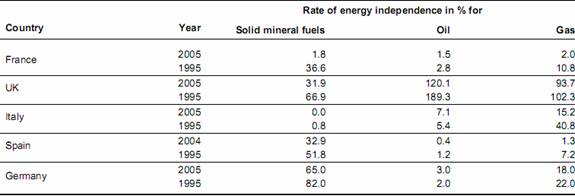
Used by permission of the World Energy Council, London , www.worldenergy.org
In the US , the number of households in fuel poverty was 15.9 million (“Fuel Poverty in the USA ”, Energy Action , March 2006).
There is difference between the fuel poor in an advanced capitalist country and fuel poor in a poor country. The level of hardship between them also differs. But that does not nullify the reality of inequality in distribution. With the financial and food crises the suffering has increased. For the homeless and the unemployed in the US , the suffering is more. A number of news reports were dispatched by news agencies that the unemployed in the US were finding it hard to pay energy bills. In extreme weather in parts of the US , like all places in the world, the suffering increases.
While the energy poor is one aspect of the crisis there is over-consumption that has contributed to the crisis.
The type and volume of energy used by households differ from country to country. Income levels, natural resources, climate and available energy infrastructure determine these.
Typical households in the OECD countries consume more energy than those in the non-OECD countries. The OECD households with higher income can afford larger homes and purchase more energy-using equipment. In the US , GDP per capita in 2006 was about $43,000 (in real 2005 dollars per person), and residential energy use per capita was estimated at 36.0 million Btu. On the other hand, China 's per-capita income in 2006, at $4,550, was only about one-tenth the US level, and residential energy use per capita was 4.0 million Btu. Poorer households in Asia , Africa and Latin America earn less, and consume less energy.
Table 2 from a World Bank publication (from the section by Alan Townsend, “Energy access, energy demand, and the information deficit”) shows that disparity between the rich and the poor in electricity use is great. Disparity in this area is nil in Albania , Bulgaria , Kazakhstan , Kyrgyz Republic , and Ukraine while it is great in other countries including Ghana , South Africa , Nicaragua , Panama , Nepal , and Vietnam .
Table 2: Disparity Between the Rich and the Poor in Electricity Use
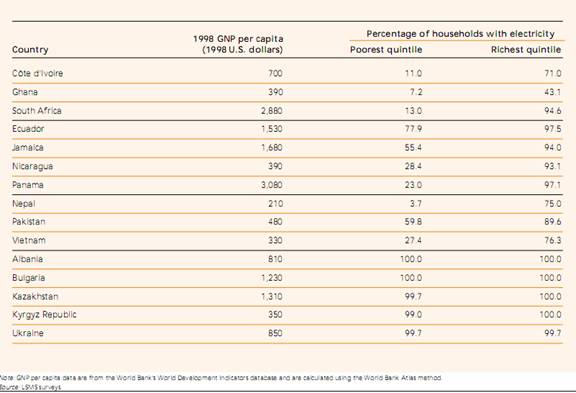
Source: the World Bank publication, LSMS survey in 15 developing countries
The US consumes most energy: 8.0 toe/person/year, followed by India and China with an average energy consumption of 7.3 toe per person per year each. On per capita basis, however, Canada consumes the most energy in the world. Its per capita energy consumption is 6.4 times the world average while that of the US is 5.1 times and Western Europe 's is 2.3 times the world's average (P O Pineau, Electricity Subsidies in Low Cost Jurisdiction, The Case of British Columbia ( Columbia ) , 2006). Italy consumes the least energy among the industrialized countries (3.1 toe per person per year). Africa 's average energy consumption only 0.14/person/year, a ratio of 1:57 , compared to the US . Average energy consumption in Bangladesh is only 0.08 toe per person per year, which is a ratio of 1: 100 when compared to the US that uses about fifteen times more energy per person than does a typical underdeveloped country. While the US share of the world's population is only 4.6 percent, it accounts for 24 percent of the world's energy consumption and over 30 percent of GDP. But the least developed countries with 10 percent of the world's population account for about 1 percent of energy consumption and a mere 1 percent of the world's GDP (Huq, et al. 2003). The energy situation Africa faces is a mixture of contradictory reality: while the continent desperately needs energy for economic growth and poverty reduction, it is a net exporter of commercial energy. Africa is home to about 7 percent of the world commercial energy, but it accounts for only 3 percent of global commercial energy consumption.
Energy use in the residential sector in 2006, according to the IEO2009 (International Energy Outlook, 2009) , accounted for about 15 percent of world delivered energy consumption. Larger homes, the Outlook said, need more energy as these homes tend to use more energy-consuming appliances. On the contrary, smaller homes usually need less energy as the smaller homes have less space to be heated or cooled, produce less heat transfer with the outdoor environment, and the appliances used in these homes are smaller. For example, residential energy consumption is lower in China than in the US . The average residence in China currently has an estimated 300 square feet of living space or less per person while the average residence in the US has an estimated 680 square feet of living space per person. The commercial or the services and institutional sector include businesses, institutions, and organizations providing services (schools, hospitals, water and sewer services, theaters, museums, art galleries, sports facilities, stores, hotels, restaurants, correctional institutions, office buildings, banks), and traffic lights. Economic activities and disposable income going to higher levels lead to increased demand for energy as demands for office space, space for business, hotels, restaurants, and facilities for cultural and leisure activities increase. Energy use per capita in the commercial sector in the non-OECD countries was much lower, 1.3 million Btu in 2006, than in the OECD countries, 16.3 million Btu.  The US is the largest consumer of commercially delivered energy in the OECD and remains in that position throughout the projection, accounting for about 44 percent of the OECD total in 2030.
The deeper, the keener observation on the issue, the more inequality gets exposed. The inequality in energy distribution comes from the unequal ownership of the energy resources, and is part of the unequal world system.
The inequality aspect should have the same, if not more, importance as other burning aspects of the energy crisis. Rectifying the inequality is one of the ways to face the crisis. Participation of people strengthens steps to face the crisis. But, shall there have any rational and moral standing if people are asked to contribute to/sacrifice for/play role into facing the crisis if they have no or little or unequal access to the energy resources? The crisis is not their creation. So, one of the first steps to face the energy crisis should be replacing the unequal energy distribution system with an equal and equitable energy distribution system. The other major step should be to inform people about the crisis and inequality so that people get aware. Awareness facilitates people getting organized and taking creative initiatives, and a collective force thus gets mobilized to face the crisis.
[ This section, modified and elaborated for clarity and completeness, is preceded by two parts of the chapter, “ Energy Inequality and Energy Poor” in The Age of Crisis (2009) by Farooque Chowdhury, a Dhaka-based freelancer. For easy identification, the section can be considered as part 3 of the chapter. ]

Monday, October 29, 2012

Energy Inequality And Energy Poor, Ignored Aspects Of Energy Crisis

The crisis in energy has cropped up on the soil of class interest as energy consumption moves along class line. In the present day world, the more a class possesses the more energy it consumes, and as a consequence, wars the class wages for accumulation and for maintaining its high-energy consuming life style aggravate the energy situation pushing it to the level of crisis.
High-carbon consuming life style based on private property at majestic level is threatening the poor, whose life is limited within the narrow neighborhood of low-carbon consumption. Capital is trying to impose its burden of energy-squandering sin on the masses of the poor, who are not even aware of capital’s business-of-future as capital keeps them in the dark of ignorance. The business-of-future is going on with the complex carbon trading, and the tapping of solar energy and “transporting” it across continent and sea. A section of capital is concentrating in this area of energy with all the possibilities of depriving the poor.
Energy crisis is usually viewed as a contradiction, gradually turning difficult to resolve, between the dwindling supply of oil and its increasing demand. Most of the discussions concentrate into this precinct, and thus overlook other aspects of the crisis. Even, the supply-demand aspect is viewed only in the perspective of advanced capitalist countries. Consequently, the entire discussion fails to look into other basics related to the crisis.
The discrepancy in the distribution of energy between the centre and the periphery, and between the people at the bottom and the absolute minority group at the top is not usually raised in the discourse on the energy crisis. But, referring the World Development Report 1986 the World Commission on Environment and Development (popularly referred as the Brundtland Commission) said: The growth of energy demand in response to industrialization, urbanization, and societal affluence has led to an extremely uneven global distribution of primary energy consumption (Our Common Future).
With intensified class war being waged by capital, aggravating economic situation, increasing inequality, lessening of access to the basics of life, deteriorating ecological reality, especially the calamities getting created by climate change, the food crisis, lack of democracy for the people including little scope for peoples’ participation in political life in most countries, especially in the Third and Fourth Worlds, lack of accountability in these societies, safeguarding the interests of the capitals involved in these countries, patronization of comprador and/or plundering ruling segments in these lands, and dominance of accumulating, at times, plundering and/or speculating interests have worsened the crisis. These have created energy crisis encompassing the life of billions at the bottom.
Little rays of light have reached the life of the people in many countries in the periphery though lots of money were and are being spent in the energy sector. But, the people do not know the plan, the design, the fund allocated, the allocation procedure, the contractor selected, the selection procedure, etc. All these are known only to the dominating segment, the bureaucrats, and the local collaborators of the capital from the center of the globalized system. These vested interests decide all related issues, reap the fruits, and have luxurious life. The crisis breeds profit. The people have to pay, in all way, through hardship, increased labor, repayment of external debt, loss of crop yield or low yield, loss of wage and working day or through longer working hour, higher prices of essentials, etc., although they have no or little access to the facilities. In countries the crisis turns out a funnel for squandering of public money on the one hand, and putting burden on and increasing suffering of the people on the other.
The energy crisis in the centre of the world system and in the periphery is not the same. The factors are different. These manifest in different ways and behave differently. The concepts of priority, risk, vulnerability, etc. also differ in these two parts of this divided world. In the centre even, the energy issue is dealt by the dominating interest in its way, not by the people. And, its interest lies in the quicker and higher, in relative term, profit. Most of the discussions on energy crisis miss this aspect also.
The world view of the dominating classes in the present world system is manifested in its concept of “free” market that includes free trade, free flow of capital, market mechanism, monopoly, etc. and this is one of the conveyors that carry the seed of crisis in the energy sector. This is the practice/approach/mechanism of the world capital even after The Great Financial Crisis.
One of the ways for overcoming the energy challenge faced by the world requires technologies superior to those available today. Cost-competitiveness of renewable energy technologies is also needed to face today’s energy crisis.
But, capital will not invest in any technology if the rate of profit is lower in the technology. The same is with investment in research and development. Capital will pump out the last stock if return is immediate and higher by drying out the stock. Capital will get engaged in speculation if it finds higher gains there than investing in any future energy source. Capital will not move an inch until peak oil or destruction of forest or some other issue appears as a threat to its profit, and until renewable energy, etc. appear as a promising market. It will even find out ways to reap profit from the growing problem of global warming. Capital will not provide energy to the poor unless it is needed for regeneration of capital and unless the poor appear a lucrative market than the speculation in bubble market. This basic nature of functioning of capital is related to energy crisis.
Energy merchants are now getting interested in the 4 billion low-income people in the base of the world economic pyramid as they form a market. Their “willingness to pay” as consumers is actually a yardstick for measuring the low-income people’s dominated position/strength/weakness/tolerance/intolerance to get appropriated, and to measure their aggregate purchasing power, which is capital’s power to widen the surplus labor time of the people, and an incentive to capital to let the low-income people have access to energy.
The World Resources Institute estimated that the total "base of the pyramid" household energy market in Africa, Asia, eastern Europe, and Latin America and the Caribbean to be $433 billion (The Next 4 Billion).
Already, the private sector, the “angel” of prosperity, has stepped in the crisis-ridden energy sector. Its “loneliness” is being overcome by the warm company of “public” sector, a patronizing hand of state at the cost of public money. An attractive name has also been innovated by the creative souls: public-private partnership, a flag to be kept unfurled till the private owners give up “shyness”, limit to their capacity, to grab the public share. “[P]rivate sector involvement in energy has been increasing. Between 1990 and 1999 seventy-six developing countries introduced private participation in their electricity and gas sectors by awarding more than 700 projects and investitures of shareholdings in electricity and gas enterprises. These transactions involved private investments totaling almost US$187 billion. While middle-income developing countries have led this revolution, low-income countries also have been active participants” (Penelope J. Brook and John Besant-Jones, “Reaching the poor in the age of energy reform”). The merchants of this market are innovating models targeted at the billions at the bottom. Prospects and promises for profit will determine the pace of capital to this market. But the “promise and prospect” of the market is a limitation of capital at the same time.
These aspects can’t and should not be ignored while looking at the issues related to energy crisis. These are, indeed, views based on class. But, the issue of energy crisis will bog down into confusion if it’s not viewed from class perspective. Interests of the dispossessed, of billions of working women and men, can’t be overlooked and ignored while discussing the energy crisis as the billions of toiling masses is vital, brain and heart, for civilization, is significant for the existence of our planet, as this billions make progress possible, as with creativity and labor power this billions create resources for making further achievements humanity requires and aspires. Civilization neither can be moved forward nor can be taken to further heights by keeping this billions energy-starved. Capital, starving and striving only for profit, nourishes the energy inequality as it stands opposed to the interests of the billions of energy poor. But, a system making energy inequality its integral part can’t be an efficient system for sustaining life on the Earth. This perspective shouldn’t be ignored while looking at the issue of energy crisis.
[This is the introductory part of the chapter, “Energy Inequality and Energy Poor”, in The Age of Crisis (2009) by Farooque Chowdhury, a Dhaka-based freelancer. This has slightly been modified for clarity and completeness. For identification, the part can be considered as part 1 of the chapter.]

Tuesday, October 16, 2012

Cooperatives In Bangladesh: Is The French Economist Rene Dumont Still Relevant?

It was 1973.
Months back, the Glorious War of Liberation in Bangladesh has compelled the occupying Pakistan army surrender. With three million martyrs, hearts were heavy with grief in the country. Signs of a war were everywhere, a ravaged, burnt to ashes land. But the dream for a Sonar Bangla, a prosperous Bangladesh, was bright in the hearts of the undaunted Bangladesh people.
Rene Dumont, a French economist, was invited by Swadesh Bose, the Bangladesh Institute of Development Studies [then, it was BIDE] director at that time, “to give a quick ‘coup d’ ceil’ of foreign observer inside some problems of rural development of Bangladesh ‘in a socialist framework’”. The framework – socialist – was a fundamental question, as Rene wrote in the “Introduction” of the report: “In such a framework, the problem is also – mainly – a political one.” It was clear that Rene had not missed the fundamental question.
Rene, whose books including L’Afrique Noir Est Mal Petite, 1962 (False Start in Africa), Terres Vivantes, 1961 (Lands Alive), Nous Allons a la Famine, 1966 (The Hungry Future) raised important issues and some of which were bestsellers and much discussed, spent two weeks at village level in Bangladesh.
Professor Rene, at that time, director of research at Institut National Agronomique, Paris-Grignon, produced two tentative reports: A Self-reliant Rural Development Policy for the Poor Peasantry of Sonar Bangladesh (May 1, 1973) and Problems and Prospects for Rural Development in Bangladesh (November 30, 1973). In the first report he tried to answer questions Swadesh Bose raised. While findings answers to the questions Rene kept his eyes, as he wrote, on the issues of “problem of self-reliant, less dependent type of rural development” and “to benefit the landless and poor farmers Bangladesh need to reduce inequalities, not only in income, but also in status, privileges, prestige and education, to make an overall change in attitudes of rich-educated people, belonging to the urban privileged minority”.
Rene was aware of his limitation that made him write: “A foreign observer, in such a field, could give only his personal opinion, which are no advices.” Opinions Rene expressed in the reports made him a controversial person.
This year has been designated by the UN as the International Year of Cooperatives, and October is the month of cooperative. This provides an opportunity to look back at Rene’s opinions on cooperative in Bangladesh.
It should not be missed that his opinion was in the context of a certain socio-political situation. The assumption was state would initiate and take a lead role, and the poor would be brought forward. The idea was summarily expressed as Rene, in his 1st report, quoted Daniel Thorner: “If the cooperative movement wants really to obtain some results, two things should first [all emphasis in Rene] to be realized: 1) The power of the powerful people (mattabar [traditional village leader], well-to-do, influential rich people), the village potentates must be broken. 2) The government must become one tool, one instrument of ordinary people and must be considered as such by ordinary people, ordinary small peasant.” Then, Rene wrote: “I agree totally with Daniel Thorner.” The basic position of Rene bears no doubt. But the reality is different.
His position turns brighter as he wrote:
All the cooperatives “could not be successful on the conventional bureaucratic lines, […] they need more people participation for the main orientation, much more people control. And, this control, to be effective, needs a political support, even at the village level. And a new type of peasants’ organization, some kind of fight.”
He outlined proportion of representation in the proposed peasants’ organization at village level “to deal with all the land, water, tenants, borga [share cropping], and money lending problems at the village level. His proposed proportion of representation had majority of the landless, share cropper, small farmer, craftsmen, medium farmer. The approach keeps no confusion regarding the representation of the majority social classes.
He even wrote: “Here appears the absolute necessity of some kind of political and administrative support in favour of the poor and silent majority.” Rene proposed a section of the dominant political party in the hands of the poor, thana [the lowest administrative tier] level officers to be on the poor people’s side.”
Rene left no ambiguity. Issues of class difference, class power and class power equation were not missed by him. Political aspect of the reality the poor face was not also missed by the French economist.
But, he was expressing his expectation, which was based on expectation that others expressed although none of the expectations were based on the political reality, a major component of which was the class composition of the political power. This limitation made many of his opinions detached from class reality, a reality different from his assumption and expectation, a reality not non-antagonistic to the poor.
However, Rene was one of the first few on the cooperative question, who explicitly mentioned the dominant role the poor should assume and the political aspect if interest of the poor is to ensure.
It will be an absurd claim to say nothing has changed since Rene expressed his opinion. Significant changes are there in rural Bangladesh.
There are claims of achievement related to the lives of the poor. But has the of class power equation changed fundamentally? Doesn’t this get reflected in everyday life, in economy, society and politics? Don’t health, education, leisure, commodities being marketed, luxury being enjoyed, spending spree being advertised, crimes being committed exhibit the proportion of power social classes/segments hold in the society?
Media unerringly mirror the upper, middle and lower parts of the society. Power and influence each of the parts holds and practices also get reflected in the media.
The reality is so cruel that it arbitrarily brushes off claims of change made by acclaimed programs as it fails to deny the reality of class power equation. Achievements related to the poor, if real, would have changed position of the poor in the class power equation. The reality of the overburdened poor is so powerful that it permits none to forget the issues of the downtrodden, and compels all to pronounce: “fight out poverty”, “stand by the poor”, “this is for the poor and that is for the poor”, “we’re all for the poor”. Hands holding big, relative to Bangladesh reality, capital, persons standing under the shadow of that big capital, persons dear to international capital and interests, are much concerned with the poor, the weak, although the weak are the numerous, the majority. The feature films are laced with dialogues and symbols that don’t fail to show sufferings and humiliation the poor are pressed into and conspiracies hatched against them, and the feature films don’t fail to reflect the rage the poor hold in their brains. It’s a show of reality. It’s also a nice indicator.

Doesn’t this tell the reality of power equation? Do the poor, the social classes forming majority, need helping hands, lips, services, initiatives, ideas, concepts and concerns of a handful of minority social class? It’s needed. It’s needed for credibility; it’s needed for acceptability; it’s needed for legitimacy of the minority social classes. An absence of these makes many “things” unsafe in the status quo.
But, this reality, majority social classes need benevolence of a minority social class, is the unmistaken evidence of the power equation between the social forces. The condition of the poor, not only their living and working conditions, level of their voice, access and participation also, is a stark evidence of the unequal power equation between the social classes.
M Mahbubur Rahman, retired lieutenant general and former chief of army staff wrote: “The rich here are filthy rich and they are getting richer and the poor are mercilessly poor and becoming poorer. The gap is widening dangerously. The rich amass wealth by illegal means, by corruption, graft, tax evasion, drug trading, human smuggling, women and children trafficking and what not. It is said in Bangladesh all big wealth are stories of big crimes. You check up their cupboards and you will find human skeletons there. (“National budget and some ethical issues”, New Age, May 17, 2012) Similar observation – the rich-poor gap – has been expressed in many other parts of the mainstream, in its literature, some of which are by former senior civil servants of the republic. They are all learned, responsible and aware personalities. Neither Mr. Rahman nor the other parts in the mainstream represent left wing in politics and society. But the reality of the poor is so crude that it turns undeniable.
The rich-poor gap, widening, and seems ever widening, can’t escape equation in power of the social classes in the rural and urban areas. Logic of existing reality and power of private property ask not to deny the reality of unequal equation in power of the social classes. The present amount and quantity of private property was unimaginable in 1973, the time Rene visited Bangladesh. That reality of 1973 made him express opinion favoring the poor.
With this gap, the issue of the poor can’t miss an analyzing mind. Cooperatives also can’t escape the reality; can’t escape the issue of the poor. In absence of institutional initiatives to organize the poor, the poor and their allies can initiate cooperatives of the poor, of the downtrodden.
As part of the process, failures and debacles will accompany the initiatives to organize cooperatives of the poor. But, the poor organized in cooperatives shall have a ground to learn and practice financial planning, management and leadership, and other vital issues for their survival, which in turn will provide them a space, a space to stand on, a space necessary. The lessons learned will help them in their struggle that they wage in their everyday life with opposing class. Parts of Rene’s opinion will appear relevant while creating the space.

Tuesday, October 9, 2012

Chávez Wins, Chávez es el pueblo , Chávez Is The People

Frustrating status quo-aspiration and falsifying most of the mainstream expectation coated with predictions, Venezuelan President Hugo Chávez has won a fourth term in office. It's a victory of the under-classes. His new six-year term will begin next year, on the 10 th of January, and the common people expect: the Bolivarian revolution, as Chávez identifies, will continue.
“The revolution has triumphed”, Chávez told the jubilant citizens from the people's balcony , a balcony of the Miraflores presidential palace in the capital city Caracas . “ Venezuela will continue its march toward the democratic socialism of the 21st century. Viva Venezuela ! Viva the fatherland! The battle was perfect and the victory was perfect”, Chávez said.
From Argentina , President Cristina Fernandez de Kirchner tweeted: “Your victory is our victory! And the victory of South America and the Caribbean !”
With a turnout of about 81% voters Chávez had won more than 54% of the votes while his opponent Henrique Capriles was able to bag about 45%. A subdued Capriles, leader of a coalition of about 30 parties opposing Chávez and standing for the interests of the rich, admitted defeat. Capriles and his cohorts are also close to the empire and opposed to Cuba .
The information in the four paragraphs above provide, in brief, the perspective of the election victory in Venezuela, an old republic striving for a new society based on equity and equality, dignity and fraternity, and standing opposed to the strongest empire in human history – the US. The struggle is within the country and in the external arena. The perspective leaves no confusion concerning the tone of politics and its debates.
Wide expectation in the mainstream was that Capriles, the Justice First candidate, would kick out Chávez as the country is being oppressed by an overvalued currency, slow moving industry, crumbling infrastructure, alarming murder rate, corruption and inefficiency.
Oil accounts for more than 90% of the country's foreign currency inflows, but the economy is still to be diversified. Inflation in the fifth largest economy in Latin America is 20% a year. “Soaring inflation and government spending – coupled with currency and capital controls – have created a widening fiscal deficit”, informed Consensus Economics, a survey organization. “The authorities are increasingly reliant on external debt to finance this.”
The China Development Bank, Bloomberg news agency informs, has lent Venezuela $42.5bn over the past five years.
Arturo Franco of the Center for International Development at Harvard University cites Venezuela as “the worst performer in GDP per capita growth.”
And, there are similar other statistics that can be easily cited as evidence of underperformance of the state Chávez leads.
During election campaigns, Capriles, who had a privileged upbringing, opposed nationalization. His argument: Nationalization discourages investment. His other arguments against Chávez included increasing autocracy, harassment of the private sector, government's involvement in the economy, which is detrimental to private sector, spiraling crime and power cuts. Capriles also referred to scandals that surface occasionally.
The line of criticism and the argument for opposition to Chávez is clear: Neoliberalism that puts everything to the “pity”, “benevolence”, cruelty and greed of capital that seeks profit only. To the poor Venezuelans, Capriles is an agent of oligarchy and the US .
A closer look into the performance by Chávez makes the demarcation line, along opposing class interests, clear: Poverty has decreased, health indicators have improved, thousands have got jobs in the expanding state sector. A house-building program has sheltered thousands of families in new homes. Billions of dollars have been channeled into misiones , social programs for the poor: healthcare, education, low-price shops, transport, cooperatives. Now, with a gradually decreasing income inequality all the citizens have a more equal slice of the cake. Venezuela is having the fairest income distribution in the region.
Chávez, who casts himself as the unlikely friend of the wealthy, who always claims somos la mayoría , we are the majority, has nationalized strategic industries and expropriated millions of hectares of land that the rich kept idle with the only purpose of speculation with land. The constitution framed under his leadership addresses social exclusion, and facilitates participation, transparency and accountability.
Chávez, who declared himself a socialist and whose campaign slogan was Chávez es el pueblo , Chávez is the people, is close to the poor, and is alienated from the elites. His opponents called him a monkey. Rich Venezuelans are angry with Chávez.
Prior to the emergence of Chávez, two political parties were peacefully altering state power. Poverty and corruption was wide and deep. A plunderocracy was reigning. Opposing the corrupt system and the elites' squandering of the oil wealth Chávez promised pro-poor social policies. He now plans to build three million homes by 2018 for the low-income people.
Capriles dared not antagonize the poor. He had to say, during campaign, he would not automatically return expropriated assets to private owners. He praised a number of programs initiated by Chávez. He had to commit he would, if elected, push building health clinics and schools for the poor.
The stage is set: the poor are aspiring for a better life for them while despising the rich for their predatory and squandering lifestyle. In a country divided between the rich and the poor with respective politics Chávez's voice against the wealthy is well-known: “predatory oligarchs”, the rotten elites, “squealing pigs”, “vampires”, who looted the oil wealth, corrupt servants of international capital, living in “luxury chalets where they perform orgies, drinking whisky”.
His opponents propagate a contradictory demand. They oppose his programs while they say he could and should have done more.
With petrodiplomacy, PetroCaribe program, standing close to Cuba , organizing ALBA with soft loans to neighbors, Chávez takes a stand for solidarity, mutual cooperation and fraternity among countries. This position can't endear him to a section in the world arena, the sections that practices Shock Therapy .
It's not an easy task to steer an old state machine on a new socio-economic-political path. All parts of the machine are old. Efforts for a gradual transformation are being made. Reality imposes a lot of limitations. There are limitations within the social forces upholding the dream for change. Chávez is operating within this limitation.
It would be a utopia to expect a corruption-free Venezuela overnight. A comparison will tell the truth: billions of dollars are “traceless”, unaccounted in two war fields. Is the amount of Venezuelan corruption to that level? Corruption in other countries that are integral part of the world system, Ben Ali's Tunisia or Mubarak's Egypt or some other similar country needs no mention. Is speculators' corruption, of rating agencies and banks, being exposed through the Great Financial Crisis comparable? Should not one compare “efficiency” of banks and real estate developers that are getting exposed at the center of the world system and in countries near to the center with the Venezuelan inefficiency? A comparison between Venezuelan power cut and power cuts in countries integrated with the world system will provide a hard truth. Should not one compare the number of schools being closed and teachers being thrown out of jobs in an advanced capitalist country and the number of schools being established and students being enrolled in Venezuela ? Should not the number of homeless families and the number of families being evicted from homes in advanced capitalist countries and the number of poor families getting home in Venezuela be compared?
Despite the facts mainstream don't refrain from its task: vilify people's efforts to build up a dignified, decent life. This reality compels one to say Chávez es el pueblo , Chávez is the people as people turn tired of inequality, deception, corruption, wasteful luxury, and as Chávez inspires the poor.

Thursday, October 4, 2012

Shoes That Tell A Despot’s Days

“Termites, storms and neglect have damaged part of former Philippine first lady Imelda Marcos’ legendary collection of shoes and other possessions left behind after she and her dictator husband were driven into U.S. exile by a 1986 popular revolt”, said the intro of “Neglect ruins Marcos prized shoes”, an AP exclusive by Jim Gomez from Manila.
The report, wired a few days ago, informed: “Hundreds of pieces of late strongman Ferdinand Marcos’ clothing, […] have also begun to gather mold and fray after being stored for years […] at the presidential palace and later at Manila’s National Museum.”
After two decades of brute rule, lies, mockery and forgery Ferdinand and Imelda Marcos had to flee to Hawaii at the climax of a 1986-popular upheaval. A helicopter from a naval fleet of US, an old, trusted friend of the despot, took the defeated and devastated couple from the presidential Palace. The US had no other alternative other than whisking away the despot they backed wholeheartedly over a long period of rule.
In a changed political reality, with active US role, the army led by Fidel Ramos stood by the “people power” upsurge. The shoes, the shirts of the fallen dictator were left back. The stultifying power had no energy and time to pick those up. Absent were the faithful and obedient persons, cronies and courtiers, to provide that service. At that tragic-comical moment of the crumbling rule, there was no crony around. A number of them turned turncoats.
The couple and their cronies stole a lot, amounting to billions of dollars. So far, $2.24 billion worth of cash, bank accounts and prime real estate have been recovered from the Marcos and co.
Imelda, with her children returned home years later. But the glee was gone. Absent was the dictator’s ghastly glory.
Imelda had to leave behind at least 1,220 pairs of shoes including famous European and American brands like Pierre Cardin, Gucci, Christian Dior. She had a battery-operated pair that blinked when she danced. Was that a dance-macabre?
She donated a pair of shoes to a US charity, and in auction that fetched $10,000. An act of benevolence after appropriating a staggering amount!
More than 150 cartons of clothes including about 100 of Ferdinand’s white barong shirts emblazoned with the presidential seal on its pocket, relics of greed, were transferred to the National Museum two years ago after termites, humidity and mold threatened those, said the AP report.
Those, captive of rapacity, lay abandoned there in a padlocked hall with leaked roof. The designer shoes, the shirts, Imelda’s leather bags, the gowns were wet, not with tears, but with rain water that dripped through the leaked roof. Termites, as the report informs, had damaged the heel and sole of a Pierre Cardin shoe. A sleeve of Ferdinand’s one presidential shirt was nearly torn off.
Her empress-ive shoe collection, a symbol of nimiety, captivated ordinary minds left to deprivation. Millions of them have not heard, even for once in entire life time, the brand names.
The people power revolt was not without after-shocks and consequences. One of those was making the despot couple’s crude life style public. Imelda’s shoes were displayed. That was a symbol of indecent life that despots and pirates aspire for and worship.
Imelda once made historic claims: Most of her foreign-branded shoes were faux and many of the shoes were gifts from Filipino shoe industry owners. Officials in Marikina city, the Philippines shoemaking capital, borrowed 800 pairs of her shoes in 2001 for a shoe museum she inaugurated. Tourists now visit the museum. Unapologetic Imelda said her shoes, “beautiful shoes” as she defined, turned her best defense, the report said.
Do the despots and the rich use all the resources they accumulate? Do they have that energy and time to enjoy all they appropriate? Don’t they get tired?
How much resource and energy do the despots and the rich need to safeguard the resources they appropriate? Who provide that resource and energy? Who extend the backing? Are those also from acts of appropriation? Is it that they safeguard all the appropriated resource with all the appropriated resource? Is it a totally unknown arithmetic?
Despots, the rich, the powerful, the appropriators always appall, astound and amuse people. It’s two ways of life; it’s two ways of looking at life and comfort: One of the people, and another of the rich. Two different world views differentiate them, put them in two camps. Two poles, opposite and antagonistic, emerge. These facts, disliked by a section, have been told and analyzed by many.
Despots don’t crop up from a void or don’t usurp all power overnight. Ruling elites create despots as their savior, to ensure their democracy, a dictatorial power over people. An individual dictator carries out tasks of a class dictatorship.
But mainstream finds it safe not to identify the class dictatorship. It’s not that mainstream don’t know and understand class dictatorship. The stream understands it in a much better way than the stream opposing it. The Mainstream shrouds class dictatorship with confusion to make the rule safe. The individual dictator is identified, and removed, the moment it feels that unseating the despot is a safer approach to ensure dictatorship of the ruling elites.
In societies, at times, elites find no alternative political process to deal the distribution work other that resorting to dictatorial process as existing political process fails to preside over their competition for grabbing, encroaching, plundering resources in respective societies. At times, elites’ existing process turns ineffective to coerce, silence and control (CSC) masses of people. Appropriated properties feel threatened if people aren’t CSCed. Elites’ only alternative appears resorting to dictatorial rule. The elite power, embodied in a dictator, thus stands on a weak foundation.
Brute face of a dictator is the face of helpless ruling elites, whose only path to secure rule is nothing but brutalizing the ruled. Crude culture a dictator practices is the culture of ruling elites as the dictator represents interest and culture of the ruling elites.
It’s an insidious culture of lies and plunders with iron hands, exhibition of extravagance, vulgar life style, rotten “aroma” and unsophisticated ideas. Their songs turn loud; their dances turn hops and jumps, their literature looses life, their games turn gamble, their intellectuals turn clowns, an act of perfidy to people.
And, the rule turns ineffective and weak. The elites not only fail to deliver prosperity to the ruled, but also fail to distribute booty among them to the satisfaction of all their factions. At least a section of them falls apart. At least a section of the ruling elites perceive corruption and coercion make their class rule vulnerable. Their masters, sitting across oceans, also gain the same knowledge that was taught by reality.
Process to unseat the dictator is initiated. But the dictator with a brain turned sterile by intoxicating power and privilege feels comfort with infantile easiness.
Dictator’s and the dictatorial elites’ imbalanced corrupt senses shamelessly gets shaken the moment they are thrown into a bin of despise. Disdain only accompanies the individual dictator and the ruling elites’ dictatorship. Like shadows, their shoes wait to be tattered by time, to be despised as those bring up memories of despotic rule, of a shameless ruling culture.

Wednesday, September 26, 2012

The Benghazi-Botch And No Retreat Now

A few unresolved old questions have once again been raised by the tragic incident in Benghazi.
Pankaj Mishra in his article “America’s Inevitable Retreat From the Middle East” in the September 24, 2012 issue of The New York Times said: “The drama of waning American power is being re-enacted in the Middle East and South Asia after two futile wars and the collapse or weakening of pro-American regimes.”

Mishra, author of From the Ruins of Empire: The Intellectuals Who Remade Asia, continued with his dissection: “[T]he United States […] missed the central event of the 20th century: the steady, and often violent, political awakening of peoples […] This strange oversight explains why American policy makers kept missing their chances for peaceful post-imperial settlements in Asia.”

He pinpoints a few embarrassing facts: “[President Woodrow Wilson], a Southerner fond of jokes about ‘darkies’, believed in maintaining ‘white civilization and its domination over the world’. Franklin D. Roosevelt was only slightly more conciliatory when, in 1940, he proposed mollifying dispossessed Palestinian Arabs with a ‘little baksheesh’.” Roosevelt changed his mind after meeting the Saudi leader Ibn Saud and learning of oil’s importance to the postwar American economy.”
A practical problem is identified by Mishra: “Given its long history of complicity with dictators in the region […] the United States faces a huge deficit of trust”.

He mentions another embarrassing incident that expresses a dilemma also: “It is not just extremist Salafis who think Americans always have malevolent intentions: the Egyptian anti-Islamist demonstrators who pelted Hillary Rodham Clinton’s motorcade in Alexandria with rotten eggs in July were convinced that America was making shady deals with the Muslim Brotherhood.”
On the basis of a trend Mishra assumes “a strategic American retreat from the Middle East” as he observes, “the limits of both American firepower and diplomacy have been exposed. Financial leverage, or baksheesh, can work only up to a point […]”
This leads Mishra to conclude: “It is the world’s newly ascendant nations and awakened peoples that will increasingly shape events in the post-Western era. America’s retrenchment is inevitable. The only question is whether it will be as protracted and violent as Europe’s mid-20th century retreat from a newly assertive Asia and Africa.”
The opinion is accompanied by a report in the September 24, 2012 issue of The New York Times: “Attack in Libya Was Major Blow to C.I.A. Efforts”. The report said: The attack in Benghazi “has dealt the CIA a major setback […] at a time of increasing instability in the North African nation.”
It informed: “Among the more than two dozen American personnel evacuated from the city after the assault […] were about a dozen C.I.A. operatives and contractors, who played a crucial role in conducting surveillance and collecting information […]” The CIA’s surveillance targets include Ansar al-Sharia and suspected members of Al Qaeda’s affiliate in North Africa. “Eastern Libya is also being buffeted by strong crosscurrents that intelligence operatives are trying to monitor closely”, said the report.
Quoting an American official the report said: “It’s a catastrophic intelligence loss. We got our eyes poked out.” “Senior American officials acknowledged the intelligence setback, but insisted that information was still being collected using a variety of informants on the ground, systems that intercept electronic communications like cell phone conversations and satellite imagery. ‘The U.S. isn’t close to being blind in Benghazi and eastern Libya’, said an American official.”
The NYT report informed: Within months of the start of Libyan upheaval in February 2011, the CIA began building a meaningful but covert presence in Benghazi. American intelligence operatives helped train Libya’s new intelligence service. Though the agency has been cooperating with the new post-Qaddafi Libyan intelligence service, the size of the CIA’s presence in Benghazi apparently surprised some Libyan leaders. The deputy prime minister, Mustafa Abushagour, was quoted in The Wall Street Journal last week saying that he learned about some of the delicate American operations in Benghazi only after the attack on the mission, in large part because a surprisingly large number of Americans showed up at the Benghazi airport to be evacuated. The CIA personnel carried out their missions. The New York Times agreed to withhold locations and details of these operations at the request of Obama administration officials, who said that disclosing such information could jeopardize future sensitive government activities and put at risk American personnel working in dangerous settings.
Mishra will appear logical if one listens to Mohammed Morsi, Egypt’s president, and Barack Obama, US president, along with the NYT’s Benghazi-report and recent incidents in Egypt, Libya and Tunisia.
On the eve of his first visit to the US as Egypt’s president, Mohammed Morsi said he will demonstrate more independence from the US in decision-making. He told Washington not to expect Egypt to live by its rules. Morsi’s message was through an interview with The New York Times. The NYT asked Morsi if the US was an ally, “to which he replied with a laugh by saying: ‘That depends on your definition of ally.’ However, he quickly followed by saying he wants a real friendship with the US, ‘real friends’.”
On the other hand, President Obama responded at Mitt Romney’s criticisms of his handling of Syria and Iran, saying that if the Republican standard-bearer “is suggesting that we should start another war, he should say so.”
The tones of two presidents, one of independence and another of conciliation, may sound strange. Further developments in New York and Libya followed.
Hillary Clinton, US secretary of state, offered Libya more help stressing that Washington will remain a firm partner. Mrs. Clinton met Mohammed Magarief, the interim Libyan leader, in New York, and received his personal apology for the Benghazi attack. Citing a senior US official media report informed: Clinton reviewed US assistance to Libya and crack down on armed militia groups. “The secretary offered to intensify our support and help for the Libyan government in all of those areas”, the official said following the meeting. Despite a temporary drawdown in US personnel following the Benghazi attack, the official said security cooperation and training was ongoing and would expand.
In Libya, the country’s army has removed the heads of two of Benghazi's main militia groups, The February 17 Brigade’s Bukatif and Rafallah al-Sahati’s Ismail. The Ansar al-Sharia group was driven out of Benghazi. Two militant groups based in Derna were disbanded on Sunday. Magarief, on Sunday, issued a 48-hour deadline for militias to vacate state property. Magarief asserted: “[We want to] dissolve all militias and military camps which are not under the control of the state.”
In the Middle East, days of disorder lie ahead as competing capitals are trying to gain control. Africa, actually, is being re-conquered by the same competing interests. Interference, covert war and secret backing to bands are parts of regular activities by powerful players. Possessions are changing hands, and positions are being strengthened and widened in the continent. Business and investment reports, trade agreements and contracts, and political, diplomatic and military maneuvers in the region reveal the fact. Incidents in Libya, Egypt, Tunisia and Sudan are not isolated developments.
A single example: Hollande, the French leader, in his first appearance at the UN general assembly, is expected to call for backing for an international force to be sent to Mali to help dislodge Islamist militants who have taken over the north of the country. Examples of maneuver, to deepen involvement and extend hands, are abundant in the region and the continent. The continent carries lucrative promises for capital.
Neither the competition nor the contradiction is with the militants. Interests are there, who arm and train bands. The interests are competing, and competition is accelerating and intensifying.
In a time of compounded competition, the question of retreat is difficult to consider, at least now. Decline within doesn’t always lead to retreat. Arrangements, deals and agreements, widening area of operation, being done by competing interests don’t signal: It’s time to retreat.
The Benghazi-botch, the assault on the US consulate in Benghazi and murder of four Americans there, is not equal to the Tehran-thorn, seizure of the US embassy in Tehran in 1979. The situation is not also equal to the fall of Saigon, now Ho Chi Minh City, in 1975. These are neither in terms of local condition nor in terms of international array of forces.
The latest one, Benghazi incident, shows a number of limitations that may appear strange but not strange in real perspective. Is the incident a mere technical, security and intelligence, failure or assumption and management mistake? Are there shadow players, deeply entrenched, in the “game” with a long term agenda? Is there any trace of factionalism, not only in Libya and Egypt, elsewhere also? Unattended questions related to involvement, contradictions, imbalance of power, decline and aggressiveness move around while instigations are made and lives are lost.

Friday, September 21, 2012

All These Volatile Days

The days now are volatile and uncertain. Assange-incident now seemingly has gone to backyard. Same is the Occupy Movement anniversary. Flaring incidents in regions around the world are engulfing days and attention. Implications of the incidents are long-term. And, exposed are the perpetrators.
Iran front is tense since long. A shadow war is going on there. As goes the cyber war. That’s part of a great game. With expanding hands Iran is still holding its position.
Interventionists are flaring up Syria. That’s also part of a grand strategy. Stakes are higher in the area.
The war, virtually, is being waged from Pakistan to Syria, a large theater that touches fringe of Europe. Lebanon, Jordan, Kurdistan, Turkey, all have been made active party to the conflagration. Turkey has started taking hits. Lebanon is charged. The moment of formal burst out is unknown there.
Iraq and Afghanistan are regular headlines with deadly strikes and deaths.
Neither central Asia nor the Caspian region is cool. The Pacific, the South China Sea, the Far East are turning tense with each passing day and with each move by the jealous actors. Military moves are there in Australia and Indonesia. There is renewed military engagement between New Zealand and the US. Competition is beating war drum. But, war is not an easy strike.
Near to China, the island-trade by Japan isn’t a stray one. The customer, Japan, was well aware of the follow up tension. China’s reaction is fitting to the innocent appearing business deal. Not only China, any one will find provocation in the trade. The business has provided pretext to mobilize weapons and for conducting test of hybrid aircraft, defensive in appearance, in Japan.
Japan’s China invasion anniversary is an annual event. The Chinese people reiterate their independence and denounce the aggressor. But the assault on the US ambassador’s car in the Chinese capital is unprecedented. It’s a strong and loud message.
Neither the island- nor the car-incident happened without much exercise. None of these were thoughtless act.
From Moscow, news is dispatched: office of the USAID, the US official aid agency, in the Russian capital has been asked to close down. Moscow’s tone is strong. After the 90s, it’s unprecedented incident in Moscow. It’s also a significant message from the Kremlin bosses. The Kremlin has gone through much change. Change is also in Russian money-power. The change in attitude follows.
In Africa, maneuvers and incidents are many. Very significant initiatives are being taken by the world players there. Tough, almost cut throat competition is going on in the continent.
Europe is occupied with pains and problems of one of its biggest projects – the Union. Bankers’ interest is playing the biggest role in the present day Europe. Competitions are powerful. There are budget constraints, unemployment, sufferings. The electorates in Europe are frustrated, and turning restless. A section of the Europeans are migrating to Africa in search of employment. An astonishing shift!
Gloomy economy is charging political battle in the US. Its citizens are turning tired with wars. Painful news from Afghanistan is reaching the land. Expressions are not happy. Teachers’ strike, historic, emerged there.
Royal photo episode is trying to keep citizens busy. But, ultimately it attracts only the saucy news seekers, not the job seekers. There is legal action to secure royal dignity. The legal initiative shows there is limit to expression.
Suddenly, portions of a film mysteriously emerged. Its path of publicity is equally mysterious. Situation, from Indonesia to Tunisia, suddenly flared up. An analyst expressed doubt about the existence of the entire film. But, there is no doubt that portions of the film exist. Some aspects of the following events were unprecedented.
Impact of following events – in countries, in areas of election, military mobilization, geopolitics, alliance, political career and political equation – don’t miss any onlooker’s eyes. Along with loss of valuable lives burning questions of life in societies turned blurred and volatility emerged starkly.
Societies, in the North and in the South, reeling under crises – from financial, food and energy to climate and environment – are passing uncertain days overwhelmed with fundamental questions of survival. Hospitals and educational institutions are feeling burnt of the crises. So, the patients, physicians, students, teachers and guardians are. Profit seekers are taking hold of health care and education. Strikes are regular feature of citizens’ struggle in Europe. At times, the strikes with economic demands are turning political.
Food crisis is looming over the lives of millions. There is water crisis. Vanishing polar ice and rapidly retreating glaciers are sending alert messages. Extreme weather is declaring uncertain yield and time. The situation carries elements of volatility.
Arms traders need profit, the unquenched thirst. Strife and war are their requirement as they always require. State of some economies is hastening the requirement.
Is it that elements of volatility are rushing together? Or, are factors trying to create pretext for widening area of operation? Or, are efforts being made to influence election or geopolitical move? Or, is peoples’ attention being diverted? Answers to the questions are essential.
Answers to the questions are indefinite to many. Hatred charged situation harms peoples’ democratic struggle. Common problems of bread, peace and democracy are missed with spread of hatred and divisive force among people. Democracy faces new challenge as peoples’ solidarity and fraternity are breached, an act that capitals perform efficiently in societies during fickle time.
Powers initiate desperate projects as they realize self-limitations. It’s a desperado-game. They need diversionary tact. But, should people step in into the trap?

Wednesday, September 19, 2012

An Exercise In Imagination

Let’s imagine, the days are pre-’90s, 1969 or ’84 or ’88. The name of the country, in imagination, is USSR, popularly known as the Soviet Union, or GDR (DDR), popularly known as East Germany, or Bulgaria or Hungary or some other country with a post-revolutionary society.
Let’s imagine, the name of the ruler, termed dictator in mainstream parlance, is Brezhnev or Kosygin or Podgorny or Chernenko or an X, Y, Z considered as adherents of centralized planning and opposed to a world propagated free.
Let’s imagine, hundreds, thousands of citizens of that society have been pushed out of their homes and many of them are living in tents set up between railway tracks or living in subway stations or on pavements while thousands of homes silently stand vacant. Many of them are going hungry and they rely on breadlines to have their barest minimum human existence. Hundreds, thousands of children go hungry, they drop out of schools. Hundreds of schools are being closed down as revolutionary politicians are failing to arrange money for running the schools. The same reason pushes hundreds of teachers out of jobs. The post-revolutionary societies can’t arrange health care for hundreds of its citizens. The numbers may be more than hundreds or thousands. The numbers probably reach to millions. The centralized economy is throwing away, to mention in a sober way, thousands of its workers as it is failing to run its manufacturing units. But, the speculation market in this imagined society of dream is trading, actually gambling with, let’s name it, revolutionary bonds, worth of trillions of dollandro. The trillion dollandro transaction goes on only within a few days, not in a year. The centrally planned economies are of old age, keeping the count low, 200 years.
Let’s imagine, a number of towns, cities, municipalities in the post-revolutionary society has gone bankrupt or filed for bankruptcy due to bickering among the municipal revolutionary leadership or mismanagement or inefficiency or debt. In at least a municipality in the vast Soviet land citizens gathered and demanded pay cut of municipal leadership as it turned out that the revolutionaries were drawing salary of illogical and irrational size, too big. Individuals frustrated with the revolutionary tax officials have protested. At least one frustrated and desperate revolutionary guy tried to hit a tax office with a small plane. A number of schools in the Soviet land experienced incidents of shooting by students and number of students died. The type of the shooting is almost a regular event. And, the society regularly produces frustrated but trigger-happy shooters.
Let’s imagine, workers with revolutionary zeal have defied their Marxist trade union leadership and occupied at least a plant. And, in the land of revolutionary freedom at least a law can be found that stands on the way to organize unions and makes striking difficult, sometimes impossible.
The imagined land of revolutionary hope witnessed riots, sometimes by immigrants invited to run its factories, sometimes by youth and children. A number of those rioting young boys were in the age group of 11-14.
Institutions of higher learning in the imagined land are controlled by the state enterprises. There in the land, a lot of students are debt burdened. Sometimes, cases emerge that the debtor-student has completed her or his student life and has tuned old, but the debt is yet to be repaid as the former student failed to repay as the former student lacks capacity to repay.
Strange is the imagined revolutionary society! Sometimes, case emerges that this or that famous artist, film star or singer, turns drug addict, turns frustrated, commits suicide or dies in mysterious circumstance. The society produces such frustrated celebrities facing a hopeless horizon.
An amused environment, in truest sense, dominates the imagined land. Jovial persons are there in the society. They spend a lot, unimaginable amount of money, for drinks-dinning-dancing and all related activities while noteworthy number of children languish in den of misery.
Amazing vigor the society produces! One can always find some persons spewing hatred; sometimes against color, sometimes against religious belief.

Let’s forget these lower parts of these societies that propagate a nice world of revolutionary liberty and freedom.
Suddenly, it comes to light that an East German or a Hungarian revolutionary leader was provided with money by a despised dictator in Africa to smoothly conduct revolutionary election in the polit bureau or in the Supreme Soviet, the highest legislative body. Suddenly, it comes to light that another revolutionary leader from another revolutionary land was provided with money by an old lady equipped with revolutionary ideology. Suddenly, it comes to light that a section of members of the Supreme Soviet were tricking with bills they submitted with the authority. Suddenly, it comes to light that number of scandals with Supreme Soviet members is not a few.
Wise is the Supreme Soviet Court, the imagined highest revolutionary legal office that delivers justice! The court finds: Collective farms or state-run super-industries are person; so these are entitled rights of persons. As these turn persons, these production or business bodies contribute money, huge in amount, to elections so that their candidate of choice gets elected so that they can repay by formulating laws favorable to the collectivehood or industryhood.
The year 1984 was near to nose of citizens. Pravda, Izvestia, the main section of the press in the Soviet land, Tass, the main news agency of the country, Radio Berlin or Budapest TV, the main broadcaster or telecaster of the land started discussing the touted Orwell-novel Nineteen Eighty-Four. They were also discussing Animal Farm. Their media-comrades in other lands joined them and an inter-continental orchestra, at least 12-month long, was organized. The purpose was to make the world alert of big brother in a tyrannized land, who was always keeping eyes on its subjects, controlling and manipulating brains of citizens. It was a noble mission to alert ordinary citizens about dictatorial rule. But suddenly it came out that the imagined land of freedom was having a bigger eye, stronger manipulation, and an all encompassing ideology – greed and accumulate.
Anyhow, the revolutionary leadership organized an international sport event. To ensure safety of the event, the revolutionary leadership decided to mobilize missiles, but not the ICBMs, on rooftops of civilian citizens in Moscow or Warsaw.
Anyway, the Soviet polit bureau failed to forget the Roman rulers’ tact: Invade a country or wage a war anywhere whenever there is possibility of a rebellion in home. They were faithful to the Roman ruling tact.
Whatsoever, the economy in the imagined Soviet land required the wars. Those were not only for distracting and demobilizing the citizens. Wars were like life lines to the revolutionary economy claiming to be the best.
Whatever goes in the economy, there was revolutionary politics, and the politics inspired the Soviet Blackmail & Hacking magazine editor to press the chief of the imagined state to hasten the decision to invade a country.
The economy, wisest and most efficient in the world, was successfully keeping in abeyance contradictions with the society. That was the revolutionary efficiency. And, it was happy with its efficiency of keeping contradictions unresolved. It was more than confident that contradictions within can be kept unresolved for indefinite period. It was a hope-infinite.
This story can move on and on as it was a story of a system destined to bring peace, prosperity and happiness to the world humanity, as it was a society Conceived in Liberty. It will be an affront to the society and its leadership to compose short stories on the system. It requires epics. It’s a justified expectation.
Should not humanity prefer this society? If the imaginary exercise nose dives and finds the ground reality? And, if the ground reality shows that the society is capitalist society hundreds of years old? Should humanity prefer it?

Monday, August 27, 2012

Greece Faces French-German Pressure And Mounting Human Crisis

Casting away all confusion related to “socialist” stance the French and German bankers’ interests unite to press down Greece while the Greek people face human crisis.
Echoing the German chancellor Angela Merkel’s voice the French president “socialist” François Hollande has told the Greek prime minister Antonis Samaras, in a meeting in Paris, to wait for an EU-IMF-ECB troika inspectors’ report on progress Athens has so far made in privatizing public resources, changing labor market and imposing austerity measures. “There’s no time to lose, […] and the sooner the better,” Hollande said. He offered no concessions to the Greek leader.
Only a few weeks ago Evangelos Venizelos, the leader of Greece’s socialist party Pasok, pinned hopes on the election of Hollande as the best guarantor of the growth policies. In an interview with the Guardian, Venizelos said: Hollande is “by far the best solution.”
But now, with Hollande’s backing Merkel has rejected pleas from the debt-pressed Greek leader for a two-year repayment extension. She said: Germany would await “reliable evidence”, a reference to the Troika report.
Germany is the single largest contributor to two Greek bailout packages. Earlier, Merkel and Hollande met in Berlin and agreed to take a uniform approach: No extra time to Athens, and Athens has to meet commitments of privatization-belt tightening measures in return for the bailout money.
Samaras’ meetings with the French and German leaders have failed to bring anything for Greece but renewed pressure and humiliation. He promised voters that he would request extra time to make additional cuts.
Samaras had to face mocking, humiliation indeed, by a section of the German press. Bild, one of Germany’s most popular tabloid newspapers, interviewed Samaras and asked him to sign a letter of guarantee that Greece will pay back its international loans. It included provisions that he “vows personally” to ensure repayment. The letter mentioned that financial aid provided to Greece will not cause trouble to German tax payers, and Athens will take any necessary measure to exit from the crisis including sales of uninhabited islands if needed. On the question of returning to drachma, the Greek prime minister had to swear in the name of god: “For God’s sake, no. The consequences would be catastrophic for Greece.” It was not a dignified show for a prime minister of a country. But bankers’ power tolerates dignity of none but its. Bild has already published articles mocking Greek politicians, football players and singers.
Leading German politicians, sections of German finance-political elites are not willing to grant more time and money to Greece in its fifth straight year of recession. Parts of the German mainstream media reflect the interest. The German finance minister Wolfgang Schäuble also rejected Samaras’ plea for extra time.
The Troika bosses are due to reach Athens within days to assess Athenian efforts to appease the creditors, virtual owners of Greek life, honor and sovereignty. The bosses will report to the Eurozone finance ministers’ Oct. 8 meeting and the ministers will decide whether to release a $38.8 bn installment, the last in a first series of $152 bn in bailout loans while a second for $173 bn is in limbo until Athens imposes more austerity.
Uncertain Greek economy is annoying many others. Possibility of a Greek default is making the US president Barak Obama anxious as the default could negatively affect his re-election result. Obama and the British prime minister David Cameron discussed the Eurozone crisis during a conference call on Aug. 22. Citing British sources The Independent said: “The Obama Administration is fearful of the fall-out on the US economy if Greece tanks and the ripples affect the Eurozone and world markets.” Obama is “reportedly squeezing European leaders not to do anything that could force Greece out of the Eurozone before the American elections in November.”
Capitalism is really delicate! A far-flung smaller economy can impact politics of a bigger economy.
Continued pressure to slash $14.16 bn and accelerate privatization process is being faced by the unstable conservative-Socialist coalition government in Greece.
To meet the demands of its international creditors, the Greece government, promise-bound to the lenders, have slashed pay, trimmed pension and increased taxes on everything, which have worsened recession in Greece. The draconian measures accompany bailout money loaned to Greece. Without this loaned money Athens would not have enough funds to pay salaries and pensions. Athens has already stopped paying its bills. Recapitalization of Greece’s four largest banks will not be completed until the end of the year, or in early 2013.
State of the German economy is playing a role behind the inflexible German position of bankers and politicians. Concerns about the German economy’s future are increasing. The German Federal Statistical Office recently informed a surplus of $10.4 bn for the first half of the year, which is 0.6% of GDP. In 2011, Germany had a budget deficit of 0.5%. The German labor market remained strong and revenues from wage and income tax increased by 6.3%.
However, economic growth of Germany is largely stagnant. According to the FSO, the German economy grew by 0.5% in the first three months of the year against just 0.3% in the second quarter. Amidst high state and municipal budget deficits the euro crisis has affected Germany’s exports. “Faith in German state finances are an important factor for stability in the current crisis, but that faith is not unshakable”, the Bundesbank, Germany’s central bank, said in its monthly report released in August.
On the other pole, with declining wages, condition of the Greek people has turned unbearable. The face of a human crisis in Greece is coming to public view.
Archbishop Ieronymos, the head of the Greek Orthodox Church, has described austerity measures demanded by creditors as “lethal medicine”. In a letter to the prime minister, Ieronymos wrote: “Homelessness and even hunger – phenomena seen during the war – have reached nightmare levels [....] We must all understand the feeling of insecurity, desperation and depression in every Greek home. This, unfortunately, is continuing to lead to suicide among those who can no longer stand the drama in their family and the suffering of their children.”
A recent central bank of Ireland study has found that the Greeks are making deeper cuts, measured according to GDP, than all other crisis-hit Eurozone countries. Since 2010, Greece has responded to pressure from the IMF-EU by cutting down expenditures and increasing taxes worth the equivalent of 20% of GDP that represents the most brutal austerity program in the EU-history.
“Greece is bleeding”, a Bild headline said. Ta Nea newspaper describes the Greek society as a “society on the verge of a nervous breakdown.” The living condition the creditors created for the Greek people is making deep changes in the Greek society.
In the last three years, quality of life in Greece has fallen down by 30% while pensioners have lost one-fifth of their monthly benefits. Charity funds are being organized in the US and Australia to aid the poor in Greece. With these funds, food is being supplied to scores of Greek homes.
Citing a recent survey by Thessalonica University BBC reported 76% of Greeks would like to emigrate, but for those who cannot afford to start a new life abroad, going back to farming the land is an increasingly attractive alternative. (“ Greeks go back to basics as recession bites”, Aug. 20, 2012) In the face of financial crisis Albanian immigrants, in thousands, seem to be leaving Greece. Their destination is Australia.
Capitalism is a depopulating force. It deports populace. It makes people restless. Its old practice is still being upheld.
In 2011, the BBC report said, the Greek economy shrank by 7% and 2012 could make a similar slide busting thousands of businesses and lying off tens of thousands of people. Around 1,000 Greeks a day are losing their jobs and already the percentage of the population not working is higher than the employed. The present unemployment benefit in Greece is now around $431 a month for only one year, but only those who have up-to-date national insurance contributions are eligible.
Hardship imposed on the Greek people is getting reflected in the number of suicides.
From Athens, Barbara Hardinghaus and Julia Amalia Heyer wrote: “Greece, a country whose Orthodox Church does not condone suicide, has always had one of the lowest suicide rates in Europe. But now, there were 350 suicide attempts and 50 deaths in Athens in June alone. Most of the suicides were among members of the middle class and, in many cases, the act itself was carried out in public […]” (“Troubled Times Wave of Suicides Shocks Greece”, Aug. 15, 2012)
Referring to rising suicide rate in Greece, Wall Street Journal wrote: “The social impact of the economic crisis has become increasingly apparent on the streets of Athens and other cities, while suicide rates have jumped.” (“Greek pensioner commits suicide in central Athens”)
Citing police data WSJ said: “[T]he number of suicides in both 2010 and 2011 surpassed 600 each year, a 20% jump over the rate in 2009, the year before the start of the Greek debt crisis.”
“Painful austerity measures and a seemingly endless economic drama”, the Guardian wrote in late 2011, “is exacting a deadly toll on the [Greek] nation. Statistics released by the Greek ministry of health show a 40 percent rise in those taking their own lives between January and May [2011] compared to the same period in 2010,” This surge in suicides was the highest in Europe during that time period.
The Greek Orthodox Church, it was reported, denies church burials to people who have committed suicide.

There are reports of school students unable to afford food. A program has been initiated in February to distribute early-morning snacks to them in a school. A municipality has documented about 1.9% of all students in the municipality arrive at school without having breakfast. This figure is higher among primary school and middle school students, 2.8% and 2.16% respectively. The education ministry has to introduce similar program in 18 state schools in greater Athens. The program has been introduced following reports by teaching unions that children of unemployed parents were showing signs of malnutrition and are even fainting in class rooms.
Reports of primary school students fainting during classes due to starvation in downtown Athens surfaced in 2011. Primary school teachers union from the districts of Ampelokipi-Erythros-Polygonon in a statement depicted horrifying condition of students. Dimitris Margiolis, a teacher, confirmed that students came to school with torn shoes. In school canteens the number of students buying snacks has decreased.
“The incidence of HIV/Aids among intravenous drug users in central Athens”, citing Reveka Papadopoulos, the head of Médecins sans Frontières Greece the Guardian reported, “soared by 1,250% in the first 10 months of 2011 compared with the same period the previous year […] while malaria is becoming endemic in the south for the first time since the rule of the colonels.” The extraordinary increase in HIV/Aids among drug users is due largely to the suspension or cancellation of free needle exchange programs. (“Greece on the breadline: HIV and malaria make a comeback”, March 16, 2012)
Reveka informed: Following savage cuts to the national health service budget including heavy job losses and a 40% reduction in funding for hospitals, Greek social services were “under very severe strain […]” There was a 24% increase in demand for hospital services “largely because people could simply no longer afford private healthcare. The entire system is deteriorating.” Cases of transmission between mother and child surfaced for the first time in Greece, a phenomenon usually found in sub-Saharan Africa, not Europe. There is also a sharp increase in cases of tuberculosis among the immigrants. Nile fever caused 35 deaths in 2010.
Capitalism is really powerful. It can push down a capitalist society in Europe to the level of a continent ruthlessly exploited and kept dispossessed for centuries by colonial powers! Capitalism also carries a backward force.
Mark Lowen of BBC reported from Athens: Hundreds of citizens queuing in front of municipal soup kitchen is not an unusual sight today. The number of food-seekers has increased. Homelessness has increased by an estimated 25% since 2009. There is the “new homeless” – well-dressed and well-educated. Until 2011 the “new homeless” had a good flat or a nice car, but now they have nothing. Some homeless people lie buried behind subway tunnels and in parks. (“Meeting the ‘new homeless’ on Greece’s freezing streets”, Feb. 4, 2012)
Mark quotes Vicky Kolozi, a former journalist with the state broadcaster ERT, and one of the new regulars at the soup kitchen as Vicky lost her job a year ago and now can’t afford to feed herself and her daughter: “It is hard to feel that I have to depend on this now. I have dreams and when you come here, the dreams go out of yourself. You must accept reality - and the reality is very difficult.”
Capitalism snatches away dreams of ordinary people.
The BBC Aug. 20, 2012 report refers to a young Greek working as a cleaner, but making barely enough to feed his family: father, mother and his fiancé – all unemployed and depend on food handouts to supplement the little they manage to grow in their garden. He and his finance are unable to plan a future together. Starting a family is completely out of the question. (“Greeks go back to basics as recession bites”)
Capitalism takes away future of common people.
The last winter with freezing temperatures was brutal for the poor in Greece as snow blanketed almost all around. An intense, harsh cold intensified the human crisis “gifted” by the finankers, financers and bankers, speculasters, and their ruling system – capitalism. Today’s Greece is a live example of capitalism’s catastrophic power – connected through ideology, economy and politics – that creates havoc in civilization.