Showing posts with label current affairs. Show all posts

Wednesday, October 31, 2012

Equality Denied To The Energy Poor

The global energy reality exposes an aspect of the energy crisis: equality denied. Billions in this planet is the embodiment of this denial, one of the manifestations of the energy crisis along class line.
“Around 2.64 billion people, 40% of the world's population,” writes Alejandro Litovsky, “lack modern fuels for cooking and heating. 1.6 billion have no access to electricity, three-quarters of them living in rural areas” ( OpenDemocracy , Sept.7, 2007). He continues: “As decision-makers in Europe and north America wonder how to reduce energy consumption, massive regions of the developing world remain literally in the dark. Populations in the energy-poverty trap – covering vast areas of south Asia and sub-Saharan Africa – are nowhere likely to influence the accountability of the energy policies of their governments.”
With the intensification of urbanization the problem is likely to increase. Current projections show that the majority of the people in the underdeveloped world will be living in urban and suburban areas by 2020. A number of the cities in the underdeveloped countries will emerge as the largest cities in the world in terms of population. The urban life already is overwhelmed by low-income population and with the problems pressing them down to dust. This low-income population has least money to access energy as they have to live within a precarious life, which is full with hunger, unemployment, disease, illiteracy. The places they live in don't support human existence. Lack of safe water and sanitation, insecurity, daily harassment by tools of rule and indignity are integral part of their life. In this life, there is no scope to access better energy source.
“Worldwide, hundreds of millions of low-income households,” a World Bank publication informs, lack access to modern energy (electricity and petroleum products),
[ B ] ut estimating the figure even within a few hundred million people is difficult. A common (though perhaps outdated) estimate is about 2 billion people, a third of the world's population. Households in many African countries consume little commercial energy compared with households in the countries of the former Soviet Union , for example, where the electricity infrastructure built in Soviet times still connects almost 100 percent of the population. Low-income households consume a relatively small amount of energy, and that energy is of low quality. Per capita energy consumption in South Asia is only 2.6 percent — and that in Sub-Saharan Africa only 1.3 percent — of per capita consumption in the United States . For these supplies, survey and anecdotal evidence suggests, South Asians and Sub-Saharan Africans pay among the world's highest unit costs — and get some of the world's worst-quality energy. Ugandans spend an estimated US $100 million a year — an incredible 1.5 percent of GDP — on dry cell batteries to power radios, flashlights, and other small items. The average Ugandan household spends an estimated US $72 a year on dry cell batteries, used in 94 percent of Ugandan households. The cost per unit of energy consumed works out to US $400 a kilowatt-hour. Ugandans may spend almost as much per year on kerosene for their lamps. Car batteries, which cost about US $120 a year to operate, produce better-quality power at about US $3 a kilowatt-hour. But poor households often spend a higher share of their income, as in Bulgaria , Jamaica , Kazakhstan , Nepal , Pakistan , Panama , and South Africa . More households use electricity than have in-house water taps or telephones in countries in Europe and Central Asia and in [some] other countries…. Poor countries consume on a per capita basis, only five percent of the modern energy consumed by rich countries. Four out of five people without access to electricity live in rural areas. They include particularly the rural women and children that depend totally on traditional fuels. Sub-Saharan Africa and South Asia present the largest gaps in access to energy services: Sub-Saharan Africa has the lowest electrification rate, with 77% of the population lacking access, or about 526 million people. In South Asia the equivalent figures are 59% and about 800 million people. (Rural Energy and Development: Improving Energy Supplies for Two Billion People , 1996 )
More than 95 percent of rural households in Angola , Benin , Cameroon , Chad , Congo ( Kinshasa ), Ethiopia , Ghana , Sudan , and Zambia among others still use fuel wood and charcoal for cooking. Many areas of China , India , and Bangladesh also rely heavily on fuel wood, wood waste, and charcoal for cooking. In China , about 55 percent of the rural population uses biomass for cooking, as does 87 percent of the rural population in India . There are more facts provided by the mainstream that tell the deprivation of the poor in the area of energy. The Energy and Poverty Reduction – Fact Sheet by the World Bank adds the following:
1.6 billion people lack access to network electricity.… 1.4 billion people will still lack electricity access in 2030.…2.4 billion people rely on traditional biomass … for cooking and heating. This will increase to 2.6 billion by 2030 without change in policies. Poor people in developing countries spend up to a quarter of their cash income on energy. As of 2004, the richest 20% of the world's population consume 58% of total energy, whereas the poorest 20% consume less than 4%. The … poorest people use only 0.2 tons of oil-equivalent energy per capita annually, while… those earning on average over US $20,000 a year — use nearly 25 times as much. 1.6 million women and children die prematurely from indoor air pollution caused by burning solid fuels in poorly ventilated spaces. 40 million new cases of chronic bronchitis are caused by exposure to soot and smoke every year. More than 80% of all deaths in developing countries attributable to air pollution-induced lung infections are among children under 5 (Energy Poverty Issues and G 8 Actions, Feb. 2, 2006).
There is also wide disparity, according to the World Energy Council, between the energy consumption levels of the rich and poor. In terms of electricity consumption, the richest 20 percent uses 75 percent of all electricity while the poorest 20 percent uses less than 3 percent.
This is also the reality of energy crisis in the present day world. The billions lacking access to energy services lead to the “famous” “vicious poverty trap”. It affects health of the poor, leads to lower productivity, to food insecurity. But the problem is ignored by the metropolis of the world system.
Unequal distribution of modern energy services and low level of income in poor countries are two of the major reasons that constitute the factor leading to poor access to modern energy services. Lack of or poor infrastructures in the poor countries, lack of resources to develop the required infrastructure, and biased institutional and legal framework also have their share in creating the problem for the poor. Absence of political commitment in favor of the poor is the foremost problem that limits the access to modern energy by the poor. The political commitment is biased, tilted to the rich. It follows the class line.
The poor households in the underdeveloped countries mainly use firewood, dung, tree leaves, crop residues, and in some cases, charcoal. The World Energy Outlook 2006 estimated that $8 billion (including capital and fuel) a year up to 2015 would be required for 2.5 billion people for their switching over to liquid petroleum gas for cooking.
The poor pay a high price for the energy they use: in terms of cash, labor, time, and health. They spend a much greater proportion of their income on energy than wealthy people. In Burkina Faso, a survey found, the poor devoted 5.6 percent and 1.3 percent of their income to firewood and kerosene respectively while in Guatemala and Nepal, firewood expenditure for households in the poorest quintile accounts for 10-15 percent of total household expenditure (R Heltberg, Household Energy and Energy Use in Developing Countries, A Multi-Country Study, 2003).
Studies on Bangladesh environment found that the availability of biomass has decreased. This has increased the hardship of the poor, especially of the women. They have to spend more time to collect biomass. The slum dwellers in Dhaka informed that they cooked once or twice a day instead of three times. That was the way they “innovated” to economize the spending on fuel. The price of firewood compelled them to follow the method though it was not good for food quality and health. The participants in the study suffered from health problems due to smoke from firewood. Villagers from different parts of the country also informed that the availability of biomass decreased. The changed reality taxed them in terms of labor, wage lost, and hardship. Consequently, this touches the limits of nutrition, household income, and productivity. The women had to bear most of the burden as they collected fuel for their families. Sometimes, an entire day was spent by the earning member of a family for collecting firewood (Farooque Chowdhury, “Urban Poor: Never-ending Quest for Energy”, “Scarce Fuel: Growing Scarcer”, and “Fuel, Firewood and Ghatail” in People's Report 20002-2003: Bangladesh Environment , UNDP, 2004).
These are the people who have been and are being pushed down to energy poverty that constitutes one of the elements of energy crisis. In ultimate analysis, these people have been kept confined within an inefficient system, which they have not organized. Rather, the system constructed by the dominating capital has been imposed on them. The system is so much inefficient that it cannot utilize the labor and creativity of these poor people. That means: the system lacks the capacity to tap energy.
The disparity is not only limited among the rich and the poor. Wide variations are there in the levels of energy consumption, according to the Human Development Report 2007/2008, between industrialized and the underdeveloped countries. Per capita energy consumption in North America is about 18 times that of Africa and four times the world average.
Energy poverty is defined as the “inability to cook with modern cooking fuels and the lack of a bare minimum of electric lighting to read or for other household and productive activities at sunset” (UNDP 2005). By this definition, the 2.5 billion people relying on biomass for cooking and the 1.6 billion people with no access to electricity could be classified as being energy poor.
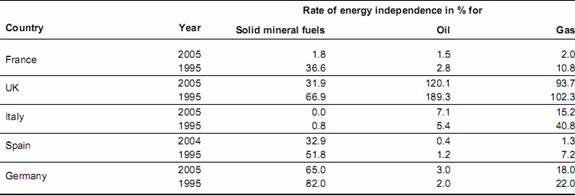
Originating from the UK and Ireland 's grassroots level environmental health movements in early 1980s the concept of energy poverty or fuel poverty, has gained in importance. “With the energy crises of 1973/74 and 1979,” the World Energy Council said, “low-income households experienced difficulties with increased heating bills. The fuel poverty concept is an interaction between poorly insulated housing and inefficient in-housing energy systems, low-income households and high-energy service prices. At the beginning of the 21st Century, the British Government set up a strategy on fuel poverty aiming at eradicating this phenomenon by 2010 … for vulnerable households and by 2016 for all English households. According to the British standard definition that was adopted, a household is poor in fuel if it needs to spend more than 10% of its income on all fuel use to heat the home to an adequate standard and to meet its needs for other energy services (lighting, cooking, cleaning, etc.).” (World Energy Council, Europe's Vulnerability to Energy Crisis , 2008) The report added, “In England … the number of households poor in fuel decreased from 5,1 million in 1996 to 1,7 million on 2001 and to 1,2 million on 2004.” Table 1 provides a picture of fuel poverty in a number of European countries during the period 1994-'97. Portugal had the highest percentage of households defined at fuel poverty while Denmark had the lowest.
Table 1: Households Defined at Fuel Poverty, 1994-1997
Used by permission of the World Energy Council, London , www.worldenergy.org
In the US , the number of households in fuel poverty was 15.9 million (“Fuel Poverty in the USA ”, Energy Action , March 2006).
There is difference between the fuel poor in an advanced capitalist country and fuel poor in a poor country. The level of hardship between them also differs. But that does not nullify the reality of inequality in distribution. With the financial and food crises the suffering has increased. For the homeless and the unemployed in the US , the suffering is more. A number of news reports were dispatched by news agencies that the unemployed in the US were finding it hard to pay energy bills. In extreme weather in parts of the US , like all places in the world, the suffering increases.
While the energy poor is one aspect of the crisis there is over-consumption that has contributed to the crisis.
The type and volume of energy used by households differ from country to country. Income levels, natural resources, climate and available energy infrastructure determine these.
Typical households in the OECD countries consume more energy than those in the non-OECD countries. The OECD households with higher income can afford larger homes and purchase more energy-using equipment. In the US , GDP per capita in 2006 was about $43,000 (in real 2005 dollars per person), and residential energy use per capita was estimated at 36.0 million Btu. On the other hand, China 's per-capita income in 2006, at $4,550, was only about one-tenth the US level, and residential energy use per capita was 4.0 million Btu. Poorer households in Asia , Africa and Latin America earn less, and consume less energy.
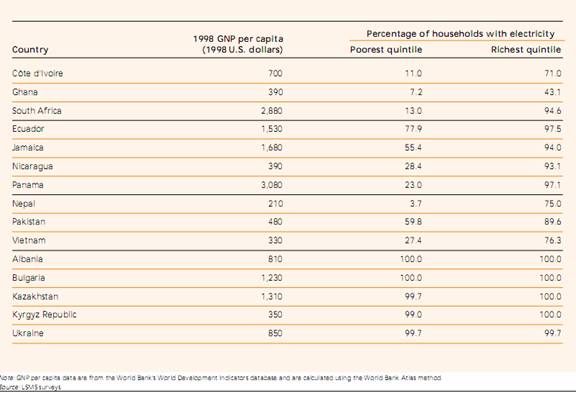
Table 2 from a World Bank publication (from the section by Alan Townsend, “Energy access, energy demand, and the information deficit”) shows that disparity between the rich and the poor in electricity use is great. Disparity in this area is nil in Albania , Bulgaria , Kazakhstan , Kyrgyz Republic , and Ukraine while it is great in other countries including Ghana , South Africa , Nicaragua , Panama , Nepal , and Vietnam .
Table 2: Disparity Between the Rich and the Poor in Electricity Use
Source: the World Bank publication, LSMS survey in 15 developing countries
The US consumes most energy: 8.0 toe/person/year, followed by India and China with an average energy consumption of 7.3 toe per person per year each. On per capita basis, however, Canada consumes the most energy in the world. Its per capita energy consumption is 6.4 times the world average while that of the US is 5.1 times and Western Europe 's is 2.3 times the world's average (P O Pineau, Electricity Subsidies in Low Cost Jurisdiction, The Case of British Columbia ( Columbia ) , 2006). Italy consumes the least energy among the industrialized countries (3.1 toe per person per year). Africa 's average energy consumption only 0.14/person/year, a ratio of 1:57 , compared to the US . Average energy consumption in Bangladesh is only 0.08 toe per person per year, which is a ratio of 1: 100 when compared to the US that uses about fifteen times more energy per person than does a typical underdeveloped country. While the US share of the world's population is only 4.6 percent, it accounts for 24 percent of the world's energy consumption and over 30 percent of GDP. But the least developed countries with 10 percent of the world's population account for about 1 percent of energy consumption and a mere 1 percent of the world's GDP (Huq, et al. 2003). The energy situation Africa faces is a mixture of contradictory reality: while the continent desperately needs energy for economic growth and poverty reduction, it is a net exporter of commercial energy. Africa is home to about 7 percent of the world commercial energy, but it accounts for only 3 percent of global commercial energy consumption.
Energy use in the residential sector in 2006, according to the IEO2009 (International Energy Outlook, 2009) , accounted for about 15 percent of world delivered energy consumption. Larger homes, the Outlook said, need more energy as these homes tend to use more energy-consuming appliances. On the contrary, smaller homes usually need less energy as the smaller homes have less space to be heated or cooled, produce less heat transfer with the outdoor environment, and the appliances used in these homes are smaller. For example, residential energy consumption is lower in China than in the US . The average residence in China currently has an estimated 300 square feet of living space or less per person while the average residence in the US has an estimated 680 square feet of living space per person. The commercial or the services and institutional sector include businesses, institutions, and organizations providing services (schools, hospitals, water and sewer services, theaters, museums, art galleries, sports facilities, stores, hotels, restaurants, correctional institutions, office buildings, banks), and traffic lights. Economic activities and disposable income going to higher levels lead to increased demand for energy as demands for office space, space for business, hotels, restaurants, and facilities for cultural and leisure activities increase. Energy use per capita in the commercial sector in the non-OECD countries was much lower, 1.3 million Btu in 2006, than in the OECD countries, 16.3 million Btu.  The US is the largest consumer of commercially delivered energy in the OECD and remains in that position throughout the projection, accounting for about 44 percent of the OECD total in 2030.
The deeper, the keener observation on the issue, the more inequality gets exposed. The inequality in energy distribution comes from the unequal ownership of the energy resources, and is part of the unequal world system.
The inequality aspect should have the same, if not more, importance as other burning aspects of the energy crisis. Rectifying the inequality is one of the ways to face the crisis. Participation of people strengthens steps to face the crisis. But, shall there have any rational and moral standing if people are asked to contribute to/sacrifice for/play role into facing the crisis if they have no or little or unequal access to the energy resources? The crisis is not their creation. So, one of the first steps to face the energy crisis should be replacing the unequal energy distribution system with an equal and equitable energy distribution system. The other major step should be to inform people about the crisis and inequality so that people get aware. Awareness facilitates people getting organized and taking creative initiatives, and a collective force thus gets mobilized to face the crisis.
[ This section, modified and elaborated for clarity and completeness, is preceded by two parts of the chapter, “ Energy Inequality and Energy Poor” in The Age of Crisis (2009) by Farooque Chowdhury, a Dhaka-based freelancer. For easy identification, the section can be considered as part 3 of the chapter. ]

Tuesday, October 9, 2012

Chávez Wins, Chávez es el pueblo , Chávez Is The People

Frustrating status quo-aspiration and falsifying most of the mainstream expectation coated with predictions, Venezuelan President Hugo Chávez has won a fourth term in office. It's a victory of the under-classes. His new six-year term will begin next year, on the 10 th of January, and the common people expect: the Bolivarian revolution, as Chávez identifies, will continue.
“The revolution has triumphed”, Chávez told the jubilant citizens from the people's balcony , a balcony of the Miraflores presidential palace in the capital city Caracas . “ Venezuela will continue its march toward the democratic socialism of the 21st century. Viva Venezuela ! Viva the fatherland! The battle was perfect and the victory was perfect”, Chávez said.
From Argentina , President Cristina Fernandez de Kirchner tweeted: “Your victory is our victory! And the victory of South America and the Caribbean !”
With a turnout of about 81% voters Chávez had won more than 54% of the votes while his opponent Henrique Capriles was able to bag about 45%. A subdued Capriles, leader of a coalition of about 30 parties opposing Chávez and standing for the interests of the rich, admitted defeat. Capriles and his cohorts are also close to the empire and opposed to Cuba .
The information in the four paragraphs above provide, in brief, the perspective of the election victory in Venezuela, an old republic striving for a new society based on equity and equality, dignity and fraternity, and standing opposed to the strongest empire in human history – the US. The struggle is within the country and in the external arena. The perspective leaves no confusion concerning the tone of politics and its debates.
Wide expectation in the mainstream was that Capriles, the Justice First candidate, would kick out Chávez as the country is being oppressed by an overvalued currency, slow moving industry, crumbling infrastructure, alarming murder rate, corruption and inefficiency.
Oil accounts for more than 90% of the country's foreign currency inflows, but the economy is still to be diversified. Inflation in the fifth largest economy in Latin America is 20% a year. “Soaring inflation and government spending – coupled with currency and capital controls – have created a widening fiscal deficit”, informed Consensus Economics, a survey organization. “The authorities are increasingly reliant on external debt to finance this.”
The China Development Bank, Bloomberg news agency informs, has lent Venezuela $42.5bn over the past five years.
Arturo Franco of the Center for International Development at Harvard University cites Venezuela as “the worst performer in GDP per capita growth.”
And, there are similar other statistics that can be easily cited as evidence of underperformance of the state Chávez leads.
During election campaigns, Capriles, who had a privileged upbringing, opposed nationalization. His argument: Nationalization discourages investment. His other arguments against Chávez included increasing autocracy, harassment of the private sector, government's involvement in the economy, which is detrimental to private sector, spiraling crime and power cuts. Capriles also referred to scandals that surface occasionally.
The line of criticism and the argument for opposition to Chávez is clear: Neoliberalism that puts everything to the “pity”, “benevolence”, cruelty and greed of capital that seeks profit only. To the poor Venezuelans, Capriles is an agent of oligarchy and the US .
A closer look into the performance by Chávez makes the demarcation line, along opposing class interests, clear: Poverty has decreased, health indicators have improved, thousands have got jobs in the expanding state sector. A house-building program has sheltered thousands of families in new homes. Billions of dollars have been channeled into misiones , social programs for the poor: healthcare, education, low-price shops, transport, cooperatives. Now, with a gradually decreasing income inequality all the citizens have a more equal slice of the cake. Venezuela is having the fairest income distribution in the region.
Chávez, who casts himself as the unlikely friend of the wealthy, who always claims somos la mayoría , we are the majority, has nationalized strategic industries and expropriated millions of hectares of land that the rich kept idle with the only purpose of speculation with land. The constitution framed under his leadership addresses social exclusion, and facilitates participation, transparency and accountability.
Chávez, who declared himself a socialist and whose campaign slogan was Chávez es el pueblo , Chávez is the people, is close to the poor, and is alienated from the elites. His opponents called him a monkey. Rich Venezuelans are angry with Chávez.
Prior to the emergence of Chávez, two political parties were peacefully altering state power. Poverty and corruption was wide and deep. A plunderocracy was reigning. Opposing the corrupt system and the elites' squandering of the oil wealth Chávez promised pro-poor social policies. He now plans to build three million homes by 2018 for the low-income people.
Capriles dared not antagonize the poor. He had to say, during campaign, he would not automatically return expropriated assets to private owners. He praised a number of programs initiated by Chávez. He had to commit he would, if elected, push building health clinics and schools for the poor.
The stage is set: the poor are aspiring for a better life for them while despising the rich for their predatory and squandering lifestyle. In a country divided between the rich and the poor with respective politics Chávez's voice against the wealthy is well-known: “predatory oligarchs”, the rotten elites, “squealing pigs”, “vampires”, who looted the oil wealth, corrupt servants of international capital, living in “luxury chalets where they perform orgies, drinking whisky”.
His opponents propagate a contradictory demand. They oppose his programs while they say he could and should have done more.
With petrodiplomacy, PetroCaribe program, standing close to Cuba , organizing ALBA with soft loans to neighbors, Chávez takes a stand for solidarity, mutual cooperation and fraternity among countries. This position can't endear him to a section in the world arena, the sections that practices Shock Therapy .
It's not an easy task to steer an old state machine on a new socio-economic-political path. All parts of the machine are old. Efforts for a gradual transformation are being made. Reality imposes a lot of limitations. There are limitations within the social forces upholding the dream for change. Chávez is operating within this limitation.
It would be a utopia to expect a corruption-free Venezuela overnight. A comparison will tell the truth: billions of dollars are “traceless”, unaccounted in two war fields. Is the amount of Venezuelan corruption to that level? Corruption in other countries that are integral part of the world system, Ben Ali's Tunisia or Mubarak's Egypt or some other similar country needs no mention. Is speculators' corruption, of rating agencies and banks, being exposed through the Great Financial Crisis comparable? Should not one compare “efficiency” of banks and real estate developers that are getting exposed at the center of the world system and in countries near to the center with the Venezuelan inefficiency? A comparison between Venezuelan power cut and power cuts in countries integrated with the world system will provide a hard truth. Should not one compare the number of schools being closed and teachers being thrown out of jobs in an advanced capitalist country and the number of schools being established and students being enrolled in Venezuela ? Should not the number of homeless families and the number of families being evicted from homes in advanced capitalist countries and the number of poor families getting home in Venezuela be compared?
Despite the facts mainstream don't refrain from its task: vilify people's efforts to build up a dignified, decent life. This reality compels one to say Chávez es el pueblo , Chávez is the people as people turn tired of inequality, deception, corruption, wasteful luxury, and as Chávez inspires the poor.

Wednesday, September 19, 2012

An Exercise In Imagination

Let’s imagine, the days are pre-’90s, 1969 or ’84 or ’88. The name of the country, in imagination, is USSR, popularly known as the Soviet Union, or GDR (DDR), popularly known as East Germany, or Bulgaria or Hungary or some other country with a post-revolutionary society.
Let’s imagine, the name of the ruler, termed dictator in mainstream parlance, is Brezhnev or Kosygin or Podgorny or Chernenko or an X, Y, Z considered as adherents of centralized planning and opposed to a world propagated free.
Let’s imagine, hundreds, thousands of citizens of that society have been pushed out of their homes and many of them are living in tents set up between railway tracks or living in subway stations or on pavements while thousands of homes silently stand vacant. Many of them are going hungry and they rely on breadlines to have their barest minimum human existence. Hundreds, thousands of children go hungry, they drop out of schools. Hundreds of schools are being closed down as revolutionary politicians are failing to arrange money for running the schools. The same reason pushes hundreds of teachers out of jobs. The post-revolutionary societies can’t arrange health care for hundreds of its citizens. The numbers may be more than hundreds or thousands. The numbers probably reach to millions. The centralized economy is throwing away, to mention in a sober way, thousands of its workers as it is failing to run its manufacturing units. But, the speculation market in this imagined society of dream is trading, actually gambling with, let’s name it, revolutionary bonds, worth of trillions of dollandro. The trillion dollandro transaction goes on only within a few days, not in a year. The centrally planned economies are of old age, keeping the count low, 200 years.
Let’s imagine, a number of towns, cities, municipalities in the post-revolutionary society has gone bankrupt or filed for bankruptcy due to bickering among the municipal revolutionary leadership or mismanagement or inefficiency or debt. In at least a municipality in the vast Soviet land citizens gathered and demanded pay cut of municipal leadership as it turned out that the revolutionaries were drawing salary of illogical and irrational size, too big. Individuals frustrated with the revolutionary tax officials have protested. At least one frustrated and desperate revolutionary guy tried to hit a tax office with a small plane. A number of schools in the Soviet land experienced incidents of shooting by students and number of students died. The type of the shooting is almost a regular event. And, the society regularly produces frustrated but trigger-happy shooters.
Let’s imagine, workers with revolutionary zeal have defied their Marxist trade union leadership and occupied at least a plant. And, in the land of revolutionary freedom at least a law can be found that stands on the way to organize unions and makes striking difficult, sometimes impossible.
The imagined land of revolutionary hope witnessed riots, sometimes by immigrants invited to run its factories, sometimes by youth and children. A number of those rioting young boys were in the age group of 11-14.
Institutions of higher learning in the imagined land are controlled by the state enterprises. There in the land, a lot of students are debt burdened. Sometimes, cases emerge that the debtor-student has completed her or his student life and has tuned old, but the debt is yet to be repaid as the former student failed to repay as the former student lacks capacity to repay.
Strange is the imagined revolutionary society! Sometimes, case emerges that this or that famous artist, film star or singer, turns drug addict, turns frustrated, commits suicide or dies in mysterious circumstance. The society produces such frustrated celebrities facing a hopeless horizon.
An amused environment, in truest sense, dominates the imagined land. Jovial persons are there in the society. They spend a lot, unimaginable amount of money, for drinks-dinning-dancing and all related activities while noteworthy number of children languish in den of misery.
Amazing vigor the society produces! One can always find some persons spewing hatred; sometimes against color, sometimes against religious belief.

Let’s forget these lower parts of these societies that propagate a nice world of revolutionary liberty and freedom.
Suddenly, it comes to light that an East German or a Hungarian revolutionary leader was provided with money by a despised dictator in Africa to smoothly conduct revolutionary election in the polit bureau or in the Supreme Soviet, the highest legislative body. Suddenly, it comes to light that another revolutionary leader from another revolutionary land was provided with money by an old lady equipped with revolutionary ideology. Suddenly, it comes to light that a section of members of the Supreme Soviet were tricking with bills they submitted with the authority. Suddenly, it comes to light that number of scandals with Supreme Soviet members is not a few.
Wise is the Supreme Soviet Court, the imagined highest revolutionary legal office that delivers justice! The court finds: Collective farms or state-run super-industries are person; so these are entitled rights of persons. As these turn persons, these production or business bodies contribute money, huge in amount, to elections so that their candidate of choice gets elected so that they can repay by formulating laws favorable to the collectivehood or industryhood.
The year 1984 was near to nose of citizens. Pravda, Izvestia, the main section of the press in the Soviet land, Tass, the main news agency of the country, Radio Berlin or Budapest TV, the main broadcaster or telecaster of the land started discussing the touted Orwell-novel Nineteen Eighty-Four. They were also discussing Animal Farm. Their media-comrades in other lands joined them and an inter-continental orchestra, at least 12-month long, was organized. The purpose was to make the world alert of big brother in a tyrannized land, who was always keeping eyes on its subjects, controlling and manipulating brains of citizens. It was a noble mission to alert ordinary citizens about dictatorial rule. But suddenly it came out that the imagined land of freedom was having a bigger eye, stronger manipulation, and an all encompassing ideology – greed and accumulate.
Anyhow, the revolutionary leadership organized an international sport event. To ensure safety of the event, the revolutionary leadership decided to mobilize missiles, but not the ICBMs, on rooftops of civilian citizens in Moscow or Warsaw.
Anyway, the Soviet polit bureau failed to forget the Roman rulers’ tact: Invade a country or wage a war anywhere whenever there is possibility of a rebellion in home. They were faithful to the Roman ruling tact.
Whatsoever, the economy in the imagined Soviet land required the wars. Those were not only for distracting and demobilizing the citizens. Wars were like life lines to the revolutionary economy claiming to be the best.
Whatever goes in the economy, there was revolutionary politics, and the politics inspired the Soviet Blackmail & Hacking magazine editor to press the chief of the imagined state to hasten the decision to invade a country.
The economy, wisest and most efficient in the world, was successfully keeping in abeyance contradictions with the society. That was the revolutionary efficiency. And, it was happy with its efficiency of keeping contradictions unresolved. It was more than confident that contradictions within can be kept unresolved for indefinite period. It was a hope-infinite.
This story can move on and on as it was a story of a system destined to bring peace, prosperity and happiness to the world humanity, as it was a society Conceived in Liberty. It will be an affront to the society and its leadership to compose short stories on the system. It requires epics. It’s a justified expectation.
Should not humanity prefer this society? If the imaginary exercise nose dives and finds the ground reality? And, if the ground reality shows that the society is capitalist society hundreds of years old? Should humanity prefer it?

Monday, August 27, 2012

Greece Faces French-German Pressure And Mounting Human Crisis

Casting away all confusion related to “socialist” stance the French and German bankers’ interests unite to press down Greece while the Greek people face human crisis.
Echoing the German chancellor Angela Merkel’s voice the French president “socialist” François Hollande has told the Greek prime minister Antonis Samaras, in a meeting in Paris, to wait for an EU-IMF-ECB troika inspectors’ report on progress Athens has so far made in privatizing public resources, changing labor market and imposing austerity measures. “There’s no time to lose, […] and the sooner the better,” Hollande said. He offered no concessions to the Greek leader.
Only a few weeks ago Evangelos Venizelos, the leader of Greece’s socialist party Pasok, pinned hopes on the election of Hollande as the best guarantor of the growth policies. In an interview with the Guardian, Venizelos said: Hollande is “by far the best solution.”
But now, with Hollande’s backing Merkel has rejected pleas from the debt-pressed Greek leader for a two-year repayment extension. She said: Germany would await “reliable evidence”, a reference to the Troika report.
Germany is the single largest contributor to two Greek bailout packages. Earlier, Merkel and Hollande met in Berlin and agreed to take a uniform approach: No extra time to Athens, and Athens has to meet commitments of privatization-belt tightening measures in return for the bailout money.
Samaras’ meetings with the French and German leaders have failed to bring anything for Greece but renewed pressure and humiliation. He promised voters that he would request extra time to make additional cuts.
Samaras had to face mocking, humiliation indeed, by a section of the German press. Bild, one of Germany’s most popular tabloid newspapers, interviewed Samaras and asked him to sign a letter of guarantee that Greece will pay back its international loans. It included provisions that he “vows personally” to ensure repayment. The letter mentioned that financial aid provided to Greece will not cause trouble to German tax payers, and Athens will take any necessary measure to exit from the crisis including sales of uninhabited islands if needed. On the question of returning to drachma, the Greek prime minister had to swear in the name of god: “For God’s sake, no. The consequences would be catastrophic for Greece.” It was not a dignified show for a prime minister of a country. But bankers’ power tolerates dignity of none but its. Bild has already published articles mocking Greek politicians, football players and singers.
Leading German politicians, sections of German finance-political elites are not willing to grant more time and money to Greece in its fifth straight year of recession. Parts of the German mainstream media reflect the interest. The German finance minister Wolfgang Schäuble also rejected Samaras’ plea for extra time.
The Troika bosses are due to reach Athens within days to assess Athenian efforts to appease the creditors, virtual owners of Greek life, honor and sovereignty. The bosses will report to the Eurozone finance ministers’ Oct. 8 meeting and the ministers will decide whether to release a $38.8 bn installment, the last in a first series of $152 bn in bailout loans while a second for $173 bn is in limbo until Athens imposes more austerity.
Uncertain Greek economy is annoying many others. Possibility of a Greek default is making the US president Barak Obama anxious as the default could negatively affect his re-election result. Obama and the British prime minister David Cameron discussed the Eurozone crisis during a conference call on Aug. 22. Citing British sources The Independent said: “The Obama Administration is fearful of the fall-out on the US economy if Greece tanks and the ripples affect the Eurozone and world markets.” Obama is “reportedly squeezing European leaders not to do anything that could force Greece out of the Eurozone before the American elections in November.”
Capitalism is really delicate! A far-flung smaller economy can impact politics of a bigger economy.
Continued pressure to slash $14.16 bn and accelerate privatization process is being faced by the unstable conservative-Socialist coalition government in Greece.
To meet the demands of its international creditors, the Greece government, promise-bound to the lenders, have slashed pay, trimmed pension and increased taxes on everything, which have worsened recession in Greece. The draconian measures accompany bailout money loaned to Greece. Without this loaned money Athens would not have enough funds to pay salaries and pensions. Athens has already stopped paying its bills. Recapitalization of Greece’s four largest banks will not be completed until the end of the year, or in early 2013.
State of the German economy is playing a role behind the inflexible German position of bankers and politicians. Concerns about the German economy’s future are increasing. The German Federal Statistical Office recently informed a surplus of $10.4 bn for the first half of the year, which is 0.6% of GDP. In 2011, Germany had a budget deficit of 0.5%. The German labor market remained strong and revenues from wage and income tax increased by 6.3%.
However, economic growth of Germany is largely stagnant. According to the FSO, the German economy grew by 0.5% in the first three months of the year against just 0.3% in the second quarter. Amidst high state and municipal budget deficits the euro crisis has affected Germany’s exports. “Faith in German state finances are an important factor for stability in the current crisis, but that faith is not unshakable”, the Bundesbank, Germany’s central bank, said in its monthly report released in August.
On the other pole, with declining wages, condition of the Greek people has turned unbearable. The face of a human crisis in Greece is coming to public view.
Archbishop Ieronymos, the head of the Greek Orthodox Church, has described austerity measures demanded by creditors as “lethal medicine”. In a letter to the prime minister, Ieronymos wrote: “Homelessness and even hunger – phenomena seen during the war – have reached nightmare levels [....] We must all understand the feeling of insecurity, desperation and depression in every Greek home. This, unfortunately, is continuing to lead to suicide among those who can no longer stand the drama in their family and the suffering of their children.”
A recent central bank of Ireland study has found that the Greeks are making deeper cuts, measured according to GDP, than all other crisis-hit Eurozone countries. Since 2010, Greece has responded to pressure from the IMF-EU by cutting down expenditures and increasing taxes worth the equivalent of 20% of GDP that represents the most brutal austerity program in the EU-history.
“Greece is bleeding”, a Bild headline said. Ta Nea newspaper describes the Greek society as a “society on the verge of a nervous breakdown.” The living condition the creditors created for the Greek people is making deep changes in the Greek society.
In the last three years, quality of life in Greece has fallen down by 30% while pensioners have lost one-fifth of their monthly benefits. Charity funds are being organized in the US and Australia to aid the poor in Greece. With these funds, food is being supplied to scores of Greek homes.
Citing a recent survey by Thessalonica University BBC reported 76% of Greeks would like to emigrate, but for those who cannot afford to start a new life abroad, going back to farming the land is an increasingly attractive alternative. (“ Greeks go back to basics as recession bites”, Aug. 20, 2012) In the face of financial crisis Albanian immigrants, in thousands, seem to be leaving Greece. Their destination is Australia.
Capitalism is a depopulating force. It deports populace. It makes people restless. Its old practice is still being upheld.
In 2011, the BBC report said, the Greek economy shrank by 7% and 2012 could make a similar slide busting thousands of businesses and lying off tens of thousands of people. Around 1,000 Greeks a day are losing their jobs and already the percentage of the population not working is higher than the employed. The present unemployment benefit in Greece is now around $431 a month for only one year, but only those who have up-to-date national insurance contributions are eligible.
Hardship imposed on the Greek people is getting reflected in the number of suicides.
From Athens, Barbara Hardinghaus and Julia Amalia Heyer wrote: “Greece, a country whose Orthodox Church does not condone suicide, has always had one of the lowest suicide rates in Europe. But now, there were 350 suicide attempts and 50 deaths in Athens in June alone. Most of the suicides were among members of the middle class and, in many cases, the act itself was carried out in public […]” (“Troubled Times Wave of Suicides Shocks Greece”, Aug. 15, 2012)
Referring to rising suicide rate in Greece, Wall Street Journal wrote: “The social impact of the economic crisis has become increasingly apparent on the streets of Athens and other cities, while suicide rates have jumped.” (“Greek pensioner commits suicide in central Athens”)
Citing police data WSJ said: “[T]he number of suicides in both 2010 and 2011 surpassed 600 each year, a 20% jump over the rate in 2009, the year before the start of the Greek debt crisis.”
“Painful austerity measures and a seemingly endless economic drama”, the Guardian wrote in late 2011, “is exacting a deadly toll on the [Greek] nation. Statistics released by the Greek ministry of health show a 40 percent rise in those taking their own lives between January and May [2011] compared to the same period in 2010,” This surge in suicides was the highest in Europe during that time period.
The Greek Orthodox Church, it was reported, denies church burials to people who have committed suicide.

There are reports of school students unable to afford food. A program has been initiated in February to distribute early-morning snacks to them in a school. A municipality has documented about 1.9% of all students in the municipality arrive at school without having breakfast. This figure is higher among primary school and middle school students, 2.8% and 2.16% respectively. The education ministry has to introduce similar program in 18 state schools in greater Athens. The program has been introduced following reports by teaching unions that children of unemployed parents were showing signs of malnutrition and are even fainting in class rooms.
Reports of primary school students fainting during classes due to starvation in downtown Athens surfaced in 2011. Primary school teachers union from the districts of Ampelokipi-Erythros-Polygonon in a statement depicted horrifying condition of students. Dimitris Margiolis, a teacher, confirmed that students came to school with torn shoes. In school canteens the number of students buying snacks has decreased.
“The incidence of HIV/Aids among intravenous drug users in central Athens”, citing Reveka Papadopoulos, the head of Médecins sans Frontières Greece the Guardian reported, “soared by 1,250% in the first 10 months of 2011 compared with the same period the previous year […] while malaria is becoming endemic in the south for the first time since the rule of the colonels.” The extraordinary increase in HIV/Aids among drug users is due largely to the suspension or cancellation of free needle exchange programs. (“Greece on the breadline: HIV and malaria make a comeback”, March 16, 2012)
Reveka informed: Following savage cuts to the national health service budget including heavy job losses and a 40% reduction in funding for hospitals, Greek social services were “under very severe strain […]” There was a 24% increase in demand for hospital services “largely because people could simply no longer afford private healthcare. The entire system is deteriorating.” Cases of transmission between mother and child surfaced for the first time in Greece, a phenomenon usually found in sub-Saharan Africa, not Europe. There is also a sharp increase in cases of tuberculosis among the immigrants. Nile fever caused 35 deaths in 2010.
Capitalism is really powerful. It can push down a capitalist society in Europe to the level of a continent ruthlessly exploited and kept dispossessed for centuries by colonial powers! Capitalism also carries a backward force.
Mark Lowen of BBC reported from Athens: Hundreds of citizens queuing in front of municipal soup kitchen is not an unusual sight today. The number of food-seekers has increased. Homelessness has increased by an estimated 25% since 2009. There is the “new homeless” – well-dressed and well-educated. Until 2011 the “new homeless” had a good flat or a nice car, but now they have nothing. Some homeless people lie buried behind subway tunnels and in parks. (“Meeting the ‘new homeless’ on Greece’s freezing streets”, Feb. 4, 2012)
Mark quotes Vicky Kolozi, a former journalist with the state broadcaster ERT, and one of the new regulars at the soup kitchen as Vicky lost her job a year ago and now can’t afford to feed herself and her daughter: “It is hard to feel that I have to depend on this now. I have dreams and when you come here, the dreams go out of yourself. You must accept reality - and the reality is very difficult.”
Capitalism snatches away dreams of ordinary people.
The BBC Aug. 20, 2012 report refers to a young Greek working as a cleaner, but making barely enough to feed his family: father, mother and his fiancé – all unemployed and depend on food handouts to supplement the little they manage to grow in their garden. He and his finance are unable to plan a future together. Starting a family is completely out of the question. (“Greeks go back to basics as recession bites”)
Capitalism takes away future of common people.
The last winter with freezing temperatures was brutal for the poor in Greece as snow blanketed almost all around. An intense, harsh cold intensified the human crisis “gifted” by the finankers, financers and bankers, speculasters, and their ruling system – capitalism. Today’s Greece is a live example of capitalism’s catastrophic power – connected through ideology, economy and politics – that creates havoc in civilization.

Monday, December 19, 2011

2011, A Year Replete With Revolts, Uprisings And Occupation

Uprisings, revolts and occupation are keeping their undeniable marks on 2011. In recent times, a year with so much and so wide protests from periphery to world metropolis are rare. In this crises-ridden period, the competition-charged, tumultuous year saw status quo questioned and challenged. In recent times, capitalism with its fundamental contradictions of capital accumulation has never encountered so vigorous and wide social criticism and rejection.
The globe eclipsing status quo has created conditions for protest and uprising, and also trammeled these. With these contradictory acts, status quo has illegitimated itself, and has provided legitimacy to protest and uprising against institutions for coercion and ideological hegemony that capital builds up to dominate public life. As captive of income- and opportunity-inequalities, people in countries are giving tongue to their dissatisfaction with the status quo, its philosophy, policies, politics and economy. As democratic practice, people are dissenting, disapproving and denouncing dominating power’s contempt of life and liberty. People are declining to acquiesce to the destruction of peace on the earth.
People in countries were passing days while corporate personhood was taking control of peoples’ life and bare minimum spaces essential for people’s existence. It was capital’s indifferent campaign to destruct all life on the earth.
The prevailing system with its all its brutality – poverty, unemployment, wars, intervention, and indifferent elites indulging in luxury and speculation – has provided logic to protest in countries. Working people are being deprived of their rights. Narrowed down space for dissent and curtailed rights have ignited revolts. In 2011, people began resisting mainly through nonviolent protest marches and occupation. Internet based social networking has turned into a tool to communicate and propagate. In 2011, with industrial action, by striking valiantly, labor in scores of countries heroically stood in front of capital. In Third, Second and First Worlds, student activism, their protests and marches, occupations of educational institutions and media centers unmasked the dominating system that does not hide its profit motive in the area of public instruction. In 2011, riot and anarchic acts, only a few in numbers and only in a few countries, reflect dire living condition, and encroached democratic space. These are initiatives by an impatient section to ensure jobs, homes, security and freedom from the tyranny of capital.
The Arab Spring and the Occupy Movement are two key moments in the worldwide protest process in 2011. These are junctures. In terms of magnitude and force, these two surpassed the Seattle Uprising in 1999, the Prague Anti-globalization Protests in 2000 and the Iraq War Protest in 2003. In terms of significance, these two influenced and will influence societies and politics at regional and world levels.
Tyrants, Empire-allies, caricature characters in politics, financial and political institutions, coercive apparatus, all had to face protests by people from Australia to Middle East, from North Africa to North America, from Wukan, a China village, to the US cities, from a mining giant headquarter to ports and auction house. Tunisia, Italy, Malaysia, Morocco, Russia, Bahrain, Greece, France, the UK, backward, conservative societies and advanced capitalist countries, all came under questioning by its citizens. Madrid, Athens, San Francisco, Paris, Philadelphia, London, Leeds, Los Angeles, and hundreds of cities and towns saw protest marches. Election thievery sparked protests, sometimes violent. In 2011, tens of thousands of “mass incidents”, huge demonstrations and protests, reflected undercurrents in today’s Chinese society. Striking oil workers occupied the main square in Zhanaozen, a Kazakhstan town, for more than six months. In the last days in 2011, police firing on the protesting Kazakh oil workers killed at least 10 people. During the last days of the year, protesting people continue making supreme sacrifices in Egypt, a geostrategically important area, where an alliance between retrogressive forces and imperialism has been completed. In Lens Creek Mountain, West Virginia, USA, people marched more than 50 miles to save ecology and a glorious history.
Occupy Wall Street, the Occupy Movement that began on September 17 with a few thousand protesters in New York to condemn greed and capitalism has become a political expression in the entire US, and broadly, a worldwide approach with broad coalitions. In France, Marseille Chamber of Commerce was occupied. In Kerala, India, a soft drink plant was occupied. And, 2011 saw similar many more.

Within days, the Occupy Movement became a world symbol with the universal slogan “We are the 99%”. Jobless and homeless, union members and priests, nurses, teachers and students stood in protest, peacefully marched down streets, built camps with libraries in parks and city squares, tried to make their stand in the face of forced evictions. But capital’s dictatorial force prevailed. Occupy Movement protesters have been arrested, their camps bulldozed.
Occupy Movement campaigned to move homeless people into buildings foreclosed by banks, stood by labor’s struggle, and has tried to widen its support-base. Defying cold, rain, snow falls and evictions in countries, Occupy Movement protesters are still undaunted, and hope to re-occupy public spaces.
Now, it is Occupy Everywhere. It’s a new discourse and dynamics of political action. It is not an isolated act of protest. Rather, it is now a worldwide process, an expression of revolt against capitalist economy and politics.
Labor, either in unions or defying status quoed union leadership, in countries has joined the waves of uprising, and in countries has determined pace of politics for a period, may be for a short one. Labor worldwide is trying to assert its position. In 2011, labor made strikes at Australian coal mines and walked outs at giant Grasberg mine in Indonesia. Chile’s state-owned copper giant, African gold producers, and scores of mine owners in countries had to face labor action in the year.
At least in a country, a new law banning street protest has been enacted. At least a country now plans to use its political power to detain its citizens for indefinite period. Police reportedly went undercover at an Occupy camp to find out protesters’ intentions. Police spies infiltrated protest groups at least in a country. In countries, public servants, hardly a few thousands in number, are wielding the power to define limits of “democracy” for millions, and in actual sense, billions. The year 2011 once again exposed these truths.
In 2011, by violating fundamental rights of people, and even by violating bourgeois democratic norms, ruling classes in respective societies have quashed its claims to rule, have confirmed its void moral standing, and have provided people the logic to reclaim fundamental features of bourgeois democracy and public spaces. In 2011, ruling machines in countries are breaking its laws the machines are committed to safeguard, and breeding contempt of the laws enacted to secure existing property relations and perpetuate dominance over people. In countries, honesty is an abandoned concept within forces of and institutions for hegemony. So, the logic to reclaim comes from Abraham Lincoln. In 1858, Abraham Lincoln said while debating Stephen Douglas: “We the people are the rightful masters of both Congress and the courts, not to overthrow the Constitution but to overthrow the men who pervert the Constitution.”
In 2011, capital’s “holy” alliance is being exposed. States with their inherent inefficiency and incompetence continue to stand as inefficient and incompetent. With their monopoly of coercion states are attaining mistrust of its citizens.
In 2011, main stream media got exposed as a tool of capital. MSM’s acts appeared deep rooted conspiracy, often a conspiracy of silence, to the protesting people. It tried to keep silent on the Occupy Movement. Its “shrewd” tact to ignore people’s struggles ultimately breached its credibility, and to regain credibility, it had to provide information, sometimes disinformation or misinformation.
In 2011, the dominating economy’s incapability is being exposed as it continues to snatch away social safety arrangements, as it fails to provide bare minimum livelihood space to citizens, and as it fails to balance its competing interests. In a continent, dominating capital stands on the brink of falling apart as its powerful parts fail to resolve fatal competition.
In 2011, like past years, states, huge in number, continue to serve their masters – capitals, monopoly finance capital, speculator capital, ecocide capital, war capital. With demagoguery and outright falsehood, with a state of war or a threat of war, with justification to torture and murder, states fomented protests, revolts and occupation in 2011.
Status quo is engaged with full force in stopping peoples’ legitimate claims on economy and politics. In 2011, societies are on the border of bankruptcy, societies are faltering with burden of seemingly endless mal-governance, lumpenocracy, immense corruption and hopelessness. Dominating classes’ historical role has brought the societies to this limit. The dominating classes have initiated the process of destruction of these societies. In countries, people found no other way but protest and revolt in 2011 as speculators and bankers shape economy and trample sovereignty, polluters define limits of livable environment, and tyranny encroach public spaces. All Tyranny depends on deception, hypocrisy, economic and political power, and compels people to resort to revolt. The year, as a reaction, demonstrates force and power of revolt. The year is witnessing unimaginable riches and military might, but finds it imprisoned to the desire to use the power in the interests of absolute minority section in societies. People find them encountering tyranny and oppression in the guise of status quo in 2011.
“No nation”, as James Madison said in Political Observations in 1795, “can preserve its freedom in the midst of continual warfare.” But, the world is experiencing continual war waged by dominating capital. The year 2011 with pain and tears is going through this war. It is war for resources and cheap labor being waged in lands around the globe, it is war for thievery, it is wars declared and undeclared, and it is age-old war waged by a minority class against the majority classes. Under the endless sky, it is being waged in politics, in diplomacy, in economy, in propaganda, in ideology and education. It is being waged in the squares of the cities, in slums, on waste dumping grounds, with public properties being sold in market, in factories and workshops, in ports and offices, in degraded educational institutions and hospitals without any ribbon of hope, in all public spaces.
In countries, people are now no more wandering, no more having aimless moves in 2011. In countries, people are now striving to transform politics, taking initiatives in politics with limitations imposed by a period and respective societies. Despite the fact, protesting people, revolting people, not individuals, have initiated a process to reclaim their space, their land, to reiterate
This land is your land,
This land is my land
This land is our land.

Sunday, November 6, 2011

A Drama In Disarray: G20 Summit In Cannes

The G20 summit in Cannes has concluded in disarray and without details in “agreements”. Leaders were unable to agree upon financing the IMF to help advanced capitalist countries in distress. No G20 state is willing to participate in the euro zone bailout fund.
However, one “achievement” is there instead of a total failure: interventions in two democracies – Greece and Italy – appeared close to coup although a G20 leader disagreed. So, all should agree with the leader: These are not coups de grace, but a mere attempt to change government or press government to listen to interventionists for the sake of markets. Italy and Greece have been made to submit to creditors’ dictation.
The Cannes Crisis Festival, considered a flop by some commentators, saw little progress on resolving Europe’s debt crisis. The leaders, as Angela Merkel acknowledged, had failed to interest any of the G20 state in investing in a new initiative. From her statement it appeared that China and Russia bargained a bit. Russia and China demand IMF to secure their investments. A strange symptom within a world structured along a NATO-WB-IMF-WTO design.
But Cannes summit has failed to raise market confidence. Stock markets in New York, Frankfurt and Paris initially expressed their reaction by moving down.
The continuing eurozone debt crisis dominated summit had the hope to increase IMF resources by $250bn to more than $1tn. But the hope has not touched this material world. The hope has been kept suspended for G20 finance ministers with the hope to be materialized in next February.
The summit communiqué made commitment to move “more rapidly” towards greater exchange rate flexibility, agreed to give IMF more money, welcomed Italy’s “wisdom” to invite the IMF to monitor its reforms, and called on countries with strong public finances to take steps to boost domestic demand.
“Dark clouds, Ban Ki-moon warned at an event with main stream labor leaders in Cannes, “have gathered once again over the global economy. […M]any people cannot even see the light at the end of a long, long tunnel.” With a similar mood, David Cameron said the crisis was having a “chilling effect” on his country’s economy. He hinted at worse to come, describing this as only “a stage of the global crisis”. The UK leader felt that in the interest of his country the eurozone crisis should be sorted out as rapidly as possible.
For playing down failure to make progress on major issues Nicolas Sarkozy tried to appear as a warrior for the cause of Robin Hood tax. Sarkozy expressed his willingness to “fight to defend Europe and the euro” as he said in a post-summit press conference.
Sarkozy said: We cannot accept the explosion of the euro, which would mean the explosion of Europe. He has assured that the G20 had agreed to boost the IMF. He made a forecast: G20 would agree by February. The French leader denied the demands on Silvio Berlusconi represented almost an IMF coup: “We never wanted to change governments, either in Greece or in Italy. That is not our role; that is not our idea of democracy.” However, he said that George Papandreou’s decision not to tell fellow EU leaders about plans to hold a referendum was “shocking”. Barack Obama reminded Greek and Italian parliaments to take decisive action. The US leader praised increased scrutiny of Italy as a step in the right direction.
The summit deliberations showed Britain’s inability to take burden. Cameron admitted that the G20 summit had failed to resolve the eurozone debt crisis. He went on: “I’m not going to pretend all of the problems in the eurozone have been fixed, they haven’t.” Cameron feels, “[t]he problem is that not all of the details... have been put in place.” He assured British taxpayers that increasing UK contributions to the IMF would not put their “money at risk”, and the money would not support a eurozone bailout. He revealed a fact: Contributing money to support the IMF was, as a trading nation, “in our interests”. He also suggested that the issue of increasing contribution to the IMF would not be put on a vote in the Commons. It appears that UK capital does not have interest in euro bail out, but in expansion of global business.
The Greek drama annoyed the Cannes festival as Papandreou announced to hold a referendum on austerity package being pushed through Greece’s throat. The political move panicked markets around the world and the G20 leaders. But dominating capital’s dictation made Papandreou step back. He threw away referendum plan to seek people’s mandate on the austerity plan that includes sell-off of public property. The Papandreou government sought confidence in parliament after alleged horse trading and survived a confidence vote.
Italy with its near-nonexistent growth was an amazing player in the Cannes show. Rome now threatens to carry Europe’s debt crisis up to a level that can fall on the entire earth’s capitalist economy, and make it spin listlessly. Italy’s borrowing rates are rising to the levels that forced the PIG to seek bailout “benevolence” in all its crudeness. With a $2.5 trillion debt Italy has agreed to let the IMF monitor its implementation of austerity program.
But, as a Reuter’s story described, the “fierce pressure from financial markets and European peers” was not a humiliation for Berlusconi as he agreed to have the IMF and the EU monitors. It was reported that Berlusconi “was summoned to a late-night hotel meeting with Merkel, Sarkozy, the IMF director general Christine Lagarde and Obama, where he was instructed to bring Italy under […] IMF surveillance to ensure he implements […] measures, including changes to the labor market, […] the sell-off of state assets.” However, Berlusconi tried to minimize the satiric-political impact of the decision, saying that it had been requested by Italy rather than imposed by world leaders. He boasted: He had invited the IMF to offer advice; he had rejected an offer of IMF funds. He claimed that his country was more solid than France or the UK. “Italian restaurants and vacation spots are always full. Nobody has the sense the country is in a crisis”, said the scandal-ridden Italian leader.
The IMF bosses will audit Italy’s books of accounts to make sure the austerity measures are implemented with brute force. An EC team will also supervise. Moreover, the Media Mughal of Italy with a history of not standing by promises had to make a new promise to European leaders in Cannes, the famous film festival place that sees attractive film figures: a confidence motion within 15 days in Roman Senate. These developments achieved by external and Italian finance elites impacted Italian politics. Desertions from coalition government of Berlusconi have made its life uncertain.
Shall there be horse trading in the country’s political market dominated by the rich? Shall the trade be called democratic distribution of patronage by one of the richest men of Italy? All, from Catholic Church to business, want Berlusconi’s exit. But the democratic warrior knows well that Italy is not Libya. This perception has led him to brush aside the desire of powerful interests. He has already found traitors to the country as he described party rebels. Have ghosts of fallen dictators overshadowed the character of Italian comedy in a Roman Holiday? However, there are all the possibilities of Berlusconi’s Mubarak Moment.
The world now is a bit different whatever the Italian leader claims. The IMF bosses do not only dictate the poor in the South. They are now showing muscles in advanced capitalist countries. Now, after Greek Tragedy and Italy Incident, the ruling elites, many of them are pure robbers and plunderers, of IMF-dictated-poor countries should get “rid” of sense of shame. The founding fathers of the Bretton Woods institutions had not imagined that one day in future their institutions designed to subdue the poor world would discipline advanced capitalist countries. Even, Marx had not imagined. Has something rotten down in the core of capitalism? The IMF is disciplining Ireland, Portugal and Greece, “dignified” capitalist countries not “shameless” like the poor countries.
Russia made a major advance in the summit as the country will be allowed into the WTO, “the biggest step in world trade liberalization since China joined a decade ago.” The step will have implication on present major players in the world trade club. China’s increasing power was evident in the summit as the country resisted calls to allow its currency to appreciate. It now appears that these two countries are making their voices heard in the gathering of the powerful and aspiring-powerful.
The disarrayed drama, the unwillingness to fund IMF, the flexing of power reaching close to coup in advanced capitalist countries, the humiliations, etc. raise a few fundamental questions related to capitalist world system that was in euphoria with a brute onslaught named globalization a few years back.

Monday, October 31, 2011

November 2: General Strike In Oakland

Oakland is going to observe a general strike on November 2. The strike will be “against the growing gap between the rich and everybody else,” said the website of Occupy Oakland. “The whole world is watching Oakland,” OO said in a statement. “Let’s show [the world] what is possible.” The OO announced on its website that it is planning a march to the Port of Oakland, the US’ fifth busiest, to “shut it down.” New agency reported that tens of thousands of people are expected to participate in the general strike. It was also reported that organized labor will extend support. These are signs of growing discontent.
The decision for city-wide general strike was passed by Occupy Oakland General Assembly by a 96.9% majority. The OO has urged other groups nationwide to organize similar events.
The OO statement said: “We […] propose that on […] November 2, 2011, we liberate Oakland and shut down the 1%. We propose a city wide general strike.” Now, Oakland is getting prepared for a general strike that in 1946 also observed a general strike
The OO has invited all students to walk out of school. “Instead of workers going to work […] the people will converge on downtown Oakland to shut down the city.” The statement said: “All banks and corporations should close down for the day or we will march on them.”
The OO has also called on people “for much more. People who organize out of their neighborhoods, schools, community organizations, affinity groups, workplaces and families are encouraged to self organize in a way that allows them to participate in shutting down the city in whatever manner they are comfortable with and capable of.” On November 2, marches have been planned at 9 a.m., noon and 5 p.m., so that as many people as possible can participate.
The decision for the general strike came out as a result of an incident related to Scott Olsen, 24, former Marine and Iraq War veteran. Olsen sustained a skull fracture after being shot in the head on October 25 with a police projectile while peacefully participating in an Occupy Oakland protest. The images of Olsen standing peacefully in the Oakland protest frontline, next to a Navy vet holding a “Veterans for Peace” flag, and the images from moments later of Olsen lying on the ground wounded have shocked all. The atrocity sparked anger leading to a call for the general strike. Olsen has become a rallying cry for the USwide Occupy movement.
Olsen served two tours of duty in Iraq before being discharged in 2010. After leaving the Marines, he was working as a system administrator for a software firm. He joined the Oakland protests with members of Iraq Veterans Against the War, a group raising issues of homelessness and unemployment among Iraq and Afghanistan veterans. “It’s ironic that days after Obama’s announcement of the end of the Iraq War, Scott faced a veritable war zone in the streets of Oakland […]”, The IVAW said in a statement.
John Nichols, Washington correspondent for The Nation and associate editor of The Capital Times writes: “We Are All Scott Olsen!” was the message of solidarity vigils, rallies and marches held in cities across the US and around the world in answer to a call from IVAW and Occupy Oakland for recognizing Olsen. Thousands attended a candlelight vigil in Oakland. In Las Vegas, an image of Olsen was projected at the site of the Occupy encampment. In New York, Occupy Wall Street activist took to the streets chanting “New York is Oakland, Oakland is New York.” In London, images of Olsen were displayed at gatherings. The buzz about the wounding of the veteran was everywhere, and was best summed up by activist protesting at Wisconsin’s state Capitol with Olsen in February. It read: “He could be any one of us.” (The Nation, Oct. 28, 2011)
The Oakland Occupy protests that began October 11 have witnessed more than 100 arrests and a violent confrontation last week between protesters and police. According to press reports, the conflict came after police dismantled the protesters’ camp for more than two weeks. Police fired tear gas over a three-hour period clearing out the camp on October 25.
Only Oakland is not experiencing steps by authorities. Steps against the protesters are being escalated as people are protesting in US cities. On October 30, about 30 anti-Wall Street protesters were arrested in Portland, Ore., after they refused to leave a park. Later they have been freed. In Nashville, demonstrators raised slogans in defiance of an official curfew: “Whose plaza? Our plaza.” State troopers began enforcing the curfew on October 27 night, three weeks after protests began. In Phoenix, a Councilman suggested charging demonstrators the costs of the city in overtime for police, and others since the protests began October 14. The cost was calculated: $204,162. Probably, it is the fee for protest in a democracy!
The issue of cost is not sarcasm with democratic rights, but the real face of a democracy that spends trillions of dollars to help its absolute minority, the finance-elites, and fails to help the suffering millions, the absolute majority. This has plainly been told by Monthly Review editor John Bellamy Foster in his speech in Occupy Eugene rally on October 15, 2011: “US society has become fundamentally unequal.”
In this society, John B Foster said, “between 1950 and 1970, for every additional dollar made by those in the bottom 90 percent of income earners, those in the top one hundredth of one percent received $162 dollars. But that was back when things were more equal! Between 1990 and 2002 for every added dollar made by those in the bottom 90 percent of the population, those in the top one hundredth of one percent made an additional $18,000. […] In the United States 400 individuals […] own as much wealth as the bottom half of the US population, some 150 million people. […] The top 1 percent of the population in the United States owns four times as much financial wealth (excluding houses) as the bottom 80 percent of the population. […W]e live in a plutocracy rather than a democracy, where money outvotes public opinion at every point in the political process. […U]nions are on the defensive in this country. [T]hey have been smashed by unfair legislation. [T]hey are struggling to find a way to fight back. […E]lementary and secondary education system in the United States is being privatized and destroyed. […A]ll of this is related to the system of economic power, to a society that believes in the Wall Street principle, “greed is good,” the signature of capitalism.” (“Why We Occupy, What We Know”)
The worldwide monopoly-finance capital’s tricks are many, and it has to depend on its political machine. Attempts are made to avoid public scrutiny, which expose the real face of democracy and accountability. Actual amount of bail out is much more than the widely cited amount. Citing an audit by the US General Accounting Office, John Bellamy Foster said, the Fed provided more than $16 trillion in financial assistance in the latest financial crisis to the largest corporations in the US and the world. “The rich were bailed out while the majority of the population was made to pay the cost! And we are still paying!”, he said.
The present financial crisis that has built up the background of today’s occupy movement should be understood in proper perspective. The crisis has not cropped up from housing bubble, etc. that are widely being mentioned. Rather it is a terminal stagnation in the economy that Paul Sweezy and his fellow-travelers told decades back. Pointing out this Foster said: “[T]here is no real economic recovery; […] we are in a period of economic stagnation, where only the rich are prospering. That economic growth in the United States has been slowing down in each successive decade since the 1960s and is now virtually stagnant.”
Today’s worldwide movement has the painful experience of blood and tears, an inevitable output of imperialism. The Monthly Review editor said: “United States and its allies have been engaged recently in wars in Afghanistan, Iraq, and Libya. […A]n intervention is being planned for Iran, and possibly Venezuela. […US] military bases dot the entire globe and are increasing in numbers. […US] spends around a half a billion dollars officially on the military each year, and in reality a trillion dollars a year.”
Today’s worldwide Occupy Movement is historically significant in this world of seven billion people. “We know that we are the necessary, last defense of humanity. That we are the world’s 99%. That we will not ‘thin out’ when the weather gets bad. That we are not a mob. That we are the earth, we are democracy, we are the future. The world has been occupied too long by a tiny minority. It is time for the people to reoccupy it. To take it back”, Foster said. [Emphasis added.]
Resistance and revolts in societies have respective trajectories determined by historical and socioeconomic condition. “[…A] Great Revolt from Below was likely in the United States today, given a deep and lasting economic stagnation. But that we might have to wait three or four years, just as in the great depression, for it to get off the ground, and for the people to ignite. That, just as in the Great Depression, the revolt would not materialize until people had learned that the promise of economic recovery was false, that they had been lied to and systematically robbed. Occupy Wall Street, Occupy Eugene, Occupy the United States is the Great Revolt from Below in our time. […] Everywhere people are uniting in struggle”, said the Monthly Review editor.
Today’s movement in the US is significant. “The reason is that we in the United States live in ‘Fortress America’, the heart of a world empire. Revolts are not supposed to happen here! If a break in the wall appears, if massive protests occur, here, ‘Inside the Monster’, as José Martí called it, the whole world is suddenly uplifted and encouraged to resist. Because then they know that the empire is crumbling. Our struggles here are opening up space for resistance for all the people of the world”, John Belly Foster said.
But, it should not be expected that these public protests and the general strike are the US’ Tahrir Time. Still a critical mass of labor, and, broadly, people are in the waiting. Without their active participation the Tahrir Time will not touch ground. A general strike, part of democracy people can practice, turns political, broadly and specifically. A general strike for political rights, and based on democratic principles trains people with politics. It facilitates activate passive part of populace, and raises essential and functional political questions, which are essential parts to move forward. The plebeians’ general strikes, secessio plebis, ultimately made the patrician creditors bow down – adoptions of the Twelve Tables and the Lex Hortensia. But, it took more than two hundred years in Rome.

Friday, October 14, 2011

Toward Sino-Russian Comprehensive Strategic Relationship


Russia and China are in a chorus after their recent Libya experience. The old foes turned friends are moving toward, as Chinese president Hu Jintao said, a “comprehensive strategic relationship.” Putin, the Russian leader, found no problem “in the political and humanitarian fields at all.”
Putin is not happy with the US. The former KGB boss with the dream of a new empire tried to make a sweeping stroke at US monetary policy, but the Empire. Was that a tactical restrain? To him, dollar’s dominance is parasitic. “The US is not a parasite for the world economy, but the US dollar’s monopoly is a parasite”, Putin said in an interview with Chinese state media.
Almost at the same time, as an initial response to the Currency Exchange Rate Oversight Act that the US Senate passed, and that till now verbally threatens to punish China for undervaluing its currency, China condemned the US.
The condemnation, essentially a political reaction, shows that China now stands for free trade, stands for WTO, an essential arrangement for almost global capital. Capital in its voyages to expansion required “free” trade. A Chinese foreign ministry spokesperson said: The bill is essentially trade protectionism, a serious violation of WTO rules. The Chinese commerce ministry and the People’s Bank of China had no reason to react differently. With a $273bn trade surplus with the US in 2010 China warned of triggering a trade war. Beijing will retaliate in case the bill turns into a law by taxing US multinationals in China.
China, however, still prefers to avoid confrontation with the US. The Chinese leadership’s choice is a win-win situation. The capital there, not entirely Chinese, still needs time and space. The Chinese, the former Mao followers, now, like to depoliticize economy. The Chinese foreign ministry spokesperson said: “We should […] resist politicization of economic and trade issues, and safeguard the healthy development of Sino-US relations.” A dream indeed! Economic and trade issues in modern world is fully politicized.
Led by conservatives and Democratic liberals the US bill with thin possibility of turning into a law is actually a political tact, targeting own electorate, on the part of a section of the US capital. Another section dislikes even the tact. Echoing the section, Economics professor at Long Island University Panos Mourdoukoutas wrote in Forbes: Major US multinationals with a large presence in China will be particularly vulnerable.
Many multinational companies oppose the US legislative initiative, which is still now a political posture. John Boehner, the House Speaker, also dislikes the legislation. To him, the legislative action is like dictating another country. He apprehends that dictating another country’s currency policies would be dangerous. House Republican leaders agree with many business groups that action against China could result in a trade war. The Obama government prefers diplomacy instead of the legislation that might violate international trade rules. Critics warn that it will provoke Chinese retaliation and hurt Americans in one of their fastest-growing markets.
Capital in the US is in a multidimensional problem with itself. It is failing to create jobs in home. But the jobless rate is a threat to its politics. It cannot hurt its part in home. It has to make the part competitive. It cannot also hurt its other part operating from the soil of China using cheap China labor. That part, not totally “communist” capital, has to be kept profitable. That part needs the US market. Even, cheaper commodities from “friendly” capitals will enter the US market and engage into competition if Chinese commodities are pushed away with the power of legislation. Market is really difficult! “Free” market is much more! Profit reigns there. This compels capital to dictate market for making market “free”. It is capital’s dictatorship, not even capital’s democracy. It is dictatorship of a free, democratic capital.

This Sino-US trade tension provided a partial background to Putin’s China visit, an annual diplomatic ritual. The diplomatic act commemorated the 10th anniversary of Russia-China treaty of “Good-Neighborliness, Friendship and Cooperation”.
China-Russia strategic partnership is passing a decade and a half. Now, China, as premier Wen Jiabao told reporters after meeting Putin, wanted to strengthen the strategic partnership into a comprehensive strategic partnership. The process was initiated months ago. In June 2011, Hu and Medvedev, the Russian president, confirmed the strategic goal while the Chinese president was visiting Russia: comprehensive strategic partnership.
Putin has an imperial target in view – Eurasian Union – that he unveiled in an article in Izvestia, the Moscow daily, about a week ago. His dreamed Eurasian Union, a counterweight to the EU and the US, will be a confederation of former Soviet republics. He has proposed for “creating a powerful supra-national union capable of becoming a pole in the modern world, and at the same time an effective bridge between Europe and the dynamic Asia-Pacific Region”.
Russia’s learning with the EU and NATO close-ship is not a happy one. NATO troops are training at the Russian border, in Georgia. It’s NATO’s first military training center in the Caucasus. With a vigorous posture France is trying to take an active role in the area. Ukraine and Georgia are moving closer to NATO. A chain of NATO missile defense systems stretches along the Russian border, from Turkey through Romania and Poland to Norway. The US and Romania signed an agreement on deployment of US missile defense system by 2015 at a Romanian Air Force Base. A few hundred US military personnel will be stationed there also. A few elements of EUROPRO system will be installed in Turkey. Everything indicates that the US military machine and NATO are encircling Russia.
The East appears brighter to Russia. The country likes to build a pipeline through North Korea to South Korea.
Russia, the world’s largest energy producer, and China, the world’s top energy consumer, are expanding cooperation in areas of energy and military technology. The former rivals, and now occasional partners in diplomacy, have already resolved their boundary conflict. They have held a number of joint military exercises over the years. They are in BRICS and the SCO, emerging counterweights to NATO.
Replacing Germany China became Russia’s top trading partner in 2010 with commercial turnover of $59 bn. This year, it may exceed $70 bn. The partners want to increase trade to $100 bn by 2015 and to $200 bn in 2020. Immediately before Putin’s arrival in China the two countries made 16 economic and trade deals worth over $7 bn that include China’s investment of $1.5 bn in a Siberian aluminum smelter and $1 bn into a joint investment fund.
Russia wants more Chinese investment. The energy giant began supplying oil to China through the 1,000 km Skovorodino-Daqing pipeline on January 1, 2011 boosting China’s energy security and entering a reliable energy market.
These deals, partnership, will impact regions. Russia and China will not be lone actors in these regions. Ruling elites in the region have varying types of relations with geopolitical giants. South Asia will not be a far away idyllic place.
Army General Nikolay Makarov, Russia’s chief of general staff, a few weeks ago said: Russia’s military must be ready to the worst possible scenarios as the political situation in the world is taking complicated and unexpected turns. At a Moscow press conference Makarov said: The world situation especially in North Africa and the Middle East is constantly changing. “What happened in these regions was difficult to predict and the events developed at a tremendous speed. No one can tell now what will happen there. However, this is a signal for all states. We, the military, must be ready for the worst scenarios”, said the Russian general.
Pawns and lackeys in the Third and Fourth Worlds will, if tricky enough, find opportunities to have a better prize from masters in this increasing rivalry. Faction(s) of ruling classes in these societies will enter into deals with the geopolitical actors. A few of them may have scope, at least temporarily, to withstand masters’ pressures. In turn, masters will find out trusted lackeys to replace disobedient friends. Lackeys will appear on stage with masks of civility, democracy, poverty alleviation, etc. only to ensure masters’ interests. Political strife and upheaval in some of these societies is in the waiting. Countries in south-east and south Asia are vulnerable to this changing balance of power.
Gradually increasing competition for market and source of raw materials leading to rivalry will influence democratic movement in Third and Fourth World societies. Identifying friend and foe in democratic struggle, struggle for building up a peaceful, happy life, will turn into a complex job. An informed and aware people make the task easy that can also thwart design to install new pawn.

Monday, October 10, 2011

It’s Now, Occupy World Wide


Across oceans and covering continents people around the world are struggling. There are protest marches, demonstrations, occupations. It’s now global, a globalization of struggle for democracy, for a decent life. It is One Earth One Humanity One Loved, as a placard in the Occupy Wall Street Movement announces.
It stands opposed to capital’s globalization that is going for centuries but that has failed to make this world livable. All around the globe, capitalism, its ideology and political systems in all variations are being questioned, criticized, condemned, and rejected. Even, political leaders cannot now ignore the broad message people are trying to articulate in their own ways. The leaders have to admit, even as tact to win over electorate, the rightful claims made by people.
Even, main stream media cannot now ignore the people’s struggles, sometimes sporadic, isolated, unorganized and immature, sometimes lacking clear vision, and sometimes lacking mooring in proper perspective and politics. But all are great, great in terms of goals, dreams and aspirations, great in terms of common journey. They, collectively, own a power, a power that is exerting pressure on status quo. Status quo, its politics and politicians, its arrangements and facades, its tricks and theatrical moves, its demagogues and democracy, is feeling existence of the movement, and is getting exposed. Its recent pronouncements and practices revel these.
Struggles appearing small and insignificant carry promises of lofty goal: a peaceful, mutually tolerant, decent life free from greed. The struggles, small and smaller, big and bigger, are, as a whole, creating force for gaining momentum for bringing in change in this planet, for a livable, beautiful planet.
Now, the facts:
Barack Obama, told reporters: “I think people are frustrated and [...] the protesters are giving voice to a more broad-based frustration about how our financial system works.”
House Democratic leader Nancy Pelosi has spoken out in support of the Occupy Wall Street movement. She said on ABC’s “This Week”: “I support the message to the establishment, whether it’s Wall Street or the political establishment and the rest, that change has to happen”, Pelosi said. “We cannot continue in a way that is not relevant to their lives.” She added that the bank bailout has fuelled animosity towards Wall Street as the benefits have not been felt by ordinary Americans. “The thought was that when we did that [pass the bailout], there would be capital available and Main Street would benefit from the resources that went largely to Wall Street”, said Pelosi. “That didn’t happen. People are angry.”
Eric Cantor, House Majority leader, a top Republican, referred to the OWS movement participants “growing mobs” that are trying to divide the country.
Two Republican presidential candidates accused the protesters of carrying out “class warfare”.
GOP presidential candidate Herman Cain told CBS’ “Face the Nation” that the protests are designed to draw away attention from President Obama and labeled them “anti-American”. “The proof is quite simply the bankers and the people on Wall Street didn’t write these failed policies of the Obama administration,” he said. “They didn’t spend a trillion dollars that didn’t work. The administration and the Democrats spent a trillion dollars.”
Newt Gingrich, another Presidential candidate, told CBS that he agreed that the protests are “a natural product of Obama’s class warfare.” “We have had a strain of hostility to free enterprise. And frankly a strain of hostility to classic America starting in our academic institutions and spreading across this country.”
Michael Bloomberg, New York mayor, said the protesters are “trying to destroy jobs of working people in this city.” In his weekly radio address, Bloomberg said: “They’re trying to take away the tax base we have, because none of this is good for tourism.” “If the jobs they’re trying to get rid of in the city - the people that work in finance, which is a big part of our economy - go away, we’re not going to have any money to pay our municipal employees or clean the parks or anything else”, he said.
Richard Fisher, Dallas Fed president said: “I am somewhat sympathetic - that will shock you. We have too many people out of work for too long. We have a very frustrated people, and I can understand their frustration.”
Michael Neal, head of GE Capital, the finance arm of General Electric Co, said that he was sympathetic to the OWS movement. “If I were unemployed now, I’d be really angry too. There are a lot of unhappy people right now and there’s not a lot going on that gives you much reason to be inspired”, said Neal.
The pronouncements/observations tell respective economic-political position. But, the fact is: at least for now, and till a rightist onslaught begins, it is not possible to ignore people’s aspiration and indignation. All and everyone have to reveal respective position in terms of capital and classes. One of the gains the movements have made: expose status quo, its limits, status quo cannot maintain its silence.
Depending on social reality and equation of social forces, similar movements are moving with own pace. News headlines from main stream tell: “Wall Street protests hit 70 US cities”, “Wall Street protest movement spreads to cities across US, Canada and Europe”. Similar many are there. The movement organizers claimed: In the US and around the world, there are now 1,257 Occupy Together communities.
Other than these Occupy Together communities, in struggle/occupation, in the phase of preparation, in solidarity, there are occupations going on, functionally and effectively, challenging neo-liberal policy and politics. Following are a few, very recent:
Brussels
AFP reported: Hundreds of ‘Indignants’ from France, the Netherlands and Spain set up camp in Elisabeth Park in Brussels on October 8 to protest EU-ordered austerity measures. Belgian protesters joined them. Defying a ban and rain they pitched tents. The protesters have walked, some for months, from as far as Spain’s Atlantic coast. They plan to hold an alternative parliament in the park in October 8-15. The protesters informed: police have been deployed around the park with dog handlers, mounted police and a bus for mass arrests. The authorities had banned the group from setting up camp there as the park had no running water. The local mayor suggested the protesters to move into a Flanders University empty building. The EU leaders will meet in a summit, dominated by the continent’s debt crisis, on October 17-18. (“Anti-Austerity ‘Indignants’ Occupy Brussels Park”, Oct. 9, 2011)
London
The Guardian/UK reported: More than 2,000 people staged protest on Westminster Bridge in central London on October 9 to highlight the health and social care bill. Unfurling banners reading “Save our NHS” the protesters dressed up as medics sat down and blocked the bridge. Hundreds of police looked on. UK Uncut, the anti-cuts group that organized the Block the Bridge, Block the Bill demonstration, said: “Today has brought together doctors, nurses, parents, students, unions, pensioners and children together in an unprecedented act of mass civil disobedience. We are occupying the bridge because the bill would be bad for the NHS, bad for patients and bad for society.” The protest drew support from people across the UK. Sam, a therapy radiographer from London, said: “The NHS is the greatest invention in this country's history, providing universal healthcare for all. If it is sold to private companies this will no longer be the case.” Susan Secher, 53, a human resources manager from London said: “…the bill is being pushed through and this is our last chance to stop it and people are becoming desperate.” Janet Bennett, a pensioner who had traveled down from Liverpool said: “The NHS is so important to people in this country and we need to stand up and protect it from this creeping privatization, and this is why I am here today.” The bill is due to go before the House of Lords this week. (Matthew Taylor, “Protesters Against NHS Privatization Occupy Westminster Bridge”, Oct. 9, 2011)
Chile
From Santiago the Guardian/UK reported: In late May, came the “Chilean Winter”, a national student uprising seizing control of the political agenda and taking over of public educational institutions. Now, about 200 state elementary and high schools and a dozen universities are being occupied by students in Chile. Weekly protest marches throughout the country find 50,000-100,000 students on average. There are protest marches by thousands of students in Santiago. Recently, downtown Santiago saw protesting youth, tear gas, and arrest of more than hundred students.
One of the occupied schools is the Carmela Carvajal primary and secondary school, Chile’s one of the most successful state schools. Dozens of girl students of the school, the country’s most prestigious girl’s school, are living a revolution since May. They held a vote after taking over the school to approve the takeover. About half of the 1,800 students participated in the polls. The yays outnumbered the nays 10 to one. The five-month occupation shows no signs of dying.
They are still fighting for their goal: free university education for all. The student-occupied school is a wired reality of a generation that boasts the communication tools that feisty young rebels of history never dreamed of. When police forces come closer, the students use Facebook chat sessions to mobilize. Within minutes, they rally support groups from other public schools in the neighborhood. “Our lawyer lives over there”, said Angelica Alvarez, 14, as she pointed to a cluster of nearby homes. “If we yell ‘Mauricio’ really loud, he leaves his home and comes over.”
Sleeping on a tiled classroom floor and using classroom chairs to barricade themselves they are always on the lookout for police raids. Authorities have repeatedly attempted to retake the school, police were sent to evict the rebel students, but so far the students have held their ground. Police took back the school 10 times. But every time the students occupied it back.

Guest lecturers provide free classes on topics ranging from economics to astronomy. Extracurricular classes are there. Rock bands perform on weekends. Neighbors donate foods. So much food is donated that the Carmela Carvajal students regularly pass on those to hungry students at other occupied schools.
The students vote on all issues including daily duties, housekeeping schedules and the election of a president and spokeswoman. The school rules now include several new decrees: no sex, no boys and no booze. A few students tried to bring in alcohol, but they were caught and punished. As punishment they had to clean the bathrooms.
Politicians and many parents fret that 2011 is “a lost year” for public education. But for many of the students the past five months has been the most intensive education of their life.
The students are demanding a return to the 1960s’ free public university education, and education be recognized as a common right for all, not a “consumer good” to be sold on the open market. Current tuition fees average nearly three times the minimum annual wage, and with interest rates on student loans at 7%. Now, Chile’s many schools are for-profit institutions, run as businesses. A leading newspaper regularly featured advertisements of schools for sale that often described the institutions as highly profitable investments. This pushed students demand financial reform, a centerpiece of their uprising. Initially, the students’ demands were flatly rejected by the conservative government of president Pinera. But, now, the government is moving towards meeting students’ demands.
The students’ unified front is supported by an estimated 6 of 10 adults in Chile, far higher than the country’s political coalitions or President Pinera. (“Chilean Girls Stage ‘Occupation’ of Their Own School in Education Rights Protest”, Oct. 8, 2011)
Greece
In Greece, demonstrators are blocking government agencies and clashing with government thugs amid plumes of tear gas. Workers and employees are staging job actions. Almost everyday a sector is on strike. Demonstrations become more massive and more organized. “[C]lass oriented trade unions and anti-monopoly coalitions of the self employed take up initiatives, through meetings at the work places, at neighborhoods…” Students move on to huge demonstrations. In a correspondence with In These Times, George Pontikos of the All Workers Militant Front (PAME), described a steady escalation of militancy across a growing swath of Greek society. (“While Wall Street Quakes, Greece’s Fire Still Burns Bright”, In These Times, Oct. 7, 2011)
A few days back, a group of students occupied a TV station in Greece. A number of campuses are being occupied by students also.
MSM
Main stream media initially tried to ignore the movement. But it failed. That’s because of power of society, which MSM always tries to manipulate. MSM’s change in tone or posture signals a number of aspects. Now, section of MSM speaks, with its own tone that safeguards its interests, in favor of people’s aspirations and questions section of capital.

In an editorial the New York Times said: “As the Occupy Wall Street protests spread […] the chattering classes keep complaining that the marchers lack a clear message and specific policy prescriptions. The message — and the solutions — should be obvious to anyone who has been paying attention since the economy went into a recession that continues to sock the middle class while the rich have recovered and prospered. The problem is that no one in Washington has been listening.”
Further indicating the non-responsive political system, the editorial said: “It is not the job of the protesters to draft legislation. That’s the job of the […] leaders, and if they had been doing it […] there might not be a need for these marches and rallies.”
It said, as the leaders have not performed “the public airing of grievances is a legitimate and important end in itself.”
Citing the Occupy Wall Street protest as “more than a youth uprising” and “the first line of defense against a return to the Wall Street ways that plunged the nation into an economic crisis from which it has yet to emerge” the editorial said: “[P]rotest is the message […] the protesters […] are giving voice to a generation of lost opportunity. […]”
Mentioning collusion between financial sector, regulators and elected officials, it said: “The protests […] are exactly right”.
Citing profiteering from credit bubble, and consequently loss of jobs, incomes, savings and home equity costing millions of Americans the editorial said: “As the bad times have endured, Americans have also lost their belief in redress and recovery.”
The NYT editorial mentioned that bailouts and “elected officials’ hunger for campaign cash from Wall Street,” have increased “[t]he initial outrage”. Terming combination of these two as “toxic”, the editorial said: the “combination […] has reaffirmed the economic and political power of banks and bankers, while ordinary Americans suffer.”
“Extreme inequality”, it said, “is the hallmark of a dysfunctional economy, dominated by a financial sector that is driven as much by speculation, gouging and government backing as by productive investment.”
It mentioned “concentration of income in today’s deeply unequal society”, resurgence of inequality, corporate profits reaching to “highest level as a share of the economy since 1950, while worker pay as a share of the economy is at its lowest point since the mid-1950s”, decline of real income of working-age households.
Referring to research the editorial said: “[S]uch extreme inequality correlates to a host of ills, including lower levels of educational attainment, poorer health and less public investment. It also skews political power, because policy almost invariably reflects the views of upper-income Americans versus those of lower-income Americans.”
“No wonder”, the NYT editorial said, “that Occupy Wall Street has become a magnet for discontent.” As policy goals to address the grievances of the protesters the editorial mentioned 1. lasting foreclosure relief, 2. a financial transactions tax, 3. greater legal protection for workers’ rights, and 4. more progressive taxation. The editorial said: “The country needs a shift in the emphasis of public policy from protecting the banks to fostering full employment, including public spending for job creation and development of a strong, long-term strategy to increase domestic manufacturing.” (“Protesters Against Wall Street”, New York Times, Oct. 9, 2011)
MSM in the periphery initially followed its masters: totally ignore the movement, total disregard to the movement. But, now, “things” are changing. A section of the peripheral MSM, talks in the tone of movement participants, questions speculators, criticizes failures of capitalism. It’s not because of only advancement of the movement, but also because of power of capitalism’s failure, power of people’s mood, and need of the section to secure it consumers and credibility.
Solidarity from afar
Hugo Chávez has condemned the “horrible repression” of anti-Wall Street protesters. He expressed solidarity with OWS activists who are staging rallies and marches against corporate greed. “This movement of popular outrage is expanding to […] cities […]”, Chávez said at a political meeting shown on state TV. (“Chávez condemns Wall Street protest ‘crackdown’”, guardian.co.uk, Oct. 9, 2011)
Solidarity is there in countries. In countries, people have hope. Materializing hopes takes time, and time teaches through achievements and failures. This solidarity, this hope makes the movement worldwide.