Monday, February 4, 2013

Here Lived An Editor, An Activist

Dipankar Chakroborty has passed away. It’s already been a few days. Busy days are moving past. Moving are the wings of time.
But the question comes up: who he was?
Dipankar Chakroborty (1941-2013) was a friend of Bangladesh, a friend of Baangaalee. He cherished a prosperous Bangladesh, a Bangladesh free from all forms of external influence and intervention.
Dipankar Chakroborty, a veteran of the Left movement since the sixties, was founder-editor of Aneek (1964 - ), the leading independent left Bangla monthly that raised socio-political issues for debate and learning.
Aneek, under Chakroborty’s editorship took a stand during the days of our Great War of Liberation: Bangladesh people’s struggle free from influences of all geopolitical interests. Bangladesh people should be allowed to exercise their right to self-determination free from all forms of external influence and interference.
Book fairs were organized in Murshidabad in the early-1980s. In 1991, cultural program in observance of 21st of February was organized in Baharampur. As son of this soil, Dipankar was one of the organizers of these activities.
The Committee to observe 21st of February organized cultural program in Talibpur, the Murshidabad village Barkat, one of our martyrs in the Great Language Movement, was born. It was organized to pay respect to the martyr and in memory of our language movement. Dipankar was one of the initiators, planners and organizers. Talibpur villagers felt proud. And, we, the Bangladesh people conveyed the message, through Dipankar: We don’t forget our martyrs.
Bangladesh was in his heart. The land pulled him. On occasions of Ekushey Book Fair, he used to visit Bangladesh.
Hailing from Munshiganj, Dipankar had to leave Bangladesh, then East Pakistan in 1947. The factor was the 1947-partition. Baharampur, the headquarters of Murshidabad district of Paschimbanga, turned out the place of his childhood and days of activism with Student Federation. Baharampur and Kolkata, the places of his academic education, influenced his sociopolitical activism organizing youth and cultural movement, Vietnam Day program, debate and film societies.
There came the Spring Thunder over India, the Naxalbari uprising, and birth of the CPI (ML) under the leadership of Charu Majumdar. But Chakroborty did not join the new party. He made Aneek an independent forum for debates on issues related to contemporary communist movement at national and international levels.
Aneek came out regularly from Baharampur. In its later years its place of publication was shifted to Kolkata as Chakroborty had to settle in the city to avail medical facility there.
For about half-a century he edited the monthly without missing a single issue. Exceptions were his two years of imprisonment during the emergency. In a hostile socioeconomic environment accompanied by market-based decadent culture it’s no small feat. The task turned difficult as the journal kept itself free from all political groups, factions and parties and did not rely on advertisements. However, Aneek turned out as the largest circulated journal among its type. It had to rely on its readers spread across frontiers.
Aneek, with about 500 issues including about 100 special issues till today, has raised important socio-political-cultural questions. A few were raised for the first time in Bangla political literature. The questions the monthly covered included Asiatic society, ancient rural society, share croppers’ movement, land reform, communalism, parliamentary politics, social imperialism, the Moscow-Peking Great Debate, Cultural Revolution, globalization, environment, specialized economic zone. Cultural personalities involved with people’s movement were also extensively covered by Aneek. It turned out as a source of knowledge for learners.
Dipankar steered through the tumultuous path of political education and agitation with an orientation to people and the poor. In this path he used to follow Marxism-Leninism and Mao Thought as his guiding principle. Thus he kept himself free from the Khrushchevites, and later from Namboodiripad, Basavapunnaiah and co. As editor of Aneek, Chakroborty played an important role in educating activists.
Mao-thought inspired him. His felt need led him to translate the famous operas produced during the Cultural Revolution: The Red Lantern, On the Shanghai Dock. Similarly, he translated a book on Long March, couple of essays by Paul M Sweezy and edited a collection of Bangla-translated essays by Sweezy.
A political commentator with a sharp pen Chakroborty had several books to his credit. His books on the so-called Bengal Renaissance, economy of imperialism, socialism and class struggle, and essay on Subhas Bose led many to re-assess long-accepted position. The same practice led him to serialize Badruddin Umar’s book on Ishwar Chandra Vidyasagar in Aneek.
A life-long defender of human rights, he was also one of the founders of Association for Protection of Democratic Rights and its vice-president. Always active in people’s movements Chakroborty had a pioneering role in civil rights movement and campaigns for release of political prisoners since the seventies.
Despite failing health he actively took part in movements to defend human and political rights. Organizing mass mobilizations and people’s hearings were a few of his many types of activism. Mahasveta Devi, the noted novelist-activist, Amiya Bagchi, the noted economist, Medha Patkar, the noted environment activist, joined programs initiated by Dipankar.
His major efforts included informing wider society, widening cultural space, raising ideological issues, questioning status quo.
A socio-cultural-political space allowed Dipankar to carry on his activism and raise voice. An enlightened faction of middle class extended him support in the form of readership. Scores of authors contributed carefully-composed essays to Aneek. These kept the journal alive. It’s an achievement of Chakroborty’s editorship.
As a teacher of economics at Krishnanath College, Baharampur, Chakroborty actively took part in organizing college teachers. As editor, he took part in journalist union. During drought and epidemic, he organized relief work in the rural areas and cultural function in urban area to generate relief fund. One of the founders of Peoples' Books Society, a major publication house, Chakroborty was an enthusiast of Little Magazine movement in Paschimbanga, India.
Activism and journalism were integral part of his life. It’s difficult to identify the dominant: editor Dipankar or activist Dipankar. His journalism was part of his activism. Activism of new generation will keep Chakroborty’s work alive.

Thursday, January 31, 2013

Dipankar Chakraborty, Aneek Editor, Passes Away

Dipankar Chakraborty, the founding editor of the independent left Bangla journal Aneek, passed away on Sunday night.  He was 71.  A cardiac patient, he had suffered a respiratory problem in the evening and died on the way to hospital.  He is survived by his wife, son, daughter, and grandchildren.
Always active in people's movements, Chakraborty had a pioneering role in the civil rights movement.
As editor of Aneek, Chakraborty played an important role in educating generations of activists.  At the same time, the Bangla monthly, under his editorship, raised important political and cultural issues for debate.
Chakraborty was born in Dhaka in 1941 and grew up in Murshidabad after the partition.  Educated in Baharampur and Kolkata, he taught economics at Krishnanath College at Baharampur.  He later settled in Kolkata.
A veteran of the left movement since the sixties, Chakraborty began publishing and editing Aneek in 1964 when ruptures in the CPI on ideo-political issues led to its first split and the birth of the CPI (M).
In the wake of the Naxalbari uprising three years later that triggered the second split and the birth of the CPI (ML), Chakraborty did not join the new party.  But he made Aneek an independent forum for debates on contemporary communist movements, both national and international.
Under his stewardship, Aneek became one of the leading left periodicals in Bengal and among the few 'little magazines' which had survived five decades against all odds.  He himself was an accomplished political commentator and had several books to his credit.
Chakraborty was jailed by the S.S Roy government during the Emergency.  A lifelong defender of human rights, he was also one of the founders of the Association for Protection of Democratic Rights and its vice-president.
He was always active in campaigns to release political prisoners irrespective of the creeds of the ruling parties and governments.  He stood by people's movements and joined protests in their support despite his failing health-- from Maruti to Nonadanga.
Chakraborty translated into Bangla a couple of essays by Paul M Sweezy.  He also edited a collection of Bangla-translated essays by Sweezy.  Aneek regularly carried essays by John Bellamy Foster and other Monthly Review authors.
Chakraborty was also one of the founders of People's Book Society, a major publishing house, and an enthusiast of the 'little magazine' movement in Bengal.
Noted novelist and activist Mahasveta Devi, who knew Chakraborty closely, expressed her 'profound shock'.  "I am deeply grieved.  It's an irreplaceable loss for the human rights movement as well as for me,'' the octogenarian writer said.  Poet Sankhaya Ghosh also mourned Chakraborty's death.  "I feel like losing a near and dear one,'' he said.

Saturday, January 26, 2013

For Workers, A Thinner Slice of Pie

Once again, the much told fact has been reiterated: Workers get a thinner slice of pie. ILO's Global Wage Report 2012/13: Wages and Equitable Growth records the fact. The bigger slice is always for capital. This is the rule, and the rule was enacted and being implemented by capital. There is no division of power; although capital markets the power-division formula in democracy market.
An amalgamation of crises, especially financial and economic crises in the advanced capitalist countries have intensified capital's war against labor. One of the gains by capital in this war is labor's declining share in income. The ILO report finds: “ Workers get a smaller share of GDP, as a bigger slice goes to capital income.” Capital income shares increased in a majority of countries. In China , wages tripled over the last decade, but GDP grew at a faster rate than the total wage bill. This surge cut down the labor's share.
In 16 developed economies, the average labor share dropped from 75% of national income in the mid-1970s to 65% in the years just before the economic crisis, and in 16 developing and emerging countries, it decreased from 62% of GDP in the early 1990s to 58% just before the crisis.
Labor's declining share in income means labor is paid less for its necessary labor time, and less payment for necessary labor time means labor is pressed down or squeezed out more for more profit by capital, which is labor's increased hardship, deprivation, suffering. Then, labor is dictated to keep silent. And, this is the democracy capital practices. A real capitalist democracy!
To put it point blank: It's labor's starved, half-starved days, untreated diseases, degrading housing condition, more work, less rest, more uncertainty, less security, more indignity. This puts pressure on labor, weakens labor's bargaining power. So, the ILO report finds: “W age growth suffered a double-dip in developed economies.”
Between 1999 and 2011, the report tells, average labor productivity in developed economies increased more than twice as much as average wages. In a number of larger economies including the US , Germany and Japan wage growth lagged behind productivity growth.
In Germany , average wages declined in spite of positive average labor productivity growth in the years 1999–2007. In 2011, hourly wages were only marginally (0.4 percent) above their 2000 level while hourly labor productivity had grown by 12.8% over the same period. Real monthly wages remained flat although labor productivity soared by almost a quarter over the past two decades.
Citing S. Fleck, J. Glaser and S. Sprague's “The compensation–productivity gap: A visual essay”, in Monthly Labor Review (US Bureau of Labor Statistics, Jan. 2011) the ILO report says: The gap between hourly labor productivity and hourly compensation growth contributed to a decline in the labor share in the US, where real hourly labor productivity in the non-farm business sector increased by 85% since 1980 while real hourly compensation increased by only around 35%. In the UK , despite “productivity gains real average wages declined sharply”.
The declining trend is also “amazing”. In a number of countries including Greece and a number of new EU member-countries, wages declined considerably more than labor productivity.
Lower wages
Large numbers of employees are getting lower wages, finds the report. The reasons include reduced working hours and less overtime.
Companies in several countries have reduced employees' working time: Three or four-day weeks have replaced five-day week, daily hours have been reduced, and even plants have been shut down for weeks or months.
Reducing working hours is no kind-heartedness of capital. The same is with less overtime work. The measure has been taken to avoid lying off labor as lying off labor creates risky situation for capital, especially during the period of increased social tension. Threat to capital's political instability increases.
“Real average wage growth”, the ILO report finds, “has remained far below pre-crisis levels globally, going into the red in developed economies, although it has remained significant in emerging economies…. Omitting China , global real average wages grew at only 0.2 percent in 2011, down from 1.3 percent from in 2010 and 2.3 percent in 2007.” This is the hard fact of 0.2 percent, and the fact turns harder if one casts glimpses on the company, especially bank balance sheets of loss and profit. The sheets show a higher profit, higher dividends.
In developed economies, wages suffered a double dip; in eastern Europe and central Asia, real wages contracted severely in 2009; in the Middle East, real average wages appear to have declined since 2008; and in Russia , the real value of wages collapsed to less than 40% of their value in 1990s. It took another decade before the Russian wages regained its initial level. In terms of real value of wages, is it a decade lost in Russian capitalist wilderness?
In India , wage trends appeared “somewhat unclear”, as the report observes. It says: “[R]eal wages declined in a majority of recent years, shrinking the purchasing power of wage earners. This would explain the many concerns expressed by workers in India about rapidly increasing prices, particularly food prices. The trend, however, is surprising in the light of the country's rapid economic growth over the last decade.”
In a number of Arab countries, the Arab Spring “seems to have prompted [...] to make further increases in wages for local people working in the public sector. [But in] the private sector, minimum wages and collective bargaining are underdeveloped in the Arab region.”
Wage-productivity gap
The wage growth-labor productivity growth gap, the ILO report finds, is widening.
The fact turns out: Labor is made to move wheels with more speed, move its limbs and brain faster, stretch its muscles further but the number of coins that are thrown down on its frail hands increases with a slower speed. The gap widens.
When necessary labor time is squeezed down further, wheels are turned speedier, and labor's bargaining power is weakened, the crueler reality declines to hide. It gets exposed. It's hard time for labor, a time of intensified exploitation of labor, a time for higher profit by capital. It's not “equitable growth”, the ILO report's 2012/13 edition looks at. So, the academic parlance emerges: “working poverty”.
But there is cheap labor: Workers in the Philippine manufacturing sector were paid $1.40 for every hour worked. It was less than $5.50 in Brazil , $13 in Greece , $23.30 in the US , about $35 in Denmark .
A treacherous space is there. “Throughout the crisis wages continued to grow in Latin America and the Caribbean, Africa and Asia .”
Growth in wages in Latin America and the Caribbean, Africa and Asia will not reach the level in Europe and the US in near-future. So, there will be scope for threatening labor in these two continents, there will remain space for bargaining with it, and there will be profit.
IMF intervention
In Greece , the report notes, wages were growing ahead of productivity before the crisis. But, average wages were forced down by austerity programs. However, in 2010-2011 cumulatively it fell down close to 15%. The minimum wage has been severely cut, losing 22 percent of its previous value, informs the report.
“This change was made on the request of the European Central Bank, the European Commission and the IMF as a condition for giving the Greek Government access to bailout funds from the European Financial Stability Facility (EFSF).” The report cited The IMF's advice on labor market issues , IMF Fact sheet (http://www.imf.org/external/np/exr/facts/pdf/labor.pdf [17 Sep. 2012]): “Wage cuts were necessary if the country was to regain competitiveness and growth.... The IMF also considered that the minimum wage in Greece was substantially higher than in other developed economies, even though ... it was not out of range.”
Referring the case of Portugal the report says: In the country, “access to EFSF came at the condition of a minimum wage freeze.”
In Serbia and Albania , the report says, “real wages fell in spite of positive labor productivity growth, a reflection of the freezing of nominal wages in the public sector.”
Citing M. Arandarenko and S. Avlijas' “Behind the veil of statistics: Bringing to light structural weaknesses in Serbia ” in V. Schmidt and D. Vaughan-Whitehead (eds): The impact of the crisis on wages in South-East Europe (2011) the report says: “In Serbia, an agreement with the IMF signed in April 2009 included a commitment by the government to keep public sector wages and pensions frozen in nominal terms in 2009 and 2010 – as a result of which real wages in the public administration declined. This measure came with a ban on new employment in the public sector. Similarly, on the advice of the IMF, budgetary restrictions on wage growth in the public sector have been introduced in Albania .”
The IMF's wage-freezing “story” is told, at least for now.
Space for capital
It's preached: companies need breathing space – scope for making profit – in times of crisis. So, an arrangement was imposed on labor: work sharing.
Many companies, the report finds, have adopted new working practices, and labor's hourly wage rates were changed. Brains in the moneybag of capital have not suggested reducing profit rate.
Citing ILO's Decent world country profile: Ukraine (Geneva, 2011) and G. Kulikov and V. Blyzniuk's Impact of the financial and economic crisis on wages, income distribution and the tax system (Budapest, 2010) the report says: In Ukraine, “[m]any employees had to go on unpaid leave, especially in the industrial sector while others saw their basic wages frozen and their bonuses cut.” The Ukraine labor has experienced the award of formally resorting to open market its red turned white party bosses promised.
However, the reality emerges: capital finds its breathing space by further and further encroachment of labor's breathing space.
Capital's increased share
The report says: “The mirror image of the fall in the labor share is the increase in the capital share of income (often called the profit share), which is measured most frequently as the share of gross operating surplus of corporations as a percentage of GDP.... [I]n advanced economies, profits of non-financial corporations have increasingly been allocated to pay dividends, which accounted for 35 percent of profits in 2007 and increased pressure on companies to reduce the share of value added going to labor compensation.”
The report shows: In many countries, there is a long-term trend towards labor compensation's falling share and profit's rising share.
Citing studies/reports including OECD's Divided we stand: Why inequality keeps rising ( Paris , 2011) and J. Roine and D. Waldenström's “On the role of capital gains in Swedish income inequality” (in Review of Income and Wealth , Vol. 58, No. 3, 2012) the report said: In the period 1987–2008, a large part of the increased surplus of corporations went into boosting the dividends to shareholders. In France , total dividends increased from 4% of the total wage bill in the early 1980s to 13% in 2008. In the US , three-quarters of the increase in gross operating surplus went into the payment of dividends. The greater concentration of income with capital instead of labor, booming dividends have often contributed to higher overall household income inequality.
No interpretation is needed. “Truth needs no flowers of speech”, writes Pope.
Void capitalist globalization
Capitalist globalization was hawked vociferously by mainstream. But, void promise by capitalist globalization has been exposed. Financialization is actually gambling with incapacity by a few that savages broader society. To labor, capitalist globalization is a savage fact. Capitalist globalization-lords delivered sermon on benefits of trade globalization, expansion of financial markets, etc. But, reality has exposed those lies.
“The drop in the labor share is due to technological progress, trade globalization, the expansion of financial markets, and decreasing union density, which have eroded the bargaining power of labor”, says the report. “Financial globalization, in particular, may have played a bigger role than previously thought.”
Citing D. Rodrik's 1997 work Has globalization gone too far? (Washington DC, Institute of International Economics) and Ö. Onaran's “Globalisation, macroeconomic performance and distribution” in E. Hein and E. Stockhammer's (eds) A modern guide to Keynesian macroeconomics and economic policies (2011) the report says: “[F]inancial globalization has probably weakened workers' bargaining position.
In developed economies, the report says, “global financialization contributes 46 percent of the fall in labor income shares, compared to contributions of 19 percent by globalization, 10 percent by technology and 25 percent by changes in two broad institutional variables: government consumption and union density. ... [F]inancialization, globalization and technological progress have all grown in magnitude over time, thus contributing negatively to changes in labor income shares between the two periods.”
The working poor
“One of the key findings”, the report says, “is the growing inequality in income, in terms of functional and personal income distribution.”
“[M]any waged and salaried workers in developing countries are in fact living with their families in poverty”, says the report. Out of about 209 million wage earners in 32 developing countries from 1997 to 2006, about 23 million were earning below US$1.25 a day and 64 million were earning less than US$2 per day, the international poverty lines for 32 developing countries.
An “interesting” relation is mentioned in the report. “A lower labor share”, the report says, “was associated with a higher share of net exports in all countries. A 1 percent lower labor share was associated with higher rates of investment in GDP in nine countries as well as in the eurozone group, but had no perceptible effect on investment in five emergent economies and the US . The positive effect of lower labour share on exports is perhaps not surprising, given the close relationship between the concept of the labour share and the concept of unit labour costs. A decline in unit labour costs is often seen as an improvement in external cost competitiveness [...] lower unit labor costs are [...] frequently advocated as a means of restoring economic growth and promoting employment. This is [...] the rationale behind the decision in Greece to reduce the minimum wage by 22 percent, with a further 10 percent cut for young workers, together with a reduction in non-wage costs (social security contributions) by 5 percentage point. Similar [...] measures were also part of IMF programs in Portugal , Serbia and Latvia .”
The fact shows capital's efficiency in imposing burden on labor: To sharpen competitive edge, press down, squeeze out labor, ask labor to “sacrifice”/“contribute”, which is actually appropriation. To ensure the “sacrifice”/“contribute”, there is force, the force of political mechanism. And, to hide the act of appropriation and use of force, there are crude jargons “innovated” by a section of dignified academic brains.
The reality of shrinking income, increasing hardship, growing poverty of the labor, and rising profit of capital finds Guy Ryder, ILO Director-General, write in the Preface of the report: “On a social and political level this trend risks creating perceptions that workers and their families are not receiving their fair share of the wealth they create.”
In developed economies, according to the report, unemployment rose from less than 6% to more than 8% of the labor force. The figure was double-digit in Greece , Ireland , Portugal and Spain . Worldwide unemployment has gone up by 27 million since the start of the crisis, bringing the overall number of unemployed to about 200 million or 6% of the global labor force.
In this saturnalia organized by capital, shall labor's discontent and rising appear immoral and illogical?

Sunday, January 6, 2013

2012-2013, And Quiet Flows The Time-Stream

Here, 2013, a new year, has already dawned. But, 2012, the yesteryear, deny departing as streams of concussions and conflicts, deals and diplomacies flow into 2013 with their complexities and knots, with sounds and force.
In areas of economy and politics, society and culture around the globe, 2012 saw changes and stalemates, initiatives and thwarted efforts. A glimpse into 2012 may help track unfolding time.
Crises in banking, finance, debt, employment, economy, and increased competition in world market and for sources of energy and labor produced diplomatic intrigues, direct and proxy interventions, bloodshed and suffering of peoples in countries in 2012.
Austerity, unemployment, apprehension of EU’s possible implosion, much touted Arab Spring’s turning back to Arab Winter, elusive recovery overwhelmed 2012. Anger, protests, demonstrations and general strikes raged in countries. Capitalism found none to defend it in 2012. Even parts of mainstream media and academia publicly criticized capitalism.
Austerity & Poverty
Capital exposed its shrewd and cruel face as it imposed austerity measures with all tact and powers in countries. With increasing suffering of peoples in countries austerity turned out as a major issue in political and financial circles and among economists in 2012. It was debated, and it was forcefully implemented.
But people rejected it within their capacity and available opportunity. The election results in France and Greece came out as peoples’ verdict against austerity.
Suicides followed austerity. Suicide of a Greek activist made headline in international media. The increasing number of suicides in Greece and Spain turned out as an authentication of crisis in economy.
Hunger, poverty, eviction from mortgaged homes, longer breadlines, ailing hospitals, rickety schools appeared regular reality in some European countries. To many European youths, 2012 was hopeless. In search of work, a flow of migration, although tiny, from Europe to Africa began. Poverty was not only a Third World case; it turned out as a European case also.

As an outgrowth of crisis neo-Nazis appeared on the Greek political scene.
Workers in countries found shrinking wages, longer work hours, dwindling real income although productivity increased.
Fear of a food crisis gripped policy makers while it spirited speculators.

Listless Europe
In 2012, EU faced biggest ever challenge as crises deluged economy and politics induced a question: shall the Union implode? The PIGS – Portugal, Ireland, Greece, Spain – mastered finance bosses’ and bankcrats’ minds, and nervy markets. Germany dictated terms in the crises atmosphere. Downgrading of ratings of important economies brought annoyance.
Dictations of the Troika – the tripartite bank alliance – were unprecedented on European soil. Bankers’ high-handedness was a developing world-phenomenon. But, the on-going crises made a “strange” add-on in bankers’-dictation pattern. There was change of regime in two European countries. Actually, those were bankers’ coups, unprecedented in post-WWII in Europe. Greece kept creditors annoyed. Grexit and Brexit, pair of terms with deeper meaning, emerged in lexicon of EU-politics.
Tension centering missile system around Russia was a new phenomenon in post-USSR period.
Lenin, it seemed, was not harsh in his criticism of bourgeois press as a part of mainstream UK press got exposed with its blackmail, bribe, machination and wicked connivance.
North America
Unemployment, poverty, hunger rose and spread in the US as the country went through election process. Tea Party lost its steam. Teachers strike was unprecedented. Reelection of Barack Obama confirmed public aspiration. Scandals, in finance and politics and among generals, wrecked careers of a number of personalities in politics and military. Recovery was like a mirage.
The last days of the year found spreading protests and hunger strike in Canada.
China
China’s in-road in European economy, and its increasing trade and economic relations in Africa and South America heightened competition. The year saw further expansion of Sino-Russian trade, part of BRICS and Shanghai cooperation initiatives.
Arab Winter
With interventions, collusions and unresolved contradictions within society the much advertised the Arab Spring turned back to Arab Winter. In countries in the Arab world, contradiction between retrogressive and liberal forces sharpened as liberty, bread and employment remained elusive.
Tunisian towns and cities experienced demonstrations, blockades. Tunisian president was pelted with stones. Discontent rose in protests.
The Benghazi killing including the US ambassador, unprecedented in recent times, exposed fault lines in many areas within Libya and in the USA. Pogrom of black workers in Libya remained a subject of silence. In-fighting turned approach to resolve issues of governance in the country as it faced threat of bifurcation.
Not only Bahrain, Kuwait and the neighboring oil kingdom also experienced days of protest. The kingdom had to take softer stance in some areas including its history. It opened its archeological sites, unimaginable only a few years ago. A report said the oil-rich kingdom would turn net oil importer.
Egypt witnessed a betrayal to its Tahrir-time, the democracy uprising, a revolution claims a section. Demonstrators once reached periphery of presidential palace in Cairo as they were protesting dictatorial moves and sectarian constitution.
Syria turned a chess board to world powers as oil and gas in the Mediterranean flamed competition. But, to Syrians, the days bore last chance to save the country as blood drenched the old land, as hundreds of thousands crossed borders, as thousands dropped down to dire poverty.
The Jordanian monarchy succeeded in facing sporadic gusts of the so-called Arab Spring.
AfPakIraq, the Deadly Zone
The year that passed failed to find peace in the lives of people in three countries – Afghanistan, Pakistan and Iraq.
Taliban, Al Qaida, drone assaults, explosions, deaths, Karzai brothers and corruption, departure of part of foreign troops left many questions unanswered in Afghanistan.
Osama, PakTaliban, relations with the US, corruption, legislative-judiciary tug and the question of gender equality that got highlighted with the Malala-incident dominated Pakistan society and politics.
Days without death, killing, executions and explosions were hard to find in Iraq. The governance system being constructed in the country faltered throughout the year with its unstable power equation. The Iran factor in Iraq and the dissonant Kurdish question remained alive in Iraq.
Palestine’s Victory
Palestine’s diplomatic victory in the UN and Israeli aggression in Gaza moved simultaneously that expose meaningful relations. In the UN, it was a victory of political fight free from adventurism and intolerance. It was a fight that provided no scope to resort to arms. The blood of the Palestinians that flowed in Gaza found its recognition in the comity of nations.
The Palestinian victory in the UN exposed US diplomatic isolation as the mighty country bagged only nine votes while it opposed Palestinian aspiration. It was a lesson to many, and an example of declining power.
In Gaza, the world’s largest open-air prison, a part of political forces failed to get out of Egyptian intelligence machine.
Climate Crisis
Extreme weather in countries including the US and excessive rain and flood in the UK compelled many climate crisis deniers change position. Dusts of drought flew over dried rivers and crop fields in the US. The “curse” of crop failure seemed real. The question came: Shall dust bowl return in the US?
News of melting down of glaciers, reports from the Arctic and the Antarctic were grim in 2012. But the climate crisis talks failed to produce the cherished output.
Protests & Strikes
Many European cities and towns experienced protest marches, demonstrations, street clashes, mega strikes, and anarchic adventures. Repeated general strikes in a number of European countries exposed non-responsive governance system. Coal miners marched for days in Spain. They fought for days.
Miners’ heroic struggle and their massacre in South Africa raised questions related to capital’s power to shape politics.
Student movement stood against neo-liberalism in South America. Students in advanced capitalist countries also rose in protest against rising tuition fees and specter of unemployment.
Africa
With the old resource wars in countries, preparations for greater and deeper interventions from the other side of the Atlantic Africa turned a hot bed of conflict.
Mali, CAR – Central African Republic took their places on headlines. Bifurcated Sudan was not free from conflict, displaced persons and hunger.
A number of economies in the continent gained momentum to follow the path of free market. Land grabbing by MNCs created news.
The continent now bears elements of heightened tension, increased competition and conflict and more bloodbaths. Increased presence of AFRICOM annoyed many.
However, the pirates of the Atlantic appeared subdued although pirates of African resources tightened their grips on the continent.
The Asia-Pacific
Increased mobilization of resources for bolder presence in the Pacific heightened tension. Geostrategic moves found increased military presence of the US in the region.
China’s commissioning of an aircraft carrier, its development of armory, isle dispute, North Korea’s posture, and increased US meddling in the region were part of increasing competition in the region.
Myanmar appeared a state in a process of adjustment with possibilities of increased rivalry between two world economies as it took steps towards widening its gate to MNCs. Political measures paired there.
Elections
Elections in Egypt, US and Venezuela raised interests around the world. The elections carried significances.
In Egypt, Morsi, the president, now dubbed the new pharaoh, faced a society charged with tension between religious and liberal elements. Workers, women, Christians, lawyers, media and progressives were opposing Morsi as he curtailed their rights.
In Venezuela, Chavez promised to carry Bolivarian revolution, an initiative having far-reaching implication. Obama’s reelection highlighted changes in electoral map that GOP has to recon with.
South America
Despite many constraints South America continued its emergence as a challenge to hegemon. Brazil’s journey remained unabated. Nationalization steps by Argentina and Bolivia stirred power blocks.
Chavez’s struggle to restructure the Venezuelan society and economy was steadfast despite his deadly encounter with cancer. The country continued its initiatives with participatory democracy. Its election process was praised by international observers.
Cuba kept its hope high with promises of oil in its sea, a development that some experts in the related area forget.
Decreasing poverty and income inequality in a number of South American countries startled many. Asserting sovereignty over national resources turned bold in the continent. The solidarity and integration process in the region continued. Fidel kept on making news with his silence and reflections.
Asylum for Assange
Assange, the person behind massive exposure of states’ doings and misdoings, became an issue of diplomatic David and Goliath incident in London as he sought asylum in a South American country. Now, bogged in an embassy he has already become a symbol of democratic rights.
The incident also signified the way a country can face a situation with dignity, and the strength Latin American unity now holds.
Culture
Alleged suicide and death of singers in the West again raised the issue of the state of society that produces such incidents or pushes celebrities to the limit. The question comes: how celebrity “mind” is manipulated or pressed to desperation?
Gun culture in US, the gun trading, again became an issue of debate as the Newtown killing of students in the country shocked people around the world. But, the following debate exposed power of money involved with gun trading.
In the last days of 2012, violation of a human in Delhi overwhelmed all disgusted with an economy and culture of power.
Limitation & Expansion
A duality prevailed. Intervention in Syria, and expansion of military activities in a number of European and African countries and in Australia were part of imperialist expedition although Middle East peace process stumbled. Extension of NATO’s fold and area of operation was there. But, it was not possible to achieve a decisive victory by the military alliance.
Promises that Lurked
Promises in the areas of recovery, employment, peace, democracy and environment lurked in vain in 2012 although the Mars found mankind’s activities and inquisitive brains persisted with the dreamed particle. The world witnessed silent exit of Neil Armstrong, the cosmonaut who imprinted the first human step on moon on behalf of the world of human. Alive was the Occupiers’ initiatives among Sandy battered citizens, by the side of the debtors and the evicted from foreclosed homes in the US.
2013
Shall peace wing in 2013? Shall the United Nations and the Bretton Woods institutions be democratized? Shall there be an end to interventions? Economy and the interests in command of the world economy shall bring woes of 2012 into 2013. With increased competition and crises dominants shall not beat swords into plowshares and spears into pruning hooks until a great subaltern rebellion dominates the dominants.

Sunday, December 16, 2012

Constitutionalism Of The Dominating Interests In Bangladesh

Incidents of plunder in the Bangladesh society narrate the state of the labor and the dominant capital in the land. It’s neither the creation of a person or a group of persons nor of a particular party or parties, but of the dominant capital dictating the terms of incidents in economy, society, culture, education and ideology, governance and politics.
Resources plundered and appropriated by entire dominant segments, formally and informally, were created by entire classes in the entire society.
A wide allegory can be found in the Taj Mahal on the banks of the Yamuna. A section in this world turns amazed while they stand in front of the Mughal mantrap as it catches their love-thirsty senses. Another section sympathetically searches sweat and tears of only the workers, who were compelled to bend their backs to erect the edifice of governance. A mechanical, micro view indeed! But, the surplus labor of entire classes in the society robbed, appropriated and expropriated that enabled the rulers construct the Taj Mahal, Fatehpur Sikri, the forts and palaces in hearts and corners of the empire gets lost from the sympathetic “mind”-sight.
Broadly, the same type of concretion goes on in the Bangladesh society. Whatever has been plundered, appropriated, tricked, taken back by plunderers, appropriators, lenders and “donors” as booty, profit, privilege, perk, interest, rent were produced by entire classes in Bangladesh and by labor from Bangladesh working in far flung corners of the world. The volume of profit, pilferage, repaid loan, reinvested money, luxury, wastage signifies the volume of surplus value generated by labor in the entire society. In exchange, the toilers are scrapped without paying any value; the fact that exposes the toilers’ dominated position and the dominating capital’s commanding location.
A “bit” more barbarous narration is hidden in the account of labor from Bangladesh that toils abroad. The labor there slices out a portion it was paid for its necessary labor time, and the sliced out portion is sent back home, the remittance, for consumption by its dependents. This consumption in home and abroad is essential for capital as it helps regenerate capital. The economy feels assured with the remittance, and the mainstream makes itself glorified with the cumulated currency sent by labor working abroad, at times in inhuman condition. It’s, as Marx observed in Grundrisse, the toilers have been “stripped of all value” although their labor power has value. Mainly dominant segments appropriate that remitted money, which was paid to labor to keep itself alive as labor power is required to produce profit. A shameless and cruel face of dominant segments gets exposed.
It also shows a failure of the dominant segments of the society. Dominant segments fail to employ labor in home and depend on exporting labor although the country requires labor as there is so much work to do – encounter poverty, illiteracy, declining quality of education, diseases, inhuman slum life, defaced environment, suicidal pattern and trend of urbanization, loss of crop lands, forest and water bodies and many similar important and urgent tasks!
In the face of this degradation, the people are paying. They are paying increasingly for medical treatment, education and housing, for defaced environment and ecology, for pilferage by and luxury of a few; they are paying in home and abroad. And, they are paying for circumstances rife with instability and uncertainty, plunder and corruption.
The ways the people pay is a known fact. They pay with the surplus value produced by entire classes in the entire society. Ultimately, it’s the labor that produces the surplus value that reaches to all others and taken away by others through a number of “conveyor belts”. Labor power generating surplus value is there whether it’s toll extorted by a hoodlum or deceit-money tricked by a bank-buster or fees charged for trading education and health care or diamond encrusted ornaments sold in newly-inaugurated diamond outlets or a luxurious party of feast or many Mahals, palaces, or super shopping malls or interest, service charge.
This is the allurement. This, the surplus value, allures. Capitals from home and abroad move in, expand its net, trick, fraud, forgery, and construct facades that hide its motive and moves.
The journey started decades back, immediately-after the indomitable Bangladesh people formally defeated the occupying Pakistan army on the Sixteenth of December, 1971, a day as bright as sun in the history of the nation. A large transfer of property took place with a far-reaching consequence. With an investment ceiling of only a few hundreds of thousands of Taka, the Bangladesh currency, the local capital’s journey ensued. The amount was small, but the promise was big. And, capital began its plunder, robbing, maneuvering, political tricks, and the acts of hurting and humiliating the people. The investment ceiling gradually was obliterated as the dominating segments were accumulating money-power. The more the surplus value was produced the more intense turned the drive by capital.
With intensified drive by capital the dominating segments broke down into factions, and the competition between the factions turned crueler and bloodier – conspiracies and killings in politics. Its drive in the arena of economy took political form loaded with incapacity to resolve its internal contradictions.
Politics faithfully followed the path charted by the dominating segments factionalized by competing “hunger”. Each of the factions of the dominating segments denies democratization for the other competitor that ultimately takes away democratic space of the masses. The roots are in economic interest, which is ultimately class interest. So, it was an act by dominating segments, but concocted neither by any person or persons nor by a party or two.
Individual or individuals play significant role at junctures of history with favorable perspective. But, they alone can’t shape history, can’t determine path of politics and can’t define functions in economy. “General historical circumstances are stronger than the strongest individuals”, said Plekhanov in his essay “On the Role of the Individual in History”. It’s class or segments that act decisively or falteringly as it try to take hold of helm to advance its interest.
The reality got articulated in politics, in constitutionalism going on for decades. The politics of the dominant capital houses many homo nullius coloris, man of no color. These crème de la crème, cream of the cream, play significant role in politics and they stand for the common ground of the competing factions of the dominating capital.
Although the segments representing the dominating capital fail to devise an arrangement acceptable to all its factions to divide surplus value but they jointly resort to manipulations, where the dominant and the dominated are equal in abstract democratic pronunciations yet unequal in real power and privilege. The dominant segments try to practice democratic manipulation but lack tools and skills required for manipulation. A deceptive formal democracy, as Marx told in Grundrisse, “turn out to be inequality and unfreedom”, where labor is not free, but the plunderer, the appropriator has all the freedom.
A degeneration of democracy of the dominant interests pervades the society, where free is plunderer-power, appropriation-tools and deception techniques exercised and used by the dominant capital and bonded is the labor. The consequential reality is, as Marx observed in The Poverty of Philosophy, “the freedom of capital to crush the workers.”
Constitutionalism practiced by the dominating interests is shaped by these interests imperfect within. As dominant segments are not stable with its constitutionalism they deny democratization of political life. In the political arena, feudal-absolutism dominates.
Sometimes, to secure dominant position, faction or factions of the dominating segments mobilize people by mongering popular demands. But, the crisis, the degeneration, of democracy denies departing the hall of constitutionalism. At times, the dominating capital’s three branches of governance, like tria juncta in uno, three things in one or a single heart in three bodies, engage in quarrels with one another, one tries to nullify the other, and that spreads into the area of its constitutionalism; at times, it infringes people’s democratic space; and at times, it stands against pronouncements it regularly proclaims. The acts are directed neither by a single person nor by a single party, but by the competing interests of the dominating segments, and the interests define their constitutionalism. Thus standing on a degenerating base and resorting to contradictory acts its constitutionalism continues distorting its own democracy.

Wednesday, November 28, 2012

Death Of Workers In Bangladesh, In Germany

They, the workers burned to death in Bangladesh on a November day, are now a number only. In Germany, in another November day, disabled workers also died in a factory. They are also mere numbers.
And, they are symbols of a time and of a system, symbols of an approach to accumulation by a few. And, they are a call to repudiate and reject the system that flourishes on life.
Flaming fire in a garments factory in Ashulia near the Bangladesh capital city of Dhaka, and the death of the garments factory workers, more than a hundred, are now almost old news.
In Germany, at least 14 workers died. They were disabled workers. The disabled persons had to generate surplus value and the capital appropriated that value. This was also a fire and smoke incident.
Along with passing time, last traces of the news shall turn into peep onto newspaper pages. Within days, the last follow ups of the news shall find its place in limbo.
Even, a faint melancholy shall not keep the memories of the burned-to-death-workers alive neither in Bangladesh nor in Germany.
A silence of indifference shall faithfully spread its shroud over the death of the workers, considered insignificant and expendable to the system. It’s the dust of unawareness that the system shrewdly spreads over such “accidents”, and passes time with crafty management as it believes “time is the best healer”.
It’s not the first incident that has made the workers encounter death. Scores of similar incidents preceded it. All the incidents got assurances of effective steps so that work force is not “spent” in such an inefficient manner.
Then, time moved. And, time took away more workers to the silence of death as time moved to the past. The current Bangladesh and German numbers – more than 100 and at least 14 – are a new addition only, and only to be forgotten, and only to be ignored by the system.
The systems’ strength is the inertia of a major section of the society, the workers’ unawareness and lack of functional steps, weakness of the workers’ organization, lack of the workers’ political mobilization, the broader society’s apathy and indifference, and a significant section’s collaboration.
So, the system thrives, thrives on plunder, on appropriation, on sufferings, pains and deaths of the toilers.
Workers’ death, workers burned to death and the poor burned to death are regular “incidents” in Bangladesh society. Bangladesh newspapers carry the evidence. These are in factories, in city slums. An advanced capitalist society, Germany, does not stand as an exception.
And, the evidence exposes the seemingly innocent face of a system that survives and flourishes on the workers, the toilers’ labor and the working persons’ sacrifices.
And, the evidence exposes the harsh truth: the most dispossessed sacrifice the most for most of the gains by the most minority social class.
The cruel fact repeatedly comes out: the system can flourish only at the expense of the toilers, the working people. And, it’s the system’s only path to fill up its bottomless basket of greed.
Then, the system owns sweet smiles, soothing words, consoling assurances, faces painted with lines of pains, pens composing mal-arguments that buy scholarship, respectability and acceptability, personalities that market confusion with disjointed sentences forming illogic.
This is a system with masks. Mookhash, Mask, a Bangla poem, tells the fact: The system with masks amasses huge wealth although its hands are invisible, and, there are masks of cow, sheep, and goat.
Monkeys, jackals, wolves, leopards, hyenas having masks of human faces are also abundant in the system. This enables the system to make death of workers, hundreds over the last few years, mere numbers.
It’s safe for the system as long as it dominates workers’ politics, as long as it can manipulate workers’ movement with organizations equipped with anti-worker ideology, as long as it can put its subalterns on the position of workers’ leadership, as long as only rage dominates scientific analysis, as long as vandalism and inconsistent slogans command workers’ unorganized, unaware initiatives.
A cost-profit analysis keeps capital assured that labor turned to ashes is not a loss now. Cheap labor gluts the market. A large reserve army of labor makes labor cheap. Political intrigues or competition, whatever the background is, labor is expandable by the system. So, to the system, a callous handling of labor is not dangerous. The system is much careful with all its costly commodities. Its costly commodities don’t turn ashes.
The two countries, Bangladesh and Germany, are far away from each other. They are far away in terms of geographical distance, economy, culture, management system, class character of property owners, politics.
In a country, the dominating capital is mature. In another, it’s shamelessly crude, rustic, immature that even don’t know the art of camouflaging its face and character. In a country, the dominating capital is much old while in another, it’s quite nouveau, absolute upstart, in essence lumpen.
In both the countries, the dominating capital is defended; but in one, it’s done craftily while the other generates incoherent logic and arguments that proudly stand below juvenile level.
And, the two countries are closer. They are closer in terms of appropriation of surplus value, accumulation, dominating philosophy. In both the countries, dominating interests are fundamentally the same: appropriators. This ties the workers together.
The two economies are closer in terms of intensifying appropriation of labor. In one, the method has a sober face while the other fails to hide its rough approach.
The labor in both the economies finds capital as hostile. Both the economies fail to arrange full employment. Both the economies curtail labor’s bargaining space.
There’s no difference between black labor and white labor, between western labor and eastern labor, as is propagated by a section. And, there is no logic to identify capital as only western. The fundamental contradictions between labor and capital remain the same. Capital’s globalization has widened and sharpened these.
Whatever analyses are done, whatever losses or profits are calculated, and whatever political intrigues or competitions form background of the incidents, the deprived labor’s pains shall persist as long as labor is shackled.

Friday, November 23, 2012

Doha Climate Crisis Talks Will Find Critical Clash Of Interests

Conflicts of interests will dominate the upcoming Doha climate crisis meet while the common interest of the humanity will be pushed aside as big capitals are calculating potential gains and possible losses in the emerging climate crisis market. But, the planet’s climate health is turning worse while conflicting capitals are fighting each other.
In its recent report, the World Meteorological Organization said: The amount of CO2 in the atmosphere reached a record high – 390.9 parts per million in 2011, “which is a 40 percent increase over levels in 1750, the period humans began burning fossil fuels in earnest”. Levels of other heat-trapping gases including methane, nitrous oxide have also jumped to record altitude. The amount of excess heat prevented from escaping into outer space was 30 percent higher in 2011 than it was in 1990.
Plants and oceans’ capacity to absorb the excess CO2, said WMO Secretary-General Michel Jarraud, “will not necessarily continue in the future” as these natural sinks have been saturated.
Turn Down the Heat: Why a 4°C Warmer World Must be Avoided, the World Bank’s recently released report, said: All nations will suffer the effects of a world 4C hotter, but it is the poorest countries that will be hit hardest by food scarcity, rising ocean levels, cyclones and droughts. Without significant emissions reductions, the planet’s average temperature could climb by 4C by as early as 2060.
Most vulnerable cities in developing nations including Bangladesh, India, Indonesia, Madagascar, Mexico, Mozambique, the Philippines, Venezuela and Vietnam have been identified in the WB report
Almost immediately before the release of these two reports, a PricewaterhouseCoopers (PwC) report said in November: This planet’s temperature will increase by 6C within 88 years, which is triple the goal of the 2009 Copenhagen Accord. Although global carbon intensity is down, energy-related carbon emissions grew by 3 percent from 2010 to 2011.
According to the report, the US carbon intensity and energy-related emissions fell while these reductions were matched or exceeded by a number of industrialized countries including France, the UK, Germany and Italy and they were offset by rising emissions in a number of countries including China, Australia, Turkey, Argentina and India.
Leo Johnson, partner of the PwC, writes in the report’s introduction: “It’s time to plan for a warmer world. Even doubling our current rate of decarburization would still lead to emissions consistent with 6 degrees (Celsius) of warming by the end of the century.”
To meet the Copenhagen Accord’s target, Johnson writes, decarburization by 5.1 percent annually is an imperative. In 2011, the world reduced its carbon intensity by 0.7 percent. “[N]ot once since World War II has the world achieved that rate of decarburization but the task now confronting us is to achieve it for 39 consecutive years.”
Countries have already started facing impact of the climate crisis. Randy Astaiza reported in Business Insider (“11 Islands That Will Completely Disappear When Sea Levels Rise”, Oct. 11, 2012):

Kiribati is negotiating with Fiji to buy up to 5,000 acres of land to relocate its population as that’s their last resort, “as the tides have reached […] homes and villages” of the Kiribati people. Most of its population has already moved to one island, Tarawam, after the rest of their land disappeared in the ocean. A sea level rise of just three feet would submerge the Maldives, the world’s lowest-lying country. Seychelles, the Torres Strait Islands and Palau are facing the absolute uncertainty in the face of ocean’s rising water. Palau’s “coasts are being eroded, its local farmlands tainted by seawater, and its valuable reefs threatened.” The UN declared the approximately 100 residents of Tegua, part of the Torres Strait Islands, the first climate change refugees in 2005. The island of Vanikoro is sinking along with rising sea levels. Micronesia is being eroded away by the sea waters. High tides inundate the Carteret Islands, destroy its crops, wells, and homes. The highest point of the Tuvalu is less than five meters above sea level, but most of it is less than a meter above. Total population of these island-countries is hundreds of thousands.
In 2009, an Andhra University scientists’ research finding published in the Journal of Geophysical Research said Indian summer monsoon rains have been decreasing steadily over the past three decades, a trend not seen in the 19th century.
The monsoon impacts agriculture and water supply, and on these depend the lives of more than a billion South Asian people.
Bangladesh with worsening floods, storms and sea surges is looking at a grim future in terms of climate crisis. Countries in other continents are also facing the same gloomy future.
Assessments and predictions on global sea level bear bleak message. The rise, according to the EPA, is eight inches since 1870; the National Academy of Sciences’ 2009 predictions suggest that by 2100, the level could rise between 16 inches and 56 inches, depending how the world responds to changing climate.
This, obviously a very little description, global climate crisis reality stands as a background of the two-week 2012 UN Climate Change Conference – COP 18 (18th Conference of the Parties to the UN Framework Convention on Climate Change)/CMP 8 (8th Meeting of the Parties to the Kyoto Protocol), which will kick off on November 26 in Doha.
The conference has to search for a legally binding international framework for carbon emission cuts beyond 2012 as the Kyoto Protocol’s first commitment period will reach to its demise within a few weeks. Financing for the Green Climate Fund (GCF) is also in the conference agenda. Six countries will compete to be the host the GCF: Germany, Mexico, Namibia, Poland, South Korea and Switzerland.

After the Copenhagen COP failure in 2009 and the deal in Durban COP 17 the climate negotiation process made small achievement: the GCF with $100 billion a year to help the poorest and most vulnerable countries to cope with climate crisis.
The climate crisis diplomacy begins at this point. Economies have respective interests, which get reflected in the climate diplomacy. A number of the climate diplomacy actors are powerful.
A number of countries, fewer than the number in the original 1997 Protocol, prefer a Second Kyoto Protocol ready to roll on January 1, 2013 while another group’s choice is non-participation in the process. Canada, Japan, New Zealand and Russia probably will not sign up to the Second phase. Probably, the Second Kyoto Protocol will only find the EU countries, Australia, Norway and Switzerland to sign.
Extension of the Kyoto protocol is probably Brazil’s priority while a number of countries prefer bigger emission cuts.
The US signed the Kyoto Protocol but never ratified it. The US’ argument is: The Protocol didn’t impose any binding commitments on big emerging economies including China, India and Brazil. The Chinese line of reasoning is: China is a developing country; so it shouldn’t face the same requirements of emission reduction as the Western countries face. The Western countries have polluted the atmosphere for centuries, says the Chinese contention.
It should not be hoped that the US-China debate will be resolved in Doha.
Funding of the GCF is an area of debate. The European Council’s choice is private sector and market mechanism. The choice stands on a foundation of economic interests. But, market doesn’t favor the poor and the weak, and market doesn’t follow democratic principles.
Along with these interest-positions, powerful climate crisis is creating changes in areas including perceptions and politics in a number of major economies that are influential in climate diplomacy. Parts of a number of economies or sections of capitals are finding new “horizon” for reaping profit.
Current series of extreme weather trajectory is changing public perception in the US. A recent poll by Rasmussen found: 68% of Americans perceive climate change as a “serious problem”. In July, a poll by the Washington Post found 60% of the Americans surveyed perceived climate change was real. Some ultra-conservative politicians are also now concerned with the crisis.
In the US, in terms of climate sensitivity, it’s a big shift. In a Rasmussen poll in 2009, only 46% of Americans perceived climate change was a serious issue. In 2010, Gallup found 48% of Americans perceived the seriousness of global warming was exaggerated.
Two major hurricanes within 14 months including the superstorm Sandy, the recent extreme weather, record high temperatures are pushing the US people connect the changing weather and the climate crisis. This year, 2012, is the warmest year on record in the US, the warmest spring on record, the third-hottest summer on record, and July was the hottest month since weather records began in 1895. About 60 percent of the contiguous US faced drought conditions.
Obama was explicit on the climate crisis issue after his reelection. In his victory speech, in his first press conference since winning reelection, he mentioned the “destructive power of a warming planet”. “Climate change is not a hoax. More droughts and floods and wildfires are not a joke. They’re a threat to our children's future”, said Obama. He said: “I am a firm believer that climate change is real, that it is impacted by human behavior and carbon emissions.” The US president said: “[W]e’ve got an obligation to future generations to do something about it.”
These statements are different from the utterances of his predecessors. But, sometimes, wishes turn solo. Uncertain politicalscape makes many journeys impossible.
Big businesses with relationships to potential climate crisis market are super-active in the US: the catastrophe-modeling, catastrophe risk companies, insurance industry, reinsurers, designing and construction industry, neo-fuel industry, and many others. A section of them has already got involved while another is getting prepared to get involved in the emerging climate crisis market. Companies are planning to invest billions of dollars to construct carbon capture and storage (CCS) mechanism, and infrastructure. Concepts are being floated to build safer nuke power plants.

As an asynchronous reality, the climate crisis deniers’ camp is still strong. Millions of dollars were spent by oil and gas lobby (OGL) to promote oil, gas, and coal interests. Fossil fuel-friendly campaigns were launched. Political maneuvering is there. Lobbyists know the art of making bubbles, painting rosy pictures and propagating fabricated threats.
A section in the fuel-conservative camp has not liked Obama’s reelection. To the section, the reelection is synonymous to “the empowerment of government over the liberty of the individual and free markets” and “a profound rejection of the benefits of free enterprise”.
A highly profitable industry gets big amount of subsidies. Its anger with scientific findings on climate crisis, and political support to the fact of the crisis is not without reason. The profit margin, the industry apprehends, may get squeezed. So, there is the free-market US think tank the Heartland Institute, the American Petroleum Institute, the American Coalition for Clean Coal Electricity concerned with market’s liberty.
Market competition is pushing down coal industry in a number of countries. Its competitor is natural gas.
In the UK, nuclear, wind, wave and tidal energy industries – more than 1,000 companies – have made an unprecedented joint appeal to ministers not to abandon their commitment to combat climate change. They want a legally binding decarburization target for electricity generation. But the government lacks uniform position on the issue, a reflection of conflicting interests.
Similar conflicts of interests, essentially conflict of competing capitals, are overwhelming economy and politics in countries. At the same time, states, as a single state or as a group, represent conflicting interests also. Climate crisis diplomacy reflects these conflicting interests while people’s interest is thrown out from agenda.

A glimpse of history helps in these moments of inaction.
Droughts brought collapse of the Classic Maya civilization over centuries. The Maya people’s agriculture got disrupted, big cities gradually crumbled down, people abandoned cities, instability and political collapse followed. Research by Douglas Kennett, environmental anthropologist at Pennsylvania State University, found the agonizing fact. (D.J. Kennett et al, “Development and disintegration of Maya political systems in response to climate change”, Science, Vol. 338, November 9, 2012, p. 788, doi:10.1126/science.1226299)
However, part of mainstream is now concerned with the climate crisis. The crisis will not only ultimately hurt drive for profit, but endanger profit’s cherished status quo also.

“We will never end poverty if we don’t tackle climate change. It is one of the single biggest challenges to social justice today”, the WB chief told reporters on a recent conference call. The statement tells the urgency.
But, capitals have not yet resolved own conflicts. So, the crisis remains unattended by its sections, remains on bargaining table.
Now, it’s universally accepted, other than a few deniers, climate crisis is a planetary crisis, a human crisis. Now, there are at least 25 million climate refugees. More than 1 billion people, most of them are poor, live in low-lying coastal areas. The planet is facing climate catastrophe. To the people, climate crisis is not a hoax. To avoid irreversible damage to humanity, the present pattern of economy – the maximization of profit – has to be changed as essential steps are not taken simply to maximize profit.

Sunday, November 4, 2012

Profit And Corruption Widens Energy Inequality

Profit is the opposite side of poverty and deprivation, which is ignored by mainstream although the mainstream takes the posture of crusader against poverty. Profit fattens itself by pushing many to the world of poverty and deprivation. The sphere of energy is not free from this equation.
A comparison with the amount profit of the oil companies helps understand the inequality. The oil industry, Antonia Juhasz writes, is the most profitable industry in the world. Six of the ten largest corporations in the world are oil companies: ExxonMobil, Royal Dutch Shell (Shell), BP, Chevron, ConocoPhillips, and Total. With over $40 billion in profit in 2007, ExxonMobil is the most profitable corporation both in the world and in world history. Its profits are larger than the entire economies of 93 of the world’s nations ranked by GDP. ExxonMobil had the most profitable year of any corporation ever in 2003 and then proceeded to surpass its own record every year for the next five years. ExxonMobil’s profits were more than twice those of the next three US companies on the Fortune 500 list combined: Chevron with $18.7 billion; General Motors, which lost $38.7 billion; and ConocoPhillips with $11.9 billion. Similarly, in 2006 ExxonMobil’s profits were nearly twice those of the next two US companies combined: United Airlines with $23 billion and Citigroup with $21 billion. ExxonMobil is not alone. Each major American oil company — ExxonMobil, Chevron, ConocoPhillips, Valero, and Marathon — has surpassed its own record-breaking profits in almost every year for the last five years. Combined, they earned more than $80 billion in 2007 profits. There is simply no comparison with any other industry in the United States. The 10 largest global oil companies, according to the Fortune’s 2007 Global 500 listing, took in over $167 billion in profits in 2006 alone, about $50 billion more than the top 10 companies in the second most profitable industry, commercial and savings banks. (The Tyranny of Oil: the World's Most Powerful Industry and What We Must Do To Stop It, 2008)
Not only oil, other sources of energy also reap profit. These are lucrative. Reports on business, trade, investment in energy sector and its sub-sectors show the fact. Force, political, diplomatic and military power, manipulations and conspiracies, assassinations and murders, which are applied in areas of deals, labor, politics, geopolitics and regime change in countries and regions are indicators of power of profit in the area of energy. Identifying the source of profit helps locate source of poverty, and energy poverty is no exception. Section of political economics has long ago identified both the sources that have still not been possible to refute and nullify by the other section.
Any common person from a Fourth World country or from strife-torn Nigeria or from energy poor Bangladesh can ask: what the profit could have done in the lives of the billions living in dark, struggling daily with energy expenses, walking miles to collect biomass for cooking, in hospitals facing power outages? Even, many citizens in the US, in the low-income part of a municipality can raise similar questions. But, the true path of profit does not go along those outposts of life. Its survival and expansion depend on depriving many. Thus it creates crisis, crisis in the form of civil strife, violation of human rights, and ultimately for itself. This aggravates the energy poverty situation.
Corruption
The energy poverty situation turns grave with the factor of corruption in the entire energy business, and corruption hurts the poor most. A World Bank study said: corruption “perpetuates or deepens inequality, as the few amass power and wealth at the expense of the many.” The study defined two types of corruption: petty corruption by petty employees and “grand corruption in the allocation of lucrative monopolies” by company managers and mid-level bureaucrats associated with energy purchase or sale contracts or debt instruments. Both types of corruption hurt the common people, but the later one hurts the country, the broader public interest, the economy.
Grand corruption, according to the study, involves political campaign contributions and the personal enrichment of political leaders. It mentioned election finance scandals in industrial countries, and politicians in “new” democracies acquiring illicit sources of campaign funding. As example the study mentioned that in a south Asian country losses of two organizations related to electricity amount to more than US $100 million each year. Corruption is more common in unsolicited bids, supplier’s credits, and crash program–type procurement initiatives.
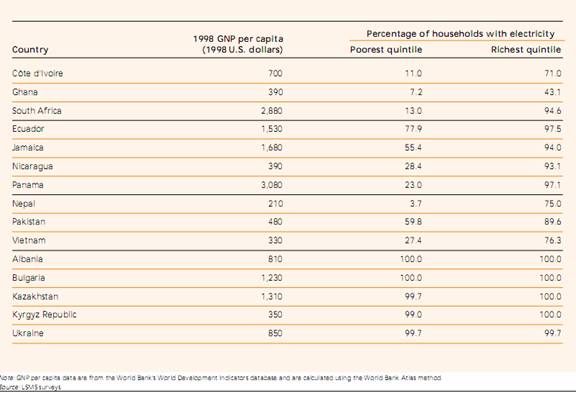
The study cited a few examples of corruption: A former prime minister in Ukraine personally granted exclusive rights to a gas trader that was reportedly controlled by him and his associates. The trader imported gas from Russia at a price of US $50 per thousand cubic meters and sold it to captive industrial consumers for US $80. The prime minister used the financial wealth generated by this lucrative monopoly to establish a political party. Diversion of utility revenues had become such a problem in Pakistan that in 1999 the government mobilized the army to supervise meter reading and billing. The scale of theft surprised the authorities, especially the extent to which the affluent benefited. Industries, shopping centers, and large residences accounted for a large share of the stolen electricity. Subsidies in power sector in one country, the study mentioned, amount to more than US$100 million a year, more than expenditure on health. The beneficiaries of the subsidies are the relatively affluent 16 percent of households that have electricity service.
The World Bank study commented: “The poor lose from the budget subsidies to the power sector in two ways: lower rates of economic growth and less social expenditure from which they would benefit directly.” Corruption that grows along the modus operandi of the dominating classes contributes to energy poverty.
With intensified competition among capitals and accelerated and almost complete globalization by capitals, corruption is a tool in the hands of capitals. Each of competing capitals aspire and demand a fair game for all but self. Each of competing capitals

Political economy of the crisis should not be missed
The energy crisis is part of the world crises now overwhelming the planet. The fundamental aspect of the energy crisis will be missed if it is only viewed in terms of the prospect of dwindling oil supply and is viewed without connecting it to the world production and distribution system. The approach pushed by the donors in the poor countries in the name of development, part of the world production and distribution system, is contributing to the crisis. A major part of this approach is oil intensive. The life style the dominating segments in the poor countries have jealously adopted is contributing to the energy poverty, and widening the gap.
Plundering of public property is the lifeline for the dominating segments in many poor countries, and the process of plundering increases energy disparity. The plundering process and the plundering class/segment is part of the present world system while the plundering of the energy resources from poor countries is an act of the world system.
Metropolitan states with their all might stand by their owners: the energy giants. The world power structure stands by their compradors, the junior partners in appropriating/plundering and squandering of public resources including energy.
Increased energy poverty is the consequence of energy loot from the poor countries. The political economy of energy poverty is thus connected to class rule and the world system. Degradation in environment and changes in climate is worsening the energy poverty situation. All these are part of the energy crisis.
The energy poverty situation puts forth a few tasks: (1) Explain this disparity and deprivation to the masses so that the possibility of drying up of oil, a major source of profit, could not be depicted by the mainstream as the only aspect of energy crisis, so that the people at the bottom turn aware of the way they are being deprived, and so that the private sector could not make the pockets of the poor a big market. (2) Demands for energy equality, environment-friendly energy for the common people, affordable energy not harmful to health should be raised. An equitable distribution of energy will stop many of the luxuries that squander energy. (3) Cooperatives for energy could be organized at community level. This will provide people, through mistakes and failures, space for debating related issues, getting mobilized, practicing democracy, running organizations, fighting bureaucracy, and articulating greater demands. (4) The designs and attempts to take control of energy sources by external actors should be exposed. (5) Popularize the approaches: (a) the lower the more, and (b) no transparency no deal. The first one is for proportionately more subsidy in energy to the poorer, more participation from the bottom in planning and decision making while the next one is for demanding all energy related deals to be made public and to be debated. Debating the energy squandering life style of the energy rich and the “development” approach prescribed by the donors will create scope for broader space.
[This section, 4th in the series, modified and elaborated, is the last part of the chapter “Energy Inequality and Energy Poor” in The Age of Crisis (2009) by Farooque Chowdhury, a Dhaka-based freelancer.]

Wednesday, October 31, 2012

Equality Denied To The Energy Poor

The global energy reality exposes an aspect of the energy crisis: equality denied. Billions in this planet is the embodiment of this denial, one of the manifestations of the energy crisis along class line.
“Around 2.64 billion people, 40% of the world's population,” writes Alejandro Litovsky, “lack modern fuels for cooking and heating. 1.6 billion have no access to electricity, three-quarters of them living in rural areas” ( OpenDemocracy , Sept.7, 2007). He continues: “As decision-makers in Europe and north America wonder how to reduce energy consumption, massive regions of the developing world remain literally in the dark. Populations in the energy-poverty trap – covering vast areas of south Asia and sub-Saharan Africa – are nowhere likely to influence the accountability of the energy policies of their governments.”
With the intensification of urbanization the problem is likely to increase. Current projections show that the majority of the people in the underdeveloped world will be living in urban and suburban areas by 2020. A number of the cities in the underdeveloped countries will emerge as the largest cities in the world in terms of population. The urban life already is overwhelmed by low-income population and with the problems pressing them down to dust. This low-income population has least money to access energy as they have to live within a precarious life, which is full with hunger, unemployment, disease, illiteracy. The places they live in don't support human existence. Lack of safe water and sanitation, insecurity, daily harassment by tools of rule and indignity are integral part of their life. In this life, there is no scope to access better energy source.
“Worldwide, hundreds of millions of low-income households,” a World Bank publication informs, lack access to modern energy (electricity and petroleum products),
[ B ] ut estimating the figure even within a few hundred million people is difficult. A common (though perhaps outdated) estimate is about 2 billion people, a third of the world's population. Households in many African countries consume little commercial energy compared with households in the countries of the former Soviet Union , for example, where the electricity infrastructure built in Soviet times still connects almost 100 percent of the population. Low-income households consume a relatively small amount of energy, and that energy is of low quality. Per capita energy consumption in South Asia is only 2.6 percent — and that in Sub-Saharan Africa only 1.3 percent — of per capita consumption in the United States . For these supplies, survey and anecdotal evidence suggests, South Asians and Sub-Saharan Africans pay among the world's highest unit costs — and get some of the world's worst-quality energy. Ugandans spend an estimated US $100 million a year — an incredible 1.5 percent of GDP — on dry cell batteries to power radios, flashlights, and other small items. The average Ugandan household spends an estimated US $72 a year on dry cell batteries, used in 94 percent of Ugandan households. The cost per unit of energy consumed works out to US $400 a kilowatt-hour. Ugandans may spend almost as much per year on kerosene for their lamps. Car batteries, which cost about US $120 a year to operate, produce better-quality power at about US $3 a kilowatt-hour. But poor households often spend a higher share of their income, as in Bulgaria , Jamaica , Kazakhstan , Nepal , Pakistan , Panama , and South Africa . More households use electricity than have in-house water taps or telephones in countries in Europe and Central Asia and in [some] other countries…. Poor countries consume on a per capita basis, only five percent of the modern energy consumed by rich countries. Four out of five people without access to electricity live in rural areas. They include particularly the rural women and children that depend totally on traditional fuels. Sub-Saharan Africa and South Asia present the largest gaps in access to energy services: Sub-Saharan Africa has the lowest electrification rate, with 77% of the population lacking access, or about 526 million people. In South Asia the equivalent figures are 59% and about 800 million people. (Rural Energy and Development: Improving Energy Supplies for Two Billion People , 1996 )
More than 95 percent of rural households in Angola , Benin , Cameroon , Chad , Congo ( Kinshasa ), Ethiopia , Ghana , Sudan , and Zambia among others still use fuel wood and charcoal for cooking. Many areas of China , India , and Bangladesh also rely heavily on fuel wood, wood waste, and charcoal for cooking. In China , about 55 percent of the rural population uses biomass for cooking, as does 87 percent of the rural population in India . There are more facts provided by the mainstream that tell the deprivation of the poor in the area of energy. The Energy and Poverty Reduction – Fact Sheet by the World Bank adds the following:
1.6 billion people lack access to network electricity.… 1.4 billion people will still lack electricity access in 2030.…2.4 billion people rely on traditional biomass … for cooking and heating. This will increase to 2.6 billion by 2030 without change in policies. Poor people in developing countries spend up to a quarter of their cash income on energy. As of 2004, the richest 20% of the world's population consume 58% of total energy, whereas the poorest 20% consume less than 4%. The … poorest people use only 0.2 tons of oil-equivalent energy per capita annually, while… those earning on average over US $20,000 a year — use nearly 25 times as much. 1.6 million women and children die prematurely from indoor air pollution caused by burning solid fuels in poorly ventilated spaces. 40 million new cases of chronic bronchitis are caused by exposure to soot and smoke every year. More than 80% of all deaths in developing countries attributable to air pollution-induced lung infections are among children under 5 (Energy Poverty Issues and G 8 Actions, Feb. 2, 2006).
There is also wide disparity, according to the World Energy Council, between the energy consumption levels of the rich and poor. In terms of electricity consumption, the richest 20 percent uses 75 percent of all electricity while the poorest 20 percent uses less than 3 percent.
This is also the reality of energy crisis in the present day world. The billions lacking access to energy services lead to the “famous” “vicious poverty trap”. It affects health of the poor, leads to lower productivity, to food insecurity. But the problem is ignored by the metropolis of the world system.
Unequal distribution of modern energy services and low level of income in poor countries are two of the major reasons that constitute the factor leading to poor access to modern energy services. Lack of or poor infrastructures in the poor countries, lack of resources to develop the required infrastructure, and biased institutional and legal framework also have their share in creating the problem for the poor. Absence of political commitment in favor of the poor is the foremost problem that limits the access to modern energy by the poor. The political commitment is biased, tilted to the rich. It follows the class line.
The poor households in the underdeveloped countries mainly use firewood, dung, tree leaves, crop residues, and in some cases, charcoal. The World Energy Outlook 2006 estimated that $8 billion (including capital and fuel) a year up to 2015 would be required for 2.5 billion people for their switching over to liquid petroleum gas for cooking.
The poor pay a high price for the energy they use: in terms of cash, labor, time, and health. They spend a much greater proportion of their income on energy than wealthy people. In Burkina Faso, a survey found, the poor devoted 5.6 percent and 1.3 percent of their income to firewood and kerosene respectively while in Guatemala and Nepal, firewood expenditure for households in the poorest quintile accounts for 10-15 percent of total household expenditure (R Heltberg, Household Energy and Energy Use in Developing Countries, A Multi-Country Study, 2003).
Studies on Bangladesh environment found that the availability of biomass has decreased. This has increased the hardship of the poor, especially of the women. They have to spend more time to collect biomass. The slum dwellers in Dhaka informed that they cooked once or twice a day instead of three times. That was the way they “innovated” to economize the spending on fuel. The price of firewood compelled them to follow the method though it was not good for food quality and health. The participants in the study suffered from health problems due to smoke from firewood. Villagers from different parts of the country also informed that the availability of biomass decreased. The changed reality taxed them in terms of labor, wage lost, and hardship. Consequently, this touches the limits of nutrition, household income, and productivity. The women had to bear most of the burden as they collected fuel for their families. Sometimes, an entire day was spent by the earning member of a family for collecting firewood (Farooque Chowdhury, “Urban Poor: Never-ending Quest for Energy”, “Scarce Fuel: Growing Scarcer”, and “Fuel, Firewood and Ghatail” in People's Report 20002-2003: Bangladesh Environment , UNDP, 2004).
These are the people who have been and are being pushed down to energy poverty that constitutes one of the elements of energy crisis. In ultimate analysis, these people have been kept confined within an inefficient system, which they have not organized. Rather, the system constructed by the dominating capital has been imposed on them. The system is so much inefficient that it cannot utilize the labor and creativity of these poor people. That means: the system lacks the capacity to tap energy.
The disparity is not only limited among the rich and the poor. Wide variations are there in the levels of energy consumption, according to the Human Development Report 2007/2008, between industrialized and the underdeveloped countries. Per capita energy consumption in North America is about 18 times that of Africa and four times the world average.
Energy poverty is defined as the “inability to cook with modern cooking fuels and the lack of a bare minimum of electric lighting to read or for other household and productive activities at sunset” (UNDP 2005). By this definition, the 2.5 billion people relying on biomass for cooking and the 1.6 billion people with no access to electricity could be classified as being energy poor.
Originating from the UK and Ireland 's grassroots level environmental health movements in early 1980s the concept of energy poverty or fuel poverty, has gained in importance. “With the energy crises of 1973/74 and 1979,” the World Energy Council said, “low-income households experienced difficulties with increased heating bills. The fuel poverty concept is an interaction between poorly insulated housing and inefficient in-housing energy systems, low-income households and high-energy service prices. At the beginning of the 21st Century, the British Government set up a strategy on fuel poverty aiming at eradicating this phenomenon by 2010 … for vulnerable households and by 2016 for all English households. According to the British standard definition that was adopted, a household is poor in fuel if it needs to spend more than 10% of its income on all fuel use to heat the home to an adequate standard and to meet its needs for other energy services (lighting, cooking, cleaning, etc.).” (World Energy Council, Europe's Vulnerability to Energy Crisis , 2008) The report added, “In England … the number of households poor in fuel decreased from 5,1 million in 1996 to 1,7 million on 2001 and to 1,2 million on 2004.” Table 1 provides a picture of fuel poverty in a number of European countries during the period 1994-'97. Portugal had the highest percentage of households defined at fuel poverty while Denmark had the lowest.
Table 1: Households Defined at Fuel Poverty, 1994-1997
Used by permission of the World Energy Council, London , www.worldenergy.org
In the US , the number of households in fuel poverty was 15.9 million (“Fuel Poverty in the USA ”, Energy Action , March 2006).
There is difference between the fuel poor in an advanced capitalist country and fuel poor in a poor country. The level of hardship between them also differs. But that does not nullify the reality of inequality in distribution. With the financial and food crises the suffering has increased. For the homeless and the unemployed in the US , the suffering is more. A number of news reports were dispatched by news agencies that the unemployed in the US were finding it hard to pay energy bills. In extreme weather in parts of the US , like all places in the world, the suffering increases.
While the energy poor is one aspect of the crisis there is over-consumption that has contributed to the crisis.
The type and volume of energy used by households differ from country to country. Income levels, natural resources, climate and available energy infrastructure determine these.
Typical households in the OECD countries consume more energy than those in the non-OECD countries. The OECD households with higher income can afford larger homes and purchase more energy-using equipment. In the US , GDP per capita in 2006 was about $43,000 (in real 2005 dollars per person), and residential energy use per capita was estimated at 36.0 million Btu. On the other hand, China 's per-capita income in 2006, at $4,550, was only about one-tenth the US level, and residential energy use per capita was 4.0 million Btu. Poorer households in Asia , Africa and Latin America earn less, and consume less energy.
Table 2 from a World Bank publication (from the section by Alan Townsend, “Energy access, energy demand, and the information deficit”) shows that disparity between the rich and the poor in electricity use is great. Disparity in this area is nil in Albania , Bulgaria , Kazakhstan , Kyrgyz Republic , and Ukraine while it is great in other countries including Ghana , South Africa , Nicaragua , Panama , Nepal , and Vietnam .
Table 2: Disparity Between the Rich and the Poor in Electricity Use
Source: the World Bank publication, LSMS survey in 15 developing countries
The US consumes most energy: 8.0 toe/person/year, followed by India and China with an average energy consumption of 7.3 toe per person per year each. On per capita basis, however, Canada consumes the most energy in the world. Its per capita energy consumption is 6.4 times the world average while that of the US is 5.1 times and Western Europe 's is 2.3 times the world's average (P O Pineau, Electricity Subsidies in Low Cost Jurisdiction, The Case of British Columbia ( Columbia ) , 2006). Italy consumes the least energy among the industrialized countries (3.1 toe per person per year). Africa 's average energy consumption only 0.14/person/year, a ratio of 1:57 , compared to the US . Average energy consumption in Bangladesh is only 0.08 toe per person per year, which is a ratio of 1: 100 when compared to the US that uses about fifteen times more energy per person than does a typical underdeveloped country. While the US share of the world's population is only 4.6 percent, it accounts for 24 percent of the world's energy consumption and over 30 percent of GDP. But the least developed countries with 10 percent of the world's population account for about 1 percent of energy consumption and a mere 1 percent of the world's GDP (Huq, et al. 2003). The energy situation Africa faces is a mixture of contradictory reality: while the continent desperately needs energy for economic growth and poverty reduction, it is a net exporter of commercial energy. Africa is home to about 7 percent of the world commercial energy, but it accounts for only 3 percent of global commercial energy consumption.
Energy use in the residential sector in 2006, according to the IEO2009 (International Energy Outlook, 2009) , accounted for about 15 percent of world delivered energy consumption. Larger homes, the Outlook said, need more energy as these homes tend to use more energy-consuming appliances. On the contrary, smaller homes usually need less energy as the smaller homes have less space to be heated or cooled, produce less heat transfer with the outdoor environment, and the appliances used in these homes are smaller. For example, residential energy consumption is lower in China than in the US . The average residence in China currently has an estimated 300 square feet of living space or less per person while the average residence in the US has an estimated 680 square feet of living space per person. The commercial or the services and institutional sector include businesses, institutions, and organizations providing services (schools, hospitals, water and sewer services, theaters, museums, art galleries, sports facilities, stores, hotels, restaurants, correctional institutions, office buildings, banks), and traffic lights. Economic activities and disposable income going to higher levels lead to increased demand for energy as demands for office space, space for business, hotels, restaurants, and facilities for cultural and leisure activities increase. Energy use per capita in the commercial sector in the non-OECD countries was much lower, 1.3 million Btu in 2006, than in the OECD countries, 16.3 million Btu.  The US is the largest consumer of commercially delivered energy in the OECD and remains in that position throughout the projection, accounting for about 44 percent of the OECD total in 2030.
The deeper, the keener observation on the issue, the more inequality gets exposed. The inequality in energy distribution comes from the unequal ownership of the energy resources, and is part of the unequal world system.
The inequality aspect should have the same, if not more, importance as other burning aspects of the energy crisis. Rectifying the inequality is one of the ways to face the crisis. Participation of people strengthens steps to face the crisis. But, shall there have any rational and moral standing if people are asked to contribute to/sacrifice for/play role into facing the crisis if they have no or little or unequal access to the energy resources? The crisis is not their creation. So, one of the first steps to face the energy crisis should be replacing the unequal energy distribution system with an equal and equitable energy distribution system. The other major step should be to inform people about the crisis and inequality so that people get aware. Awareness facilitates people getting organized and taking creative initiatives, and a collective force thus gets mobilized to face the crisis.
[ This section, modified and elaborated for clarity and completeness, is preceded by two parts of the chapter, “ Energy Inequality and Energy Poor” in The Age of Crisis (2009) by Farooque Chowdhury, a Dhaka-based freelancer. For easy identification, the section can be considered as part 3 of the chapter. ]